


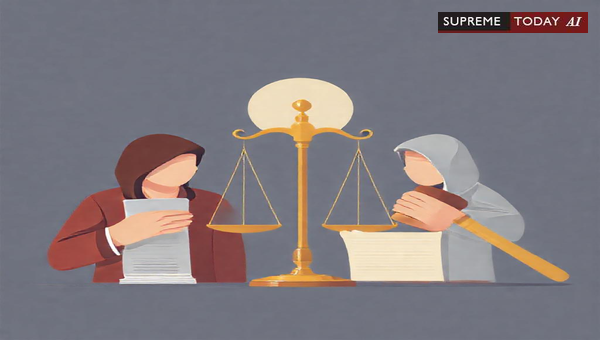
When Evidence Suggests Two Possibilities, Indian Courts Must Accept the View Favouring the Accused
A recurring question in criminal trials is: if two theories are possible in a criminal case, must the theory favouring the accused be accepted? The answer, firmly settled in Indian criminal jurisprudence, is yes. When the evidence adduced at trial admits of two equally plausible views—one pointing to the guilt of the accused and the other to his innocence—the court is bound to adopt the view favourable to the accused. This principle flows directly from the and the prosecution's duty to prove guilt beyond .
The Cardinal Principle of Criminal Justice
Courts have repeatedly described this rule as a running through the administration of criminal justice. As the Supreme Court has observed, another which runs through the web of the administration of justice in criminal cases is that if two views are possible on the evidence adduced in the case, one pointing to guilt and the other to innocence, the favourable view must prevail 2022 0 Supreme(Kar) 414 and 2023 0 Supreme(Kar) 1011.
The is not an exceptional doctrine invoked rarely; it arises naturally whenever the appreciation of evidence produces two competing but equally plausible interpretations. In such situations, the controversy is to be resolved in favour of the accused 2026 0 Supreme(Guj) 743.
Key features of the principle include:
- : The accused is presumed innocent until guilt is proved beyond .
- Non-shifting burden: The burden of proving the case always remains on the prosecution and never shifts to the accused 2022 0 Supreme(Kar) 414.
- suffices: The existence of an equally plausible innocent explanation itself constitutes a .
- Suspicion cannot replace proof: Convictions cannot rest on conjecture or probability short of certainty.
Application in Cases
The two-views principle operates with particular force in cases resting on . For a conviction based on circumstances alone, the prosecution must establish:
- Each circumstance must be proved beyond 2025 0 Supreme(Bom) 1568.
- The circumstances must exclude every possible hypothesis except the one to be proved.
- There must be a so complete as not to leave any reasonable ground for a conclusion consistent with the innocence of the accused 2023 0 Supreme(Chh) 401 and 2024 0 Supreme(Kar) 450.
- The chain must show that in all human probability the act was done by the accused.
If the proved circumstances can be reconciled either with innocence or with guilt, the theory of innocence must be adopted and any conviction must be reversed, even though the theory of guilt is the more probable 2016 1 Supreme 409. Probability alone in favour of the prosecution is not enough.
The and Time Gaps
The rule frequently arises in murder prosecutions built on the . The Supreme Court has held that the can be invoked only when same stands proved beyond 2023 6 Supreme 195. A long time-gap between the accused being last seen with the deceased and the recovery of the body, absent corroborative evidence, leaves the chain incomplete. In such cases, the prevails, and when doubts emanate, benefit accrues to accused and not prosecution 2023 6 Supreme 195. Similarly, a conviction based solely on the circumstance of being last seen together cannot be sustained without independent corroboration 2026 1 Supreme 567.
The Rule in Appeals Against Acquittal
The two-views doctrine also disciplines appellate interference. An appellate court should not disturb an acquittal merely because another view is conceivable; interference is justified only when the trial court's view is patently erroneous, perverse, or demonstrably unsustainable 1998 4 Supreme 562 and 2019 4 Supreme 258. Where the acquitted accused's view is a reasonable and possible view, it must be preferred 2019 0 Supreme(Bom) 2521. Conversely, if the materials permit only one view—that of guilt—a judgment of acquittal may be interfered with 2019 0 Supreme(Bom) 2521. The powers of appellate courts in this context have been summarised in Jafarudheen vs. State of Kerala, (2022) 8 SCC 440 2023 6 Supreme 195, and the principle has been reaffirmed in decisions such as and Raghunath v. State of Haryana, (2003) 1 SCC 398 2021 0 Supreme(All) 168 and 2018 0 Supreme(All) 1093.
Limits of the
The doctrine has boundaries:
- Equally plausible views only: The rule applies when the two views are of comparable reasonableness. If the evidence overwhelmingly establishes guilt, the court is not obliged to hunt for a remote or fanciful .
- Statutory presumptions: In special categories such as dowry death cases under of the , presumptions under of the may tilt the evidentiary landscape against the accused 2022 0 Supreme(UK) 79.
- Facts within special knowledge: Under , an accused last seen with the deceased may be expected to explain how they parted ways, though this does not shift the primary 2026 1 Supreme 567.
Practical Takeaways for the Defence and Prosecution
- Defence counsel should stress gaps in the circumstantial chain and any innocent alternative explanation consistent with the evidence.
- Prosecutors must build a complete, unbroken chain and corroborate circumstantial links—especially last seen circumstances—with independent evidence.
- Appellate lawyers should frame arguments around the reasonableness of the view taken by the trial court, whether defending an acquittal or challenging a conviction.
Conclusion
The is a cornerstone of fair trial jurisprudence: where evidence is equally consistent with guilt and innocence, the doubt is resolved in favour of the accused, and the theory favouring innocence must be adopted—even if guilt appears more probable. Whether the case involves murder, dowry death, or corruption charges, this safeguard reflects the enduring . This article is intended as general legal information; outcomes in individual cases depend on the specific evidence and circumstances involved.
#CriminalLaw #BenefitOfDoubt #CircumstantialEvidence #PresumptionOfInnocence #TwoViewsTheory









