Searching Case Laws & Precedent on Legal Query.....!
Analysing the retrieved Case Laws
Scanned Judgements…!



Searching Case Laws & Precedent on Legal Query.....!
Analysing the retrieved Case Laws
Scanned Judgements…!
Courts cannot have two different views on the same case or transaction — When a person is convicted in separate trials for different offences arising from distinct transactions, the courts are expected to maintain consistency and cannot adopt conflicting positions on the same matter. For example, in Sushil Kumar @ Shashi v. State of Himachal Pradesh (2014), the court held that convictions for separate offences in different trials related to different transactions cannot be merged or treated as a single case, and the court cannot hold two conflicting opinions on the same case ["2025 0 Supreme(HP) 447"].
Different transactions or offences require separate consideration — Courts recognize that each transaction or offence is distinct. In 2022 0 Supreme(Gau) 946, the court emphasized that even if conspirators are the same, differing objectives and facts mean the FIRs are not identical, and thus separate FIRs are justified if the facts differ substantively ["2022 0 Supreme(Gau) 946"].
Multiple views within the judiciary and the doctrine of precedent — Different benches or courts may have divergent opinions due to differences in facts or legal interpretations. The Supreme Court has acknowledged that conflicting views can arise, but consistency and adherence to binding precedents are crucial. For instance, in M.R. Kudva's case (Supra), the Supreme Court held that convictions in separate cases can stand independently, and the power to consolidate sentences is limited to the sentencing court ["2023 0 Supreme(P&H) 205"].
Intra-court consistency and the role of larger benches — When courts or benches within the same court have conflicting opinions, the matter may be referred to a larger bench for authoritative clarification. However, if no conflict exists, the courts follow established precedents. In 2023 0 Supreme(J&K) 309, the court clarified that co-ordinate benches of the High Court generally do not have conflicting opinions unless a question of law is formulated, and intra-court appeals are often not maintainable against certain orders ["2023 0 Supreme(J&K) 309"].
Conflicting judgments affect execution and finality of decrees — When different courts issue contradictory decrees, the decrees cannot be executed simultaneously. For example, in 2023 0 Supreme(Bom) 1606, conflicting decrees in a suit cannot be executed together, as they negate each other's effect, highlighting that courts must avoid issuing contradictory judgments on the same matter ["2023 0 Supreme(Bom) 1606"].
Procedure and evidence in cases and counter-cases — When handling cases and counter-cases, courts emphasize that the same investigation process and evidence should generally be maintained to avoid conflicting findings. As in 2023 0 Supreme(Kar) 741, different prosecutors and trial dates in related cases do not justify conflicting judgments, and evidence from one case cannot be automatically applied to another ["2023 0 Supreme(Kar) 741"].
Analysis and Conclusion:Courts are bound by the principle that they cannot hold two conflicting views on the same case or transaction. When cases involve different offences, transactions, or facts, separate consideration is justified. However, conflicting judgments within the judiciary can undermine legal certainty, and such conflicts are typically resolved by referring matters to larger benches or following authoritative precedents. The integrity of judicial decisions depends on consistency, especially when dealing with interconnected issues, and conflicting views on the same case are generally impermissible, ensuring the rule of law and fair adjudication.
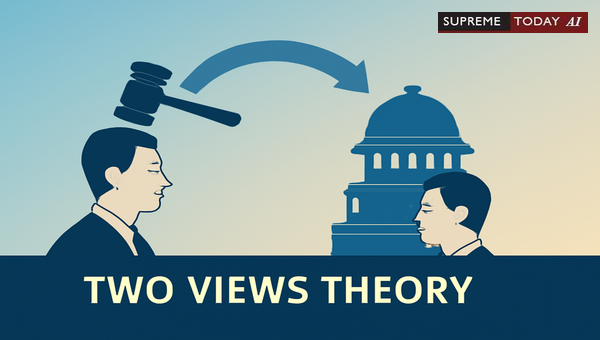
In the Indian judicial system, a common question arises: Can Supreme Judgment be or Appeal? This query often stems from cases where lower court decisions, especially acquittals, face scrutiny at higher levels. At the heart of this lies the , a pivotal principle guiding appellate courts. This theory ensures that acquittals aren't lightly overturned, balancing the with the need for justice. But what about judgments? Can they be reviewed or appealed? Let's dive into this complex terrain, drawing from established judicial precedents.
This post explores the two views doctrine, its application in appellate reviews, exceptions, and insights from cases involving conflicting judicial opinions. Note: This is general information based on legal principles and should not be taken as specific legal advice. Consult a qualified lawyer for your situation.
The is fundamental in criminal appeals within the Indian judiciary. It posits that if two reasonable interpretations of the evidence exist, the appellate court should refrain from substituting the trial court's view, particularly in acquittal cases. This upholds the and prevents 2024 2 Supreme 513.
This framework promotes judicial restraint, ensuring higher courts intervene only when necessary.
The often intersects with scenarios of conflicting judicial opinions. For instance, in cases under the , courts clarified that a second revision application is not maintainable once revision power is exercised. The distinguished prior judgments on different statutes, affirming the Full Bench's view: The court established that under the amended Sec. 154... a second revision application is not maintainable... 2023 0 Supreme(Bom) 1860. This highlights how higher courts resolve interpretive conflicts without endless reviews.
Similarly, in contempt matters, the isn't rigidly applied. The noted: may not be applied with rigidity nor can be regarded as the concept of universal application but dependent upon the nature of the jurisdiction exercised... 2023 0 Supreme(Cal) 620. Here, proper forums for contempt applications prevent docket overload and conflicting benches.
In police investigations of case and counter cases, Police Standing Order 566 mandates thorough probes to avoid conflicting judgments. Courts emphasized: The police must mandatorily follow PSO 566... ensuring thorough investigations to avoid conflicting judgments. 2024 0 Supreme(Mad) 2169. Trials should occur simultaneously before the same judge to prevent rival verdicts.
Motor accident claims further illustrate: taking two different views in respect of the same accident were scrutinized, prioritizing tribunal evidence over FIRs under the standard. 2024 0 Supreme(Gau) 36
Conflicting opinions among coordinate benches often necessitate larger bench references. In a corruption probe, the court decried: While it is open to a Judge to differ with a view of a Co-ordinate Bench sequitur is to make a reference to a larger Bench... Such an approach would result in conflicting opinions... resulting in ... 2023 5 Supreme 15. This underscores that unilateral disagreement breeds chaos; structured is key.
Under PMLA, courts avoided paradoxical outcomes: it may lead to a paradoxical result if concerned person is later on acquitted of scheduled offence while convicted of offence of money laundering... 2022 0 Supreme(Telangana) 427. Uniformity prevents dual opinions on identical facts.
Bonus disputes saw diverge: The two on same and similar issue have taken different views. Higher courts clarified exemptions under . 2018 0 Supreme(Del) 1582
IPC Sec. 153B cases required holistic article : The two Courts below have apparently held different views. Appellate courts corrected perverse findings. 2014 0 Supreme(Sikk) 11
interpretations resolved driver retirement conflicts: Thus two contrary views have been taken by different Judges of this Court on the same subject. doesn't mandate superannuation extensions. 2009 0 Supreme(Del) 33
finality is enshrined, but is possible under for errors apparent on record. follow exhausted reviews. Appeals from don't exist as it's apex. However, in two views contexts, the often settles lower court conflicts, as seen in distinctions from its precedents 2023 0 Supreme(Bom) 1860.
The theory binds even benches reviewing acquittals, intervening only on perversity. This maintains consistency, though critics note risks of from misuse or conflicting decisions STATE THROUGH vs HEMENDHRA REDDY ETC. ETC. - 2023 7 Supreme 755.
While protective, the doctrine has drawbacks:- Conflicting Decisions: Leads to chaos among judges. STATE THROUGH vs HEMENDHRA REDDY ETC. ETC. - - Potential Misuse: Allows serious offenders to evade via alternate views. 2023 7 Supreme 755
Exceptions ensure flexibility: misapprehended law or clear errors permit intervention 2022 5 Supreme 387.
The safeguards acquittals, answering whether Supreme or higher judgments can be reviewed: generally, no, unless perverse or erroneous. Conflicting views prompt structured resolutions via larger benches or reviews, preventing endless litigation.
Key Takeaways:- Appellate courts defer to trial views if reasonable alternatives exist 2024 2 Supreme 513.- Supreme reviews are narrow; appeals impossible.- Conflicts resolved hierarchically to uphold uniformity.
For nuanced cases, professional advice is essential. Stay informed on evolving jurisprudence.
#TwoViewsTheory #SupremeCourtReview #IndianJudiciary


It was laid down by the Division Bench of this Court in Sushil Kumar @ Shashi versus State of Himachal Pradesh, 2014 (1) Shimla Law Cases 214 that when a person was convicted for the commission of two offences in separate trials in respect of different transactions, the Court cannot pass ... In the instant case, petitioner Sushil Kumar was convicted for two offences in ....

The issue was whether the two conspiracies are identical. The court held that even though some of the conspirators were same in both the two events, the objectives were different. It cannot be said that both FIRs refer to the commission of the same offence 19. ... The Court established the taste of sameness, which means that unless in both the two cases, while the first....

After referring to the above referred Full Bench authorities of different High Courts and various other authorities taking different views by the different High Courts and the view expressed by Hon’ble Supreme Court in M.R. ... This aspect was considered by Hon’ble Supreme Court in M.R. Kudva’s case (Supra). In that case, conviction of the appellant wa....

Various aspects of such conflicting views were considered in the said judgement and specific reference was also made to the judgement of the Supreme Court in the case of Everest Apartments Co-operative Housing Society Limited, Bombay Vs. ... Hence, the Supreme Court was dealing with provisions that can be said to be materially different from Sec. 154 of the MCS Act, post its amendment, which was considere....

Tarun Coomer) taking a different view. A subsequent decision of the Supreme Court in case of Dineshan K.K. vs. R.K. ... It is manifest from the views expressed by the different Benches of the Supreme Court that the doctrine of merger may not be applied with rigidity nor can be regarded as the concept of universal application but dependent upon the nature of the jurisdiction exercised by ....

has expressed certain views upon the evidence in that case as to which of the two versions is correct. ... the views which he may have formed in the other case”54.Thus, the consistent position was that the case should be tried simultaneously by the same judge but with a different jury/assessors. ... Assigning these cases to two different#HL_E....
This is a classic example of a single Tribunal having two different views in respect of the same accident. 5. On 30.05.2012, Binod Ray and Nitya Charan Ray were travelling in a scooter bearing Registration No.AS-19/4069. ... So, the Tribunal held that the evidence of Pulen Ray could not be relied upon as he stated two different versions about the same occurrence before two authorities. ....

It is the internal working of the High Court which splits it into different „Benches’ and yet the court remains one. ... There is neither division of opinions between two Division Benches of this Court nor any question of law has been formulated by any bench of this Court hearing a case. ... of this Court, in exercise of its criminal jurisdiction, #HL_....

Different views exist in the case of joint decrees in favour of respondents whose rights in the subject-matter of the decree are specified. ... , the net result will be that two different decrees will be in the field. ... The decree passed by Lower Appellate Court, whereby, the appeal is allowed and the suit filed by the appellant/plaintiff has been dismissed against defendant No. 1. As ....

In the instant case, the prosecution has been conducted by two different Public Prosecutors as is evidenced in the trial court records - one prosecutor from the place called Haveri in one case and another prosecutor from another place called Dharwad have conducted the prosecution separately in two different ... In the light of the above, even though in the instant #HL_S....

Thus, two contrary views have been taken by different judges of equal strength of the High Court on the same subject and litigation.

For the same group of cases, there cannot be two sets of different opinions rendered by this Court.

A copy of the award in the case of Batra Hospital is already annexed as ANNEXURE P 2 to this petition. The two Tribunals on same and similar issue have taken different views. It is submitted, in view of difference of opinion in the two judgements of two Tribunals, it is the interest of justice that the present Petition be admitted and an authentic pronouncement by this Hon’ble Court on the issue may be made. It is submitted that the present petition raises question of vital i....

The two Courts below have apparently have held different views. The sole question that arises for determination in the present Appeal is as to whether the offending article falls within the mischief of Section 153B(1)(c) IPC.
Thus two contrary views have been taken by different Judges of this Court on the same subject. Thus two contrary views have been taken by different Judges of this Court on the same subject. While the Ld. Judges in CWP 8159/2004 and 15309/2006 (case of Shri Dharam Pal and Sh. Nirmal Singh) subject matter of LPAs No. 121/2007 and 1214/2007, have granted extension of service up to 60 years; in case of Sh. Dalel Singh and Sh. Trilochan Singh (supra) who filed CW....


An indispensable Tool for Legal Professionals, Endorsed by Various High Court and Judicial Officers
Please visit our Training & Support
Center or Contact Us for assistance

Scan Me!
India’s Legal research and Law Firm App, Download now!


For Daily Legal Updates, Join us on :



 Back to top


