Searching Case Laws & Precedent on Legal Query!
Scanned Judgements…!



Searching Case Laws & Precedent on Legal Query!
Scanned Judgements…!
Husband Purchasing Property in Wife's Name - When a Hindu husband purchases property in the name of his homemaker wife, the property is presumed to be purchased from the husband's source unless proven otherwise. This presumption applies under Section 2(9)(b) of the Benami Transactions Act, 1988, and is supported by judicial observations that such transactions are deemed to benefit the wife unless the husband proves otherwise. 2024 0 Supreme(All) 552, 2023 0 Supreme(Mad) 3243, 2023 0 Supreme(Mad) 1012
Presumption of Benefit to Wife - Law presumes that property bought in the name of the wife is for her benefit, especially if she has no independent income. The burden of proof lies on the husband or the person asserting benami status to show that the property was not purchased for the benefit of the wife. Evidence such as the wife’s lack of income or the husband's source of funds supports this presumption. 2023 0 Supreme(Mad) 3243, 2023 0 Supreme(Mad) 1012
Necessary Parties in Partition Proceedings - The wife of the deceased or the person in whose name the property is purchased is a necessary party in partition suits. Her inclusion ensures proper adjudication of rights, especially when the property is held in her name or claimed to be benami. Failure to join necessary parties like the wife can render proceedings incomplete or invalid. 2023 0 Supreme(Kar) 490, 2025 0 Supreme(Kar) 1536
Benami Transactions and Rebuttal - Properties purchased in the name of the wife or daughter are presumed benami unless the purchaser proves that the property was bought for a different purpose. The burden is on the husband or buyer to rebut this presumption with evidence showing the property was not for their benefit. Courts have held that mere family proximity or customary practices do not negate this presumption. 2024 0 Supreme(Mad) 2388, 2023 0 Supreme(Mad) 1012
Evidence and Legal Presumptions - Courts rely on legal presumptions under the Benami Act and Indian Evidence Act, such as Section 3(2), which presumes property bought in the name of wife or unmarried daughter is for their benefit. The onus then shifts to the defendant or husband to prove otherwise. Evidence like lack of independent income, source of funds, and family circumstances are critical in establishing or rebutting benami claims. 2024 0 Supreme(All) 552, 2024 0 Supreme(Mad) 2388, 2023 0 Supreme(Mad) 1012
Finality of Partition and Parties - In partition suits, all necessary parties, including wives and heirs, must be joined to ensure a comprehensive and binding judgment. Omitting such parties can lead to legal invalidity or incomplete adjudication. The property held jointly or in the name of family members must be properly represented to protect their rights. 2023 0 Supreme(Kar) 490, 2025 0 Supreme(Kar) 1536
Analysis and Conclusion:When a husband purchases property in the name of his wife, the law generally presumes the property is for her benefit, especially if she lacks independent income. This presumption can be rebutted with evidence demonstrating the property was purchased from the husband's own source or for a different purpose. In partition proceedings, the wife or the person in whose name the property is held is a necessary party, ensuring proper adjudication of rights. Courts apply legal presumptions under the Benami Act and Indian Evidence Act, placing the burden on the husband or buyer to prove non-benami intent. Proper joinder of all relevant parties, including wives, is essential for valid partition judgments.
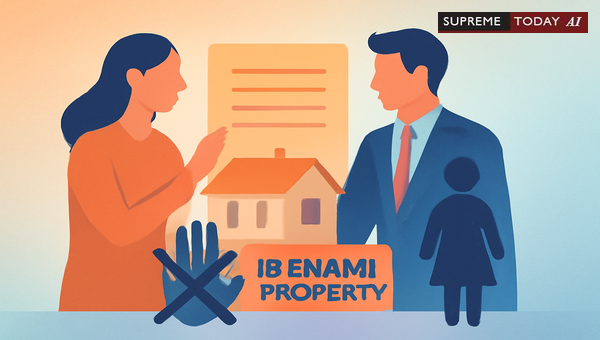
In family property disputes, a common scenario arises: a husband purchases property using his funds but registers it in his wife's name. Questions often emerge about ownership rights and who must be included in legal proceedings, especially . Husband Purchased Property in the Name of Wife: Is the Wife a in ? This is a critical issue under Indian law, particularly involving presumptions of and necessary parties.
This article delves into the legal principles, key case laws, and practical recommendations. Note: This is general information based on judicial precedents and not specific legal advice. Consult a qualified lawyer for your situation.
Under Indian law, when a husband purchases property in his wife's name, there is a strong presumption that it was intended for her benefit, even if he provided the funds. This stems from (now repealed but principles persist under the ), and judicial interpretations.
The burden lies on the husband or claimant to rebut this presumption by proving otherwise. As one ruling states: burden of proving that the property was not purchased for the benefit of wife or unmarried daughter lies on husband or father. 2024 0 Supreme(Mad) 2530
Courts emphasize that mere family proximity or the husband's source of funds does not automatically negate this. For instance, if the wife is a homemaker without independent income, the presumption strengthens. 2023 0 Supreme(Mad) 3243 2023 0 Supreme(Mad) 1012
In —where co-owners seek division of joint property—the wife whose name appears on the title is a . Her exclusion can render the proceedings invalid or incomplete, as her rights are directly affected.
Courts have ruled: The wife must be included in as her rights are directly involved. The court has emphasized that her exclusion would not be permissible, as her interest in the property is significant. 2006 0 Supreme(Pat) 241
Failure to join her leads to , potentially dismissing the suit. Related cases highlight: Whether son and daughters of Munirathinam are necessary parties for the proceedings? ... Whether the suit is bad for non joinder of necessary parties? 2023 0 Supreme(Mad) 3277
Judicial precedents solidify this:- In a dispute where husband claimed exclusive ownership despite wife's name, courts upheld her as necessary due to presumption and his admissions. 2023 0 Supreme(Mad) 3243 1970 0 Supreme(Mad) 256- The claim of the husband is that it is his property, which was purchased in the name of his wife. Yet, transfers to children were ordered to settle claims. 2018 0 Supreme(Mad) 291- Partition requires all parties, including wives/heirs: In , all necessary parties, including wives and heirs, must be joined to ensure a comprehensive and binding judgment. (Summarized from 2023 0 Supreme(Kar) 490 2025 0 Supreme(Kar) 1536)
Another example: Post-sale, husband bought land in wife's name; her admission didn't override presumption. 2024 0 Supreme(AP) 59
Husbands' authority to is limited without wife's involvement. 1939 0 Supreme(Nagpur) 102
Benami purchases (where real owner differs from registered) are scrutinized. However:- Presumption Under Law: Property in wife's name presumed for her, especially sans income. Burden on husband. 2024 0 Supreme(All) 552 2023 0 Supreme(Mad) 1012- Evidence Matters: Lack of wife's funds, husband's source supports presumption unless countered (e.g., specific intent proof). Mere customs don't suffice. 2024 0 Supreme(Mad) 2388
Courts apply alongside: Courts rely on legal presumptions under the Benami Act and , such as Section 3(2). 2024 0 Supreme(All) 552 2024 0 Supreme(Mad) 2388
In inter-spouse deals: The said order is between the husband and wife, to which proceedings the bank is not a party. 2016 0 Supreme(Kar) 607—highlighting third-party notice needs.
To navigate these:- Join the Wife: Formally add her to protect rights and avoid dismissal.- Gather Evidence: Husband's admissions, sale deeds, income proofs. 1970 0 Supreme(Mad) 256- Rebuttal Strategy: If claiming benami, provide clear proof of non-benefit intent early.- Comprehensive Joinder: Include all heirs/sharers for finality. 2023 0 Supreme(Kar) 490 2025 0 Supreme(Kar) 1536
In custody-like family matters: In such proceedings, there are not two parties - the husband and the wife - but also a third party - the children.
—extending to property, all interests count.
Generally, when a husband purchases property in his wife's name, law presumes it for her benefit, making her a in . This ensures fair adjudication, protects her interests, and upholds presumptions unless robustly rebutted. Omitting her risks invalid suits.
Key Takeaways:- Presumption Favors Wife: Burden on husband to disprove. 2024 0 Supreme(Mad) 2530 2023 0 Supreme(Mad) 3243- Mandatory Inclusion: Essential for valid partition. 2006 0 Supreme(Pat) 241 2023 0 Supreme(Kar) 490- Evidence-Driven: Admissions bind; gather facts proactively.
For tailored advice, engage a family law expert. Understanding these principles empowers informed decisions in property disputes.
References:2006 0 Supreme(Pat) 241 1970 0 Supreme(Mad) 256 2023 0 Supreme(Mad) 3243 1939 0 Supreme(Nagpur) 102 2024 0 Supreme(Mad) 2530 2024 0 Supreme(AP) 59 2023 0 Supreme(Mad) 3277 2018 0 Supreme(Mad) 291 2016 0 Supreme(Kar) 607 1992 0 Supreme(Bom) 381 2024 0 Supreme(All) 552 2023 0 Supreme(Mad) 1012 2023 0 Supreme(Kar) 490 2025 0 Supreme(Kar) 1536 2024 0 Supreme(Mad) 2388
#PartitionSuit, #BenamiProperty, #FamilyLawIndia


The Co-ordinate Bench of this Court has already observed that once a property is purchased by a Hindu husband in the name of his wife, who is homemaker, then the property will be deemed to be purchased by the husband himself from his source unless the contrary is proved. ... Proviso (iii) of Section 2(9)(b) of Prohibition of Benami Property Transactions Act, 1988 also prescribes that if ....

A reading of the above provision would make it clear that if a property is purchased in the name of wife, even assuming the consideration was paid by husband, still law presumes that it was purchased for benefit of wife unless the contrary is proved by the person who asserts the same. ... (2) Nothing in sub-section (1) shall apply to the purchase of property by any person ....

Motive for benami: The contention of the defendant is that since the said Thennavan and 1st wife Kunjammal are husband and wife, the husband had purchased the properties in the name of the 1st wife Kunjammal name and the same cannot be stated that the ... The primary contention of the defendants is that the said property is purchased....

In short, buden of proving thatthe property was not purchased for the benefit of wife or unmarried daughter lies on husband or father. ... Yet another point is that the Trial Court has made adverse comment upon the stamp papers that were purchased in the name of the husband at Tirupattur. ... On the other hand PW3 the brother of Dhanabakkiam gave evidence and his evidence was not at all ....

party i.e., wife of defendant No.1 is also necessary party and entitled for share in the suit schedule properties and whether the judgment of the Trial Court is erroneous, arbitrary and illegal. ... to the proceedings as she is the mother of the deceased shareholder and that she is a necessary party and that she is also entitled to a share in the share of deceased Santh....
Initially, the schedule property was proposed to be purchased in the joint name of plaintiff, finally, the sale deed was registered in the name of the defendant. ... Out of the sale proceedings of the properties sold on 17th January 2019 by the plaintiff's husband Late Chidanandachari and the defendant, they purchased the site bearing No.175/A, 4th ‘H’ Block, Banashankari 6th stage, Beng....

After the sale vide Ex.B.6, the 1st Defendant purchased land in the name of his wife, an extent of Ac.0.03 cents, for Rs.59,000/-under a registered sale deed dated 25.10.2010 (Ex.B.9). PW.1, the wife of the 1st Defendant, admits these transactions during cross-examination. ... and children; he has utilized the sale proceeds to develop assets, educate children and construct house; he has purchased a proper....
It is the matter of common knowledge that in an Indian family, the husband normally looks after the property which is in the name of the wife. This alone cannot determine that the husband bought the property for his interest benami in the name of his wife. ... The appeal is preferred by the wife challenging the Judgment and Decree in O.S.No.20 of 2004, by which, the le....
Whether son and daughters of Munirathinam are necessary parties for the proceedings? 2. Whether the suit is bad for non joinder of necessary parties? 3. Whether the 2nd defendant had prescribed title by adverse possession by ouster? ... The registration copy of the sale deed dated 08.12.1937 executed by Amaravathi Ammal, wife of Sadakaran @ Ponnusamy Gounder in favour of Perumal Gounder in respect of the suit properties is....
Though he may have filed a power of attorney, which also discloses that he is the husband of the plaintiff, Section 120 of the Indian Evidence Act, 1872 makes it clear that in all civil proceedings, the parties to the suit and the husband or wife of any party to the suit shall be competent witnesses. ... The plaintiff is the wife of Somasundaram and the defendant is the wife#HL....

The claim of the husband is that it is his property, which was purchased in the name of his wife. However, in order to avoid future claims, the husband shall transfer his 1/4th share in favour of three children by way of compensation forthwith. When this Court posed a question with regard to payment of compensation to the children, it is reported that there is only one property, standing in the name of the deceased wife and pursuant to her death, the said property will automa....
In that regard one of the consideration was also that the wife is in possession of the suit schedule property and the contention of the husband was that the wife can retain the property by repaying the loan to the bank as he does not have the means to do so. The said order is inter se between the husband and wife, to which proceedings the bank is not a party.

In matters of custody and access, the Family Court should be conscious that it is not merely enforcing parental rights or determining the rights of the parents. In such proceedings, there are not two parties - the husband and the wife - but also a third party - the children. Rigid formal procedures, which invariably inhere civil proceedings before Courts of law, need not come in the way of the Family Courts determining the welfare of the children. That third party is the most....

If it was so agreed between husband and wife that the flat was to be purchased jointly in the name of husband and wife , the wife would not have admitted that her name was inserted in the flat at the instance of the Developer. Surely, the reference to the word “they” is to the Developers. This will negative the case of the wife that the flat was intended to be purchased jointly in the name of husband and wife.

There could be no dispute that the tenancy rights are patrimonial rights equivalented to property rights. Being so, the husband is always a necessary party in proceedings which affect the patrimonial rights of a wife which by implication project on his own patrimonial rights. Hence the fact of the husband being a necessary party in the suit thus flows from the very frame of the suit and the relief sought for by the plaintiff therein. In my view the respondent/plaintiff in the....


An indispensable Tool for Legal Professionals, Endorsed by Various High Court and Judicial Officers
Please visit our Training & Support
Center or Contact Us for assistance

Scan Me!
India’s Legal research and Law Firm App, Download now!


For Daily Legal Updates, Join us on :



 Back to top


