Searching Case Laws & Precedent on Legal Query.....!
Analysing the retrieved Case Laws
Scanned Judgements…!



Searching Case Laws & Precedent on Legal Query.....!
Analysing the retrieved Case Laws
Scanned Judgements…!
Section 324 of IPC - Weapon Necessity The courts have clarified that Section 324 IPC does not specify a particular weapon; rather, it pertains to causing hurt voluntarily by means of any instrument used as a weapon of offence likely to cause death. The absence of recovery of the weapon does not automatically negate the offence if the evidence, such as eyewitness testimony and medical reports, establishes the act of causing hurt with an instrument (e.g., iron rod or blunt weapon).References: ["2025 0 Supreme(Ker) 1818"], ["2024 0 Supreme(Ker) 1113"], ["2023 0 Supreme(AP) 308"]
Weapon as a Factor in Section 324 and 326 IPC The classification of a weapon as dangerous or deadly depends on factors like size, sharpness, and the nature of the instrument, which influences whether the offence falls under Sections 324 or 326 IPC. The recovery of the weapon is not a sine qua non for conviction under these sections; strong ocular and medical evidence can suffice.References: ["2025 0 Supreme(Ker) 2214"], ["2023 0 Supreme(P&H) 682"], ["2025 0 Supreme(Ker) 1740"]
Non-Recovery of Weapon and Its Impact The non-recovery of the weapon used is generally considered a matter for trial and does not automatically lead to acquittal or dismissal of charges. Courts have held that the absence of the weapon alone does not prove innocence, especially when there is corroborative evidence.References: ["2023 0 Supreme(Del) 341"], ["2023 0 Supreme(AP) 308"]
Legal Precedents and Judicial Viewpoints The courts emphasize that the primary consideration is whether the act was committed with the intent or knowledge to cause death or grievous hurt, rather than the physical recovery of the weapon. The classification of the instrument as dangerous or deadly is fact-dependent and based on its nature and circumstances of use.References: ["2024 0 Supreme(Ker) 1113"], ["2025 0 Supreme(Ker) 2810"], ["2025 0 Supreme(SC) 649"]
Analysis and Conclusion:Recovery of the weapon is not a mandatory requirement to attract Section 324 IPC. The main focus is on whether the accused caused hurt voluntarily using an instrument that is likely to cause death, regardless of whether the weapon was recovered. Evidence such as eyewitness testimony, medical reports, and the nature of the instrument play a crucial role in establishing the offence. The legal consensus indicates that non-recovery alone does not absolve the accused, provided sufficient evidence links the act to the offence.Therefore, recovery of the weapon is not necessary to attract Section 324 of IPC.
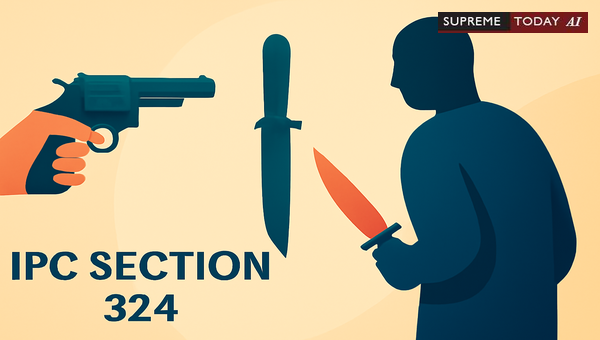
In criminal cases involving by dangerous weapons, a key question often arises: Whether Recovery of Weapon is Necessary to Attract Section 324 of IPC? This issue is pivotal for both prosecutors and defense lawyers, as it impacts the strength of evidence required for conviction. addresses serious assaults where hurt is caused using instruments like knives, firearms, or other means likely to cause death. But does the physical recovery of the weapon from the accused always need to occur for the offense to stick?
This blog post delves into the legal arguments on both sides, examines judicial precedents, and integrates insights from relevant case law. While recovery can bolster a case, courts have clarified its role. Note: This is general information based on legal principles and precedents; it is not specific legal advice. Consult a qualified lawyer for your situation.
punishes whoever voluntarily causes hurt using:- Instruments for shooting, stabbing, or cutting.- Any instrument likely to cause death when used as a weapon.- Fire, heated substances, poison, corrosives, explosives, or deleterious substances. 2015 0 Supreme(Ker) 1225
The punishment can extend to three years imprisonment, or up to ten years if hurt is caused, with or without a fine. The essence is proving the use of a or means to cause hurt, not mere possession.
Proponents argue that recovering the weapon is crucial for a robust prosecution under Section 324. Here's why:
Literal Interpretation: The term implies a tangible item capable of injury. Recovery links the accused directly to it, providing concrete evidence. Without it, proving the weapon's nature becomes speculative.
Requirement: Prosecution must establish use . Recovery offers direct proof, making it easier to show the weapon's dangerous character. 2019 0 Supreme(All) 2547 As noted, unless lapses made on the part of Investigating authorities are such, so as to cast a reasonable doubt on the case of the prosecution, or seriously prejudice the defence of the accused,... non-recovery alone isn't always fatal, but it challenges the case.
Judicial Precedents: In State of Rajasthan v. Kashi Ram (AIR 2006 SC 1803), courts stressed proving use or attempt with a . Physical recovery often corroborates this. Similarly, in cases like the one described, where the weapon fits Section 324's description, recovery strengthens conviction. 2018 0 Supreme(Guj) 882
Safeguard Against False Claims: Recovery prevents convictions based solely on oral testimony, reducing misuse in heated disputes.
On the flip side, recovery is not a . Courts focus on overall evidence.
Even critics acknowledge weaknesses:- Credibility Issues: No recovery invites doubt—could injuries stem from elsewhere?- Benefit of Doubt: Accused get the benefit if prosecution falters on proving the weapon. 2019 0 Supreme(All) 499 Nowhere it is essential that for proving case under it would be necessary to establish the rec.... (analogous principle for weapon-related offenses).- Risky Reliance on Circumstantials: Oral evidence alone may not meet the threshold without corroboration.
Real-world applications clarify the balance:
In a case involving charges under , , and , the court upheld framing charges despite contentions of a spur-of-the-moment fight. Recovery wasn't pivotal; intent via acts sufficed. 2025 0 Supreme(MP) 238
Non-recovery of the weapon or even the victim's bicycle didn't acquit the accused in a case, as investigative lapses didn't prejudice the defense or cast doubt. This underscores that for Section 324-like offenses, evidence quality trumps recovery. 2019 0 Supreme(All) 2547
In group clashes, weapons fitting Section 324 (e.g., sticks causing muscle injuries) led to convictions without emphasizing recovery, focusing instead on incident details and settlements. 2018 0 Supreme(Guj) 882 The doctor confirmed no fracture, yet the weapon qualified.
Broader contexts, like unlawful assemblies, show recovery isn't essential if eyewitnesses establish involvement. 2019 0 Supreme(All) 499
These cases illustrate: While recovery aids, it's corroborative, not conclusive. Courts assess holistically at charge-framing (mere suspicion) and trial (proof beyond doubt) stages. 2025 0 Supreme(MP) 238
For Prosecution: Prioritize medical exams detailing injury nature (e.g., incised wounds suggesting a blade), eyewitness consistency, and scene evidence. Recovery seals it but isn't make-or-break.
For Defense: Challenge via cross-examination on recovery absence, probing inconsistencies in weapon descriptions.
Investigation Tips: Recover promptly to avoid tampering claims. But lapses won't doom if other evidence shines.
In free fights or neighbor disputes—common Section 324 scenarios—courts lean toward evidence totality, sometimes reducing sentences post-settlement. 2018 0 Supreme(Guj) 882
In summary, while physical recovery significantly bolsters the prosecution’s case under , it is not an absolute requirement. The core is establishing use of a through reliable evidence. Absence may create doubt, but doesn't automatically acquit.
Disclaimer: Legal outcomes vary by facts. This overview draws from precedents; seek professional advice for case-specific guidance.
#IPC324 #WeaponRecovery #CriminalLaw


Section 324 of IPC, there is no description of any weapon as such. ... The learned counsel for the petitioner submitted that the motorbike cannot be termed as a weapon or instrument to attract the offence under Section 324 of IPC, and hence, the conviction under Section 324 of IPC is confirmed.

under Section 324 of IPC would not attract. ... Reading Section 324 of IPC as well as under Section 118(1) of the BNS, it is clear that, voluntarily causing hurt by means of any instrument which used as a weapon of offence is likely to cause death, would attract offence under Section 324 of IPC. 13. ... Therefore, it cannot be held pr....

In order to attract an offence under Section 326 IPC, evidence regarding the infliction of grievous hurt with a dangerous weapon is necessary. However, the recovery of the weapon of offence is not a sine qua non for sustaining a conviction under Section 326 of the IPC. ... However, I am unable to concur with the contention of the learned counsel for the appellants that ....
IPC , Section 324 specifies various instruments or means through which hurt could be inflicted.

Sections 324 and 326 expression "dangerous weapon" is used. In some other more serious offences, the expression used is "deadly weapon" (e.g., Sections 397 and 398). ... The facts involved in a particular case, depending upon various factors like size, sharpness, would throw light on the question whether the weapon was a dangerous or deadly weapon or not. That would determine w....

, 324 and 307 r/w 34 IPC. ... It is true that to convict an accused under Section 307 IPC, it is not necessary to show that bodily injury capable of causing death was inflicted and the question to be considered is whether the act, irrespective of its result, was done with ... Even though, the evidence of PW15 regarding the recovery of MO1 on the basis of disclosure statement of the first....

The question is whether absence of crime weapon should lead to a conclusion that there was no crime committed at all. ... After hearing both sides and on scrutiny of the material, it found prima facie material and charged the accused under Section 324 I.P.C. for causing hurt to two individuals with dangerous weapon/iron rod and the charge was read out to accused. ... Punishment prescribed under Section #H....

Learned counsel for petitioners vehemently submitted that the offence punishable under Section 324 IPC is not made out since the alleged weapon used in the offence has not been recovered by the IO. ... Regarding recovery of weapon of offence, it is a matter of trial and cannot become sole ground for discharge of an accused. 31. ... Learned counsel for the petitioner further submits that the charges framed....

No.29/2024 whereby the charges under sections 294, 147, 148, 323/ 149(06 Counts), 324/ 149(02 Counts), 307/ 149(02 Counts), 201, 506(Part-2), 427 of IPC have been framed against revision petitioner Rajesh Chouhan and charges under sections 294, 147, 148, 323/149 (06 Counts), 324/149(02 Counts), 307/149 ... It is also submitted that the incident took place at the spur of moment, so intention, motive and common object will not attra....

It may be emphasized that to attract Section 307 IPC, it is not necessary that the hurt should be grievous or of any particular degree. If hurt of any nature is caused and it is proved that there was intention or knowledge to cause death, Section 307 IPC would stand attracted. ... Saleem, (2005) 5 SCC 554, that the court in such cases has to see whether the act, irrespective of the result, was done with t....

Whether or not non-recovery of weapon is fatal for prosecution ?- Argument is raised on behalf of appellant-accused that in the present matter, neither weapon used in the occurrence nor bicycle on which deceased was travelling were recovered. Therefore, in the absence of such recovery, conviction of the appellant-accused was untenable.

Therefore we do not find it safe to convict Sahab Singh under sections 25 of Arms Act, but even in absence of his conviction under sections 25 of Arms Act, in view of eye-witnesses account in respect of his involvement in commission of above-mentioned offence of murder and attempt to murder in prosecution of common object of the unlawful assembly will remain unaffected. Nowhere it is essential that for proving case under sections 302/149 IPC it would be necessary to establish the rec....

The weapon used fits in to the description as provided under Section 324 IPC. The parties are neighbours and there is nothing on record to show that the appellant had any criminal antecedents. The occurrence has taken place almost 20 years back. In the case at hand, the doctor has not stated the injury to be grievous but on the contrary, he has mentioned that there is no fracture and only a muscle injury.

Thus, ingredients for offence punishable under Section 395 IPC are that there should be five or more persons and the victim/ victims should be put under the fear of death or hurt or wrongful restrain to commit theft or extortion. If a weapon of offence is used, the same would attract Section 397 IPC.
Whoever, except in the case provided for by section 334, voluntarily causes hurt by means of any instrument for shooting, stabbing or cutting, or any instrument which, used as weapon of offence, is likely to cause death, or by means of fire or any heated substance, or by means of any poison or any corrosive substance, or by means of any explosive substance or by means of any substance which it is deleterious to the human body to inhale, to swallow, or to receive into the blood, or by means of ....


An indispensable Tool for Legal Professionals, Endorsed by Various High Court and Judicial Officers
Please visit our Training & Support
Center or Contact Us for assistance

Scan Me!
India’s Legal research and Law Firm App, Download now!


For Daily Legal Updates, Join us on :



 Back to top


