Searching Case Laws & Precedent on Legal Query.....!
Analysing the retrieved Case Laws
Scanned Judgements…!



Searching Case Laws & Precedent on Legal Query.....!
Analysing the retrieved Case Laws
Scanned Judgements…!
Offering Job via Email but Failing to Provide It - Such conduct can constitute deficiency of service under the Consumer Protection Act, 2019, especially when the service provider (employer) makes a formal offer of employment and then fails to deliver the promised job. Courts have recognized that failure to fulfill such contractual commitments amounts to deficiency in service and unfair trade practice. ["2025 Supreme(Online)(SCDRC) 354"], ["2025 Supreme(Online)(SCDRC) 6779"]
Jurisdiction of Consumer Courts - Consumer Fora have jurisdiction to entertain complaints related to deficiency in service, including those involving employment offers, if the service provider is a service provider under the Consumer Protection Act. However, in cases involving educational institutions not providing recognized services or in matters barred by specific statutes like the RTI Act, jurisdiction may be limited or barred. ["2022 Supreme(Online)(Del) 7442"], ["2023 Supreme(Online)(Del) 18222"], ["2022 Supreme(Online)(Del) 7442"]
Deficiency of Service in Service-Related Transactions - When a service provider offers a job and then fails to deliver, or provides substandard services, courts have held such acts as deficiency in service, especially when the complainant suffers financial loss or job loss. Evidence such as emails offering employment and proof of services rendered are relevant. ["
Aashna Roy VS Yogesh Deveshwar - Consumer
"], ["2023 Supreme(Online)(Del) 18269"]Impact of RTI Act on Jurisdiction - Certain cases, especially those related to orders under the RTI Act, are barred from jurisdiction of courts under Section 23 of the RTI Act. This applies to disputes solely concerning RTI orders, not necessarily to deficiency in service claims unrelated to RTI. However, if the primary issue is deficiency in service, consumer courts may still entertain such cases unless specifically barred. ["2025 Supreme(Online)(SCDRC) 697"], ["2025 Supreme(Online)(SCDRC) 12118"], ["2025 Supreme(Online)(SCDRC) 11780"]
Analysis and Conclusion:Offering a job via email and subsequently failing to provide it can be considered a deficiency of service under the Consumer Protection Act, 2019, particularly when the offer is formal and the complainant suffers financial loss. Consumer courts have the jurisdiction to entertain such claims, provided the service provider falls within their scope. However, jurisdiction may be limited or barred in cases involving orders under the RTI Act or non-service related educational disputes. Overall, failure to deliver promised employment after an offer can be legally recognized as deficiency in service, and consumer courts are empowered to adjudicate such matters.
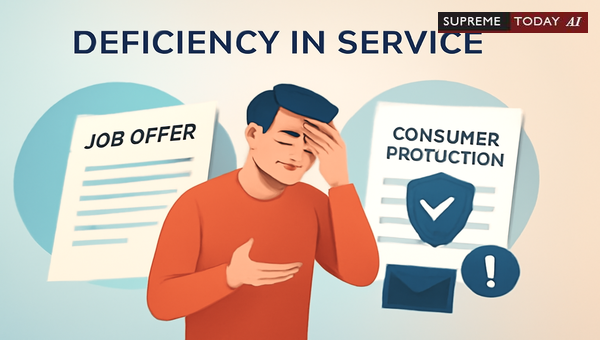
In today's digital age, job offers often arrive via email, creating excitement and expectations. But what happens when the employer backs out after sending that promising message? Is this simply a change of heart, or does it amount to a under Indian consumer law? More importantly, can step in to provide relief?
The question at hand is: Email Sent Offering the Job and Subsequently Failed to Provide Job is Deficiency of Service or Not? Whether the Consumer Court is having Power to Entertain? This issue has gained relevance as more disputes arise from unfulfilled employment promises. Generally, such scenarios may fall under the (now updated to 2019), offering potential remedies like compensation. However, outcomes depend on specific facts, and this is not legal advice—consult a professional for your case.
The , defines 'service' broadly to protect consumers from unfair practices. It includes any service made available to potential users, extending to facilities in connection with employment. Courts have interpreted this to cover promises of jobs, especially when made in writing like emails. Failure to deliver on such promises typically constitutes a , defined as any fault, imperfection, shortcoming, or inadequacy in the quality, nature, and manner of performance.
As noted in relevant precedents, the definition of 'service' encompasses provision of facilities in connection with...housing construction and similarly, the courts have extended this to include employment-related promises.
The law aims to safeguard individuals treated as consumers when engaging service providers for employment facilitation.
Yes, generally have jurisdiction to entertain complaints alleging , including unfulfilled job offers. The Act empowers to handle such matters, provided the claim value meets thresholds and it's not a pure employment contract dispute.
Explicitly, The jurisdiction of Consumer Disputes Redress Agencies...extends to complaints regarding providing of deficient services in relation to immovable property such as house...and by analogy, employment promises made as a service.
This broad remit ensures quick, cost-effective redressal without lengthy civil suits.
Indian courts have consistently upheld consumer forums' role in job-related deficiencies. In a pivotal case, failure to provide a promised job after admitting liability was held as . The court dismissed the appeal, affirming, failure to provide a promised service (a job) after admitting liability was held to be .
Similarly, in training institute disputes, courts ruled against providers who failed to deliver jobs post-payment. For instance, appellant had provided job to respondent No.1 till ...it failed to provide a job to her and as such she was entitled to refund.
Destination One Pvt. Ltd. VS Punit Pal Kaur Guron
The dismissed revision, noting concurrent findings of no job offered during the agreement period, limiting interference under .Another case highlighted alongside deficiency: OP had allured the complainants to join the Institute with a 100% job guarantee. Admittedly, the OP has failed to provide any job...it is a clear case not only of but is also of unfair trade practice.
The court directed refunds and barred misleading ads, emphasizing .
These rulings show a pattern: written promises (emails, agreements) create obligations, and breaches invite consumer court intervention.
Other cases reinforce this. In scenarios where service delays led to job loss, courts found deficiency: Opposite parties No.1 & 2 failed to provide service in a stipulated time...Due to by the opposite parties the complainant lost his JOB from which he was having income of Rs.55,000/- per month. 2024 Supreme(Online)(NCDRC) 413 2025 Supreme(Online)(SCDRC) 17826 Though barred some jurisdiction, the core principle aligns.
Job guarantee schemes in education or recruitment often fail scrutiny. Courts treat them as services, awarding compensation for mental agony and lost opportunities. However, pure employer-employee disputes (e.g., medical unfitness or internal rules) may route to , as in cases involving alternate jobs under : SCCL has provided alternative employment... is not violated. 2020 0 Supreme(Telangana) 63
In disability-related terminations, procedural lapses led to relief: The termination order lacked application of mind...granted the petitioner entitlement to invalid retirement. 2015 0 Supreme(P&H) 556 These distinguish service promises from standard employment.
An email offering a job creates a , especially if accepted or if liability is admitted. Its non-fulfillment is a , actionable in . Evidence like the email, follow-ups, and any acknowledgments strengthens claims.
Key elements for success:- Clear written promise (email).- No delivery despite assurances.- Quantifiable loss (e.g., opportunity cost, mental distress).
Courts award relief like refunds (if fees paid), compensation, and costs. In the referenced case, the forum's order stood, emphasizing consumer protection.
Not every job dispute qualifies:- Pure employment contracts: Ongoing employee issues go to labor tribunals.- No consumer angle: If no 'service' fee or facility provided, civil courts may apply.- Criminal intent: Fraud claims need police/CBI.- Alternative remedies: Some statutes bar consumer jurisdiction, like . 2024 Supreme(Online)(NCDRC) 413
Courts clarify: includes failure to perform contractual obligations related to services, including employment promises.
Thus, email offers typically qualify unless proven otherwise.
If facing this issue:1. Gather evidence: Save emails, chats, admissions.2. File complaint: In the appropriate consumer forum based on claim value (District < ₹20L, State < ₹1Cr, National > ₹1Cr under new Act).3. Claim relief: Seek compensation, job fulfillment (rare), or damages.4. Timeline: File within 2 years of cause.
offer speedy justice—typically 3-5 months.
and
.
Destination One Pvt. Ltd. VS Punit Pal Kaur Guron
.
This overview highlights protections but is for informational purposes only. Laws evolve, and specifics matter—seek tailored advice from a lawyer. Stay vigilant against job scams, and know your rights as a consumer.
#ConsumerRights, #DeficiencyInService, #JobOfferScam


Consumer Protection Act 2019. Even otherwise, it is now well-settled that training and skill development organizations, including those offering online courses and workshops, fall squarely within the ambit of "service providers" under consumer protection jurisprudence. ... Alleging the aforesaid act of Opposite Parties deficiency in service and unfair trade practice on their part, this c....

Consumer Protection Act 2019. Even otherwise, it is now well-settled that training and skill development organizations, including those offering online courses and workshops, fall squarely within the ambit of "service providers" under consumer protection jurisprudence. ... Alleging the aforesaid act of Opposite Parties deficiency in service and unfair trade practice on their part, this c....

The relevant paragraphs of the Order dated 07.02.2023 are as under:— “The question as to whether there was a deficiency in service or not would be a question of fact. ... In compliance with the directions of the Hon’ble Apex Court, the Complainant has filed on record the various email offering a higher post/job to her, certificates and letter certify....

The relevant paragraphs of the Order dated 7.2.2023 are as under: ... "The question as to whether there was a deficiency in service or not would be a question of fact. ... In compliance with the directions of the Hon'ble Apex Court, the Complainant has filed on record the various email offering a higher post / job to her, certificates and letter certif....

It is contended that even if the Education Institutions do not have a proper affiliation, Consumer Fora do not have jurisdiction to entertain the same. ... There may be instances where there may be defect / deficiency of service in pre - admission stages by an educational Institution but as the educational Institutions are not rendering any service by ....

... As the Petitioner / Opposite Party did not produce any evidence relating to adherence of service schedule, the District Forum held that there was unfair trade practice as well as deficiency in service on their part. ... The District Forum found deficiency in service on the part of the Opposite Party. ... Alleging deficiency in service on the part o....

Opposite parties No.1 & 2 failed to provide service in a stipulated time and opposite party No.3 has not taken any action as per service rules. Due to deficiency in service by the opposite parties the complainant lost his JOB from which he was having income of Rs.55,000/- per month. ... Sec. 23 of RTI Act, 2005 bars the jurisdiction of court#....
Opposite parties No.1 & 2 failed to provide service in a stipulated time and opposite party No.3 has not taken any action as per service rules. Due to deficiency in service by the opposite parties the complainant lost his JOB from which he was having income of Rs.55,000/- per month. ... Sec. 23 of RTI Act, 2005 bars the jurisdiction of court#....
Opposite parties No.1 & 2 failed to provide service in a stipulated time and opposite party No.3 has not taken any action as per service rules. Due to deficiency in service by the opposite parties the complainant lost his JOB from which he was having income of Rs.55,000/- per month. ... Sec. 23 of RTI Act, 2005 bars the jurisdiction of court#....

Opposite parties No.1 & 2 failed to provide service in a stipulated time and opposite party No.3 has not taken any action as per service rules. Due to deficiency in service by the opposite parties the complainant lost his JOB from which he was having income of Rs.55,000/- per month. ... Sec. 23 of RTI Act, 2005 bars the jurisdiction of court#....

Whether consent of employee is mandatory to provide alternate job? (vii) Whether Rule 82-A of the Rules is violated and if so, such violation vitiates entire action of SCCL?

Employee has requested to this office that due to accident his right leg was broken due to which he wants to take invalid retirement on medical grounds. Kindly repot be sent after conducting the medical of this employee to show whether conductor is fit for job or not."
Now the question to be seen is whether appellant had provided job to her or it failed to provide the job. The first appointment letter annexure R-1 is dated 7.5.2006 while appellant was provide job to respondent No.1 till 18.4.2006. The case of respondent No.1 is that she had approached the appellant several times for getting the job but it failed to provide a job to her and as such she was entitled to refund of the amount of Rs.75,000/-. 12. According to agreement, appellant....

The aim and object of both the provisions is the same i.e. to provide protective umbrella to such a disabled employee who has suffered disability in the service, by offering alternative job.
9. A critical perusal of Annexure C-1 and the brochure itself supplied by the appellant leaves no doubt in any body's mind that OP had allured the complainants to join the Institute with a 100% job guarantee. Admittedly, the OP has failed to provide any job to the complainants. It is a clear case not only of deficiency in service but is also of unfair trade practice as defined under Section 2(1)(r)(vi) of Consumer Protection Act, 1986, which reads as under: " ......... makes ....


An indispensable Tool for Legal Professionals, Endorsed by Various High Court and Judicial Officers
Please visit our Training & Support
Center or Contact Us for assistance

Scan Me!
India’s Legal research and Law Firm App, Download now!


For Daily Legal Updates, Join us on :



 Back to top


