Searching Case Laws & Precedent on Legal Query.....!
Analysing the retrieved Case Laws
Scanned Judgements…!



Searching Case Laws & Precedent on Legal Query.....!
Analysing the retrieved Case Laws
Scanned Judgements…!
Marriage Customs and Tribal Rights Tribal customs, including marriages at young ages, are recognized as either general, local, tribal, or family customs. Courts emphasize that tribal women should not be deprived of their constitutional rights to equality, including equal shares in family property, regardless of customary practices. The State has a duty to ensure the protection of fundamental rights for tribal populations, including gender equality in inheritance and succession. 2023 0 Supreme(Mad) 959
Marriage within Tribal Communities and Recognition Marriages conducted according to tribal customs are generally recognized, even if the tribe was not notified at the time of marriage. The courts acknowledge that social mobility and inter-community marriages are common and do not automatically negate tribal identity. However, verification of tribal status can involve expert opinions and scrutiny by Tribal Welfare Departments. 2024 0 Supreme(Telangana) 692,
The State of Andhra Pradesh, vs T VARAHALU - Andhra Pradesh
, 2022 Supreme(Online)(AP) 1945, 2022 Supreme(Online)(AP) 3264, 2025 Supreme(Online)(AP) 3817 2025 Supreme(Online)(AP) 3817Marriage of Tribal Women to Non-Tribal or Forward Castes Marriages between tribal women and non-tribal or forward caste men often lead to questions about the child's tribal status. Courts have held that children born from such unions generally do not retain Scheduled Tribe status if the mother marries outside her community, especially when raised outside tribal environments. Such offshoots are typically regarded as not belonging to the tribal community. 2022 0 Supreme(Bom) 1597, 2022 0 Supreme(AP) 832
Marriage at Young Age and Legal Perspectives Marriages involving minors, including tribal youth below 18, are prevalent among certain tribes. Courts recognize that early marriages are culturally ingrained but also highlight the need to prevent exploitation and ensure legal compliance. The age of the individuals, their consent, and the presence of family or elders' approval are critical factors. Courts have acknowledged that marriages at young ages, even below 18, occur with family blessings, but emphasize the importance of protecting minors from potential abuse or criminal acts. 2025 Supreme(Online)(Mad) 60661, 2024 0 Supreme(Ker) 264
Legal and Social Concerns While tribal customs may include early marriages, the legal framework aims to prevent child marriage and protect minors. Marriages conducted at young ages, especially involving vulnerable individuals, are scrutinized to prevent exploitation, and courts often consider the age, consent, and circumstances surrounding such marriages. The recognition of tribal customs must be balanced with constitutional protections against child marriage and exploitation. 2025 Supreme(Online)(Mad) 60661
Marriages under tribal customs, including those at young ages, are recognized within the legal framework, provided they adhere to constitutional rights and protections. While tribal communities have their traditions, the state is tasked with safeguarding gender equality, preventing child marriage, and ensuring minors' welfare. Marriages between tribal and non-tribal persons, especially involving minors, are complex and require careful verification of tribal status, age, and consent. Courts emphasize the importance of respecting cultural practices while upholding laws against child marriage and exploitation, striking a balance between tradition and constitutional rights.
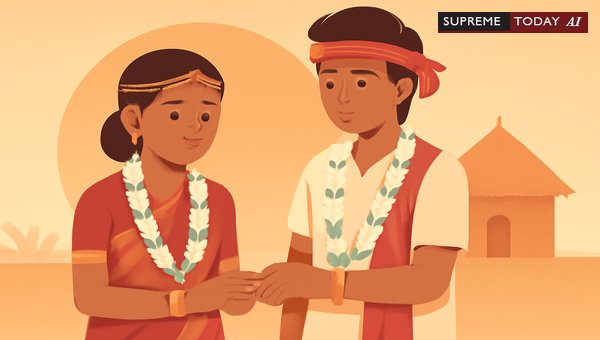
In India's diverse cultural landscape, tribal communities often follow unique customs that intersect with modern legal frameworks. A pressing question arises: Tribal Persons Getting Married under Age—is this permissible under Indian law? While the , sets the minimum age at 18 for women and 21 for men, tribal customs sometimes allow earlier unions. This blog explores the legal nuances, balancing tradition with constitutional protections.
Note: This is general information based on legal precedents and statutes. It is not specific legal advice. Consult a qualified lawyer for personalized guidance.
The core issue revolves around whether tribal persons can legally marry before attaining the , given their customary practices. Tribal customs, recognized as general, local, tribal, or family customs, play a pivotal role. Courts emphasize protecting tribal women's to equality, including property shares, while respecting traditions. However, the state must safeguard , including against child marriage. 2023 0 Supreme(Mad) 959
Marriages under tribal customs are generally recognized, even if the tribe wasn't formally notified at the time. Social mobility and inter-community marriages don't automatically negate tribal identity, but verification often involves expert opinions and scrutiny by . 2024 0 Supreme(Telangana) 692
2022 Supreme(Online)(AP) 1945 2022 Supreme(Online)(AP) 3264 2025 Supreme(Online)(AP) 3817
Under the , and , marriages below 18/21 years are or . Yet, tribal societies have ingrained practices of early marriages, often with family blessings and elders' approval. Courts acknowledge these as culturally rooted but stress preventing exploitation. 2025 Supreme(Online)(Mad) 60661 2024 0 Supreme(Ker) 264
For instance, in cases where petitioners attained majority and married voluntarily, courts protect such unions from threats, aligning with Court principles in Lata. 2025 Supreme(Online)(Guj) 11851 Both the petitioners have attained the age of majority and have voluntarily decided to get married to each other.
In tribal contexts, living together as husband and wife may be accepted as marriage, even without formal ceremonies. The petitioner’s parents Bandi Subbanna Dora and Neelamma were not legally married but on mere living together as husband and wife, the same cannot be considered, as Tribal society accepted them as tribal community. 2021 0 Supreme(AP) 609
Tribal customs can override general laws if ancient, consistent, and community-accepted, akin to adoption rules. Under the , adoption of persons over 15 is prohibited unless custom permits. The , stipulates that a person cannot be adopted if they have completed the age of fifteen years, unless a custom or usage permits otherwise. 2017 0 Supreme(SC) 1219
Judicial precedents like Kondiba Rama Papalalias Shirke v. Narayan Kondiba Papal affirm this for tribes: customs in regions like allow adoption at any age if judicially recognized. In certain regions like , customs recognize the possibility of adopting persons above fifteen years, even at any age, if such custom is judicially recognized.
Fulchand, s/o. Shankar Pawar @ Fulchand s/o. Lalu Jadhav VS State of Maharashtra, Through its Principal Secretary, Revenue Department - (2024)
This principle extends analogously to marriages. The Court recognizes tribal customs permitting practices beyond standard ages, provided they are established and don't violate constitutional norms. Among tribes, adult or older adoptions (and by extension, early marriages) are accepted if traditional. 2017 0 Supreme(SC) 1219
Fulchand, s/o. Shankar Pawar @ Fulchand s/o. Lalu Jadhav VS State of Maharashtra, Through its Principal Secretary, Revenue Department - (2024)
Marriages between tribal women and non-tribal men raise status issues for offspring. Children from such unions often lose if raised outside tribal environments. However, the situation will be different in a case where a tribal man married a non-tribal woman. In that case the offshoots of such wedlock would obviously attain the tribal status. Conversely, tribal woman to non-tribal often doesn't confer ST status. 2009 0 Supreme(Mad) 3670 2009 0 Supreme(Mad) 3655 2022 0 Supreme(Bom) 1597 2022 0 Supreme(AP) 832
Disclosure of marital status is key in legal affidavits: The woman should disclose if she is married to tribal or non-tribal. 2020 6 Supreme 322
Historical acts safeguarded inter-caste marriages if parties are above prescribed ages. The Act safeguarded inter-caste marriages and declared them as valid provided parties getting married are above the prescribed age. 2010 0 Supreme(Mad) 1188
While customs are respected, they face scrutiny:- Genuine Customs: Must be ancient, consistent, and non-arbitrary. Recent or violative customs aren't upheld.
Fulchand, s/o. Shankar Pawar @ Fulchand s/o. Lalu Jadhav VS State of Maharashtra, Through its Principal Secretary, Revenue Department - (2024)
- Child Protection: Early marriages, even customary, are examined for consent, age, and abuse risks. Legal framework prevents child marriage exploitation. 2025 Supreme(Online)(Mad) 60661- Constitutional Balance: Customs nearly acquire law status unless offending equality or rights. Courts examine case-by-case. 2017 0 Supreme(SC) 1219Limitations include:- No general adoption (or marriage override) without proven custom. 2017 0 Supreme(SC) 1219- ensures no violation.
Fulchand, s/o. Shankar Pawar @ Fulchand s/o. Lalu Jadhav VS State of Maharashtra, Through its Principal Secretary, Revenue Department - (2024)
Provide evidence of customs for validity, mirroring adoption requirements.
Tribal underage marriages navigate a delicate balance between revered customs and protective statutes. While recognized if proven ancient and consensual, they must align with anti-child marriage laws and rights. Courts uphold customs like those permitting deviations in adoption ages 2017 0 Supreme(SC) 1219
Fulchand, s/o. Shankar Pawar @ Fulchand s/o. Lalu Jadhav VS State of Maharashtra, Through its Principal Secretary, Revenue Department - (2024)
, suggesting similar leeway for marriages, but prioritize welfare.Key Takeaways:- Customs can permit early tribal marriages if established.- Inter-tribal unions affect ST status.- Always prioritize consent and constitutional compliance.- Consult experts for case-specific validity.
This framework ensures cultural preservation without compromising protections. Stay informed on evolving jurisprudence.
#TribalMarriage, #UnderageMarriageIndia, #CustomaryLaw


A custom varying a general law may be a general, local, tribal or a family custom. A general custom includes a custom common to any considerable class of persons. A custom which is applicable to a locality, tribe, sect or a family is called a special custom. ... This would not deprive the tribal women from getting equal share in the family property. In this context, rule of golden interpretation is to be adopted and the ne....

As Adi tribe was not notified when two man and woman married as per Hindu rites and customs which was prevalent at the time of their marriage in their community. ... However, it is made clear that this Court has not expressed a general opinion on the applicability of Section 2(2) of the Act to the O.Ps. filed by the persons belonging to Scheduled Tribe Community. ... In this day and age, relegating parties to customary Courts when they them....

The expert’s opinion can also be obtained as per Rule 7 from members of the Scrutiny Committee belonging to the Social Welfare and Tribal Welfare Department. Persons, who have knowledge of the social status of the applicant also may be examined. ... In the opinion of this Court in the age of social mobility the mere fact that a person is getting a spouse from a different community is not by itself enough to hold that he do....

The expert’s opinion can also be obtained as per Rule 7 from members of the Scrutiny Committee belonging to the Social Welfare and Tribal Welfare Department. Persons, who have knowledge of the social status of the applicant also may be examined. ... In the opinion of this Court in the age of social mobility the mere fact that a person is getting a spouse from a different community is not by itself enough to hold that he do....
The expert’s opinion can also be obtained as per Rule 7 from members of the Scrutiny Committee belonging to the Social Welfare and Tribal Welfare Department. Persons, who have knowledge of the social status of the applicant also may be examined. ... In contradiction to this the father-in-law of the 1 st respondent has himself stated on oath that he has given his daughter in marriage to the 1 st respondent since he had “6” daughters and had difficulty in #HL_....
The expert’s opinion can also be obtained as per Rule 7 from members of the Scrutiny Committee belonging to the Social Welfare and Tribal Welfare Department. Persons, who have knowledge of the social status of the applicant also may be examined. ... In contradiction to this the father-in-law of the 1st respondent has himself stated on oath that he has given his daughter in marriage to the 1st respondent since he had “6” daughters and had difficulty in #HL_ST....

He as well as his brothers and other members of his family are married to persons belonging to his own caste i.e. ‘Kurmi’. 34. ... Take for instance the case of a tribal woman getting married to a forward caste man and who is widowed or is abandoned by the husband shortly after marriage. She goes back to her people and the community carrying with her an infant or may be a child still in the womb. ... In t....

[2] It is the case of the petitioners herein that after the attaining the age of majority, they both have married on 26.02.2025. ... Both the petitioners have attained the age of majority and have voluntarily decided to get married to each other. They are residing together but their married life is under threat, therefore, in consonance with the principles of law enunciated by the Supreme Court in Lata ....

Take for instance the case of a tribal woman getting married to a forward caste man and who is widowed or is abandoned by the husband shortly after marriage. She goes back to her people and the community carrying with her an infant or may be a child still in the womb. ... couple or inter-religion married couple. ... For ensuring equality, the State, in certain situations, might have to treat unequally situated pe....

It is relevant to note that the victim and the first accused are belong to the Tribal Community/Thoda community. It is common that the marriage at the young age even below 18 years is prevailing among such Tribes. ... It involves the future of two young persons who are still in their early twenties. ... Inspector of Police reported in 2019 (3) MLJ Crl 110, wherein the learned single Judge had discussed in detail about the cases in which #H....

The appellate authority rejected the appeal and confirmed the order of the District Collector. The petitioner’s parents Bandi Subbanna Dora and Neelamma were not legally married but on mere living together as husband and wife, the same cannot be considered, as Tribal society accepted them as tribal community. The petitioner preferred appeal to the 1st respondent and the 1st respondent vide G.O.MS.No.144 dated 26.12.2007 based on the reports of the District Level Scrutiny Comm....

8. The woman should disclose if she has any movable or any immovable property, self-acquired or inherited from her clan. 9. The woman should disclose if she is married to tribal or non-tribal 2. I undertake to inform this Court immediately with respect to any material change in my employment, assets, income, expenses or any other information included in this affidavit. The above format may be modified or adapted by the concerned Court, as may be considered appropriate.

The Act safeguarded inter-caste marriages and declared them as valid provided parties getting married are above the prescribed age. The Act safeguarded inter-caste marriages and declared them as valid provided parties getting married are above the prescribed age. 2. 4. The then Madras Presidency witnessed grave famines including the one at Kalahandi (presently in Orissa State) in 1866 which was seen in this part of the Country. 2. 3. It will not be out of pl....

In that case the offshoots of such wedlock would obviously attain the tribal status." “The object of Articles 341, 342, 15(4), 16(4) and 16(4-A) is to provide preferential treatment for the Scheduled Castes and Scheduled Tribes having regard to the economic and educational backwardness and other disabilities wherefrom they suffer. However, the situation will be different in a case where a tribal man married a non-tribal woman. The reason being that such offshoot was brought u....
The reason being that such offshoot was brought up in the atmosphere of Forward Class and he is not subjected to any disability. However, the situation will be different in a case where a tribal man married a non-tribal woman. In that case the offshoots of such wedlock would obviously attain the tribal status."


An indispensable Tool for Legal Professionals, Endorsed by Various High Court and Judicial Officers
Please visit our Training & Support
Center or Contact Us for assistance

Scan Me!
India’s Legal research and Law Firm App, Download now!


For Daily Legal Updates, Join us on :



 Back to top


