Searching Case Laws & Precedent on Legal Query.....!
Analysing the retrieved Case Laws
Scanned Judgements…!



Searching Case Laws & Precedent on Legal Query.....!
Analysing the retrieved Case Laws
Scanned Judgements…!
Forceful Eviction and Illegal Disconnection of Power - Several sources highlight that eviction and power disconnection actions often involve disputes over legality and procedural correctness. For instance, in 2025 Supreme(Online)(Cal) 4516, the eviction suit has been pending since 1993, and allegations of forceful or illegal activities by landlords are denied, suggesting the eviction process is legally initiated but contested. Similarly, in 2023 0 Supreme(Cal) 1345, the eviction suit and subsequent power disconnection are linked to ongoing legal proceedings, with courts noting that disconnection cannot be used as a means to achieve eviction unlawfully ["2025 Supreme(Online)(Cal) 4516"], ["2023 0 Supreme(Cal) 1345"].
Legal Provisions and Court Observations - Courts have emphasized that disconnection of power supply cannot be used as a tool for eviction outside due process. For example, in SWARNALATA DIKSHIT Vs EE(ELECTRICAL), TPCODL - Orissa_HC_ODHC010100962021 and 2021 0 Supreme(AP) 395, courts observed that disconnection due to eviction must follow legal procedures and cannot be done arbitrarily or as a means of coercion, especially without proper notice or judicial approval. Disconnection is permitted under specific clauses (e.g., Clause 17 of the Power Supply Conditions) but only within the framework of law and proper procedural steps ["SWARNALATA DIKSHIT Vs EE(ELECTRICAL), TPCODL - Orissa"], ["2021 0 Supreme(AP) 395"].
Disconnection with Resistance and Due Process Violations - Several cases report disconnection occurring with resistance from the tenant or owner, often leading to allegations of arbitrariness and violation of natural justice. In
M/s. Sri Balaji Metal Crushers vs The State of Andhra Pradesh - Andhra Pradesh
andKaramcheti Siva Ram Prasad Sarma vs The State of Andhra Pradesh - Andhra Pradesh
, courts have restrained disconnection until proper procedures are followed, emphasizing that disconnection without notice or legal sanction is unlawful. For example, inKaramcheti Siva Ram Prasad Sarma vs The State of Andhra Pradesh - Andhra Pradesh
, disconnection based solely on a letter from authorities was deemed illegal, underscoring the necessity of due process ["M/s. Sri Balaji Metal Crushers vs The State of Andhra Pradesh - Andhra Pradesh
"], ["Karamcheti Siva Ram Prasad Sarma vs The State of Andhra Pradesh - Andhra Pradesh
"].Power Disconnection as a Civil Dispute and Not a Punitive Measure - Several sources clarify that disconnection should be part of civil dispute resolution rather than an extrajudicial or coercive tactic. In 2024 Supreme(Online)(AP) 19713, authorities are restrained from disconnecting power pending proper legal procedures, indicating that disconnection is permissible only within legal bounds and not as a means to enforce eviction unlawfully ["2024 Supreme(Online)(AP) 19713"].
Court Orders and Restorations - Courts have intervened to prevent illegal disconnection, ordering restoration of power and emphasizing that disconnection without notice or proper legal authority is unlawful. In TEL00000225913, the court ordered the restoration of power after disconnection was found to be without notice, reinforcing the principle that disconnection must follow due process ["TEL00000225913"].
Analysis and Conclusion:The main consensus across the sources is that eviction and power disconnection must adhere strictly to legal procedures. Disconnection as a means of eviction, especially when executed forcefully or without proper notice, is considered illegal and arbitrary. Courts have consistently upheld tenants' rights to due process, emphasizing that power disconnection cannot be used as a coercive tool outside statutory provisions. Proper legal channels, notices, and judicial approval are essential to ensure that eviction and disconnection actions are lawful.
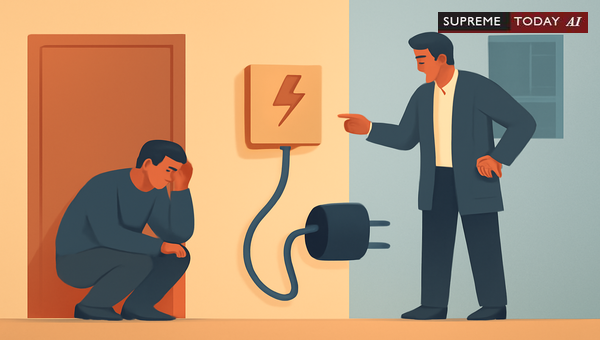
Landlords and property owners sometimes face challenges with tenants who default on rent or utilities. A common question arises: Forceful Eviction of the Tenant and Disconnection of Power – can these actions be taken without court orders? In Indian law, the answer is nuanced, balancing statutory rights with constitutional protections. This post breaks down the legal framework, drawing from key statutes like the , and tenancy laws, while highlighting judicial safeguards.
While this analysis provides general insights, it is not legal advice. Consult a qualified lawyer for your specific situation, as outcomes depend on facts and jurisdiction.
Electricity providers have specific powers under the . Section 24(1) allows a licensee to disconnect supply after requisite notice if the consumer neglects to pay charges for energy or related sums. 1995 0 Supreme(SC) 188 This is a , but it's not absolute.
Subsection (2) imposes conditions, including procedural safeguards to prevent arbitrary actions. Courts have upheld this, noting disconnection for non-payment is permissible provided is followed. 1995 0 Supreme(SC) 188
For instance, in cases involving port authorities, disconnection of power and water was allowed for outstanding dues, but only after notices and reconciliation of accounts. The authority could forfeit security deposits and halt services per guidelines, yet eviction required separate legal steps. 2025 0 Supreme(Mad) 2558
However, courts intervene if notice is absent. One ruling directed restoration of power since disconnection occurred without notice to petitioners. 2024 Supreme(Online)(TS) 11284 Another emphasized that licensees must issue notice before disconnection. 2024 Supreme(Online)(TS) 11284
Eviction falls under civil laws, rent control acts, and specific statutes like the . Forceful eviction without violates tenant rights. The stresses that proceedings must be lawful, with proper legal sanction. 1997 5 Supreme 656
The 1971 Act allows eviction of unauthorized occupants without high-powered committees but mandates adherence to procedures to avoid arbitrariness. 1997 5 Supreme 656
In a notable case, a port authority's order for dues payment (Rs. 37,53,718) was upheld, along with service disconnection, but eviction was set aside, granting access until lawful eviction. The court ruled authorities can't prevent premises access without following eviction procedures. 2025 0 Supreme(Mad) 2558
Similarly, disconnection of power supply cannot be resorted to achieve an order of eviction. Courts have directed maintaining power supply despite landlord resistance.
V.JOTHIRAMALINGAM vs M.SHANMUGAM (DIED) - Supreme(Online)(MAD) 17659
Courts adopt a cautious approach, ensuring procedural fairness under (writs) and (superintendence). They don't intrude on executive powers but check for legality and constitutional rights adherence. 2007 1 Supreme 245
In administrative contexts, like under the (Sections 27-28), disconnection is okay for non-payment, but eviction demands . Petitioners retained access until eviction. 2025 0 Supreme(Mad) 2558
have quashed arbitrary notices. For example, under , eviction powers are , requiring principles. 2021 0 Supreme(Guj) 479
Even crop cultivator cards under , don't create leases without proper signatures, allowing eviction claims if invalid. 2020 0 Supreme(AP) 528
Landlords may forfeit deposits or halt services per scales of rates, but eviction can't bypass courts. 2025 0 Supreme(Mad) 2558 Forceful actions invite writs, FIRs, or restoration orders.
In one instance, despite FIRs against occupants, courts scrutinized suppression of facts before denying relief. 2022 0 Supreme(Bom) 539
Commissions for inspections are limited; irrelevant probes to delay suits are abuses. 2022 0 Supreme(Ker) 334
This underscores that actions must align with law to avoid reversals. Stay informed, act procedurally, and prioritize dialogue over force for sustainable resolutions.
Word count: ~950. General information only – seek professional advice.
#TenantRightsIndia #EvictionLaws #PowerDisconnection


Though the case of the petitioners is entirely different version, according to the Petitioners, allegation is baseless as the eviction suit is pending since 1993 against the tenant. So, question of forceful or illegal activities upon the tenant does not and cannot arise to evict. ... Since 1993 till 2001, there was no single allegation levelled against the landlords with regard to forceful illegal activities. ... False criminal case, on t....

Learned counsel appearing for the CESC Limited submits that the CESC Limited could not even hold an inspection due to resistance by the landlord and seeks to hold such inspection to ascertain whether disconnection has been effected or not. 4. ... The petitioner, admittedly, is in occupation of the property, which has been admitted by the private respondent by filing an eviction suit against the petitioner. 9. ... It is alleged that the petitioner’s electrici....

of power supply cannot be resorted to achieve an order of eviction. ... For there already power supply given to the petitioner’s residence, power supply be maintained. ... Short grievance of the petitioner in the writ petition is that the power supply disconnection to the petitioner’s house is given with resistance of the house owner therein. ... If there is any dispute in....

According to the guidelines in the scale of rates, the respondent authority may forfeit the security deposit, halt all services including disconnection of power and water, cease the issuance of HEP to the staff and officials of the firm, and take eviction action under the Public Premises Act, 1971. ... Disconnection of power and water is also explicitly allowed, and hence, it can be performed. However, lo....

Disconnection due to Eviction 17.1.1. ... Clause 17 of the General Terms and Conditions of Power Supply, which deals with the disconnection of supply, reads as follows: 17. ... Obviously, on the basis of a letter, dated 14.06.2021, of the fourth respondent- Assistant Director of Mines & Geology, the Superintending Engineer-second respondent herein resorted to the impugned action of disconnection of #HL_ST....

Clause 17 of the General Terms and Conditions of Power Supply, which deals with the disconnection of supply, reads as follows: 17. Discontinuance of Supply 17.1. Disconnection due to Eviction 17.1.1. ... In the above background, this Court is required to examine and adjudicate as to whether the impugned action of disconnection of power supply is sustainable and tenable. 8. ... Obviousl....

He further submits that since there is a civil dispute between the petitioner and the 4th respondent, respondent Nos. 1 to 3 are not taking any steps for disconnection of the subject power connection which is situated in Sy.No.127/7 of Madhurawada Village, Visakhapatnam District. ... As contended by the learned Standing Counsel for respondent Nos. 1 to 3, that the respondents are not taking steps for disconnection of the power#HL_....

But at the same time the revision petitioner is at liberty to produce the documents to prove that he has been using the power generator and for disconnection of the electricity supply by filing necessary application before the Appellate K.MURALI SHANKAR,J. ... After enquiry, eviction was ordered. Aggrieved by the order of eviction, the revision petitioner/tenant has preferred an appeal in R.C.A.No.18 of 2010, on the file o....
It is also not in dispute that Clause 17 of the General Terms and Conditions of Power Supply also enables the licencee to order disconnection of power supply in the event of there being any order of eviction or in the absence of any permission. ... It is also his submission that Clause 17 of the General Terms and Conditions of Power Supply also enables the licencee to order disconnection....

However, it is for Respondents 3 and to issue notice before power disconnection. ... This Court also while entertaining Writ Petition on 01.04.2021, directed to restore power supply having regard to the fact that disconnection of power supply is without notice to petitioners. ... On 01.04.2021, this Court issued notice before admission and passed the order as under: “ Having regard to the fact that #HL_ST....

During pendency of Eviction Suit-the forceful dispossession In the eviction suit the respondent no.7 is admitting the possession of the petitioners over the leased area in question.

He submitted that the issues to be decided in this case are; (1) whether decree against forceful eviction is liable to be granted? (2) whether the mandatory injunction directing the vacant possession of the building by the plaintiff to the defendants is liable to be granted?

Power of eviction to be exercised only by the Competent Authority Where the Competent Authority is satisfied either upon a representation from the owner of a building or upon other information in its possession that the occupants of the building have not vacated it in pursuance of any order or direction issued or given by the Authority, the Authority shall, by order, direct the eviction of the occupants from the building in such manner and within such time as may be specified....

Ahmedabad Municipal Corporation, (1977) 18 GLR 549 : AIR 1978 Guj. 82 the Full Bench, dealing with the impugned notice of eviction observed: In this decision, the Full Bench has observed, that, once the land vests with the authority concerned as per the Scheme, the Scheme has become a legislative measure under which the rights of the parties have totally ceased to occupy the property and the power of eviction in such a context would be in the nature of an administrative power and, therefore, w....
He claims to be in actual physical possession of the land. Therefore, a prayer is made for protection from forceful eviction


An indispensable Tool for Legal Professionals, Endorsed by Various High Court and Judicial Officers
Please visit our Training & Support
Center or Contact Us for assistance

Scan Me!
India’s Legal research and Law Firm App, Download now!


For Daily Legal Updates, Join us on :



 Back to top


