Searching Case Laws & Precedent on Legal Query.....!
Analysing the retrieved Case Laws
Scanned Judgements…!



Searching Case Laws & Precedent on Legal Query.....!
Analysing the retrieved Case Laws
Scanned Judgements…!
Union of India’s Legal Standing - The Union of India appears through officials’ notices and legal proceedings, asserting its authority and addressing issues related to trade unions, transfers, and administrative actions. Several judgments confirm that the Union of India is a recognized legal entity capable of being a party in disputes, issuing notices, and defending its policies ["2025 0 Supreme(Cal) 768"], ["2023 0 Supreme(Del) 1336"], ["UNION OF INDIA vs RAJESH VYAS - Supreme Court"].
Recognition and Notices in Trade Unions - The Supreme Court and High Courts have recognized that notices issued to trade unions, including those involving retired or retrenched employees, are valid if issued under relevant statutory provisions like Section 22 of the Trade Unions Act ["2025 0 Supreme(Cal) 667"]. The Union of India’s notices and actions regarding union recognition and membership are upheld as valid, even if recognition is withdrawn or challenged ["2025 0 Supreme(Cal) 768"].
Administrative Actions and Policies - The Union of India’s decisions, such as merging government presses or formulating transfer policies, are legally recognized and often subject to judicial review. Courts have upheld the Union’s administrative decisions, provided proper procedures are followed, including issuing show cause notices and considering replies ["2008 1 Supreme 686"], ["2025 Supreme(Online)(UK) 972173"].
Judicial Acknowledgment of Union’s Role - Courts have repeatedly acknowledged the Union of India’s authority in matters of employment, transfers, and union recognition. For instance, notices issued by Union officials are considered valid, and the Union’s responses and policies are scrutinized within the legal framework ["2021 0 Supreme(Del) 608"], ["2020 Supreme(Online)(DEL) 1892"].
Main Insights and Conclusions - The presence of the Union of India through officials’ notices is well-established and accepted in judicial proceedings. The courts recognize that the Union acts through authorized officers, and its notices, whether for recognition, transfers, or other administrative matters, are deemed valid when issued following due procedures. The assertion that a union of India appears through officials notice on union of India not needed is supported by consistent legal recognition of the Union’s authority and the validity of notices issued by its officials ["2025 0 Supreme(Cal) 768"], ["UNION OF INDIA vs RAJESH VYAS - Supreme Court"].
References:- ["2025 0 Supreme(Cal) 768"]- ["UNION OF INDIA vs RAJESH VYAS - Supreme Court"]- ["2025 0 Supreme(Cal) 667"]- ["2008 1 Supreme 686"]- ["2025 Supreme(Online)(UK) 972173"]- ["2021 0 Supreme(Del) 608"]- ["2020 Supreme(Online)(DEL) 1892"]
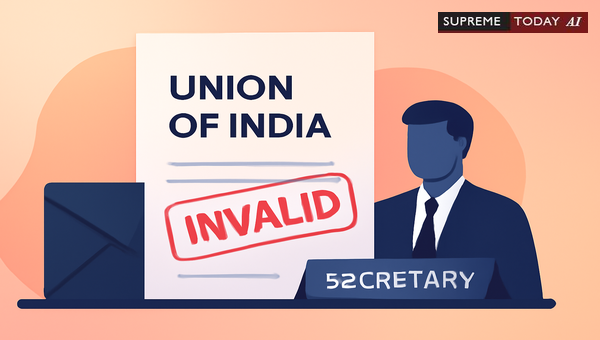
When initiating legal proceedings against the , one critical step often overlooked is the proper service of notice under . A common query arises: appears through officials. Notice on not needed? The short answer is no—proper notice is mandatory, and serving it on the wrong officer or department can render the entire suit invalid. This blog post dives deep into the legal requirements, key judgments, exceptions, and practical recommendations to ensure your notices hold up in court.
Understanding these rules is vital for litigants, lawyers, and businesses dealing with government entities. Improper service doesn't just delay cases; it can lead to dismissal. Let's explore the nuances based on established precedents. (Note: This is general information and not specific legal advice. Consult a qualified lawyer for your case.)
mandates that no suit shall be instituted against the Government or public officers without serving a notice of two months. For the , this notice must be properly addressed and served on authorized representatives, typically the Secretary to the Government or a designated officer. 1991 0 Supreme(SC) 589
Notices addressed to the wrong officer, such as the Chief Secretary instead of the Secretary, fail to constitute valid service. Proceedings initiated without proper service are invalid, including any judgments or decrees passed thereafter. 1966 0 Supreme(Guj) 101
In C. P. Agencies v. State of Madras (AIR 1954 Nag 242), a notice to the Secretary, , Madras, was valid as it reached the proper officer, despite minor addressing issues. However, service on a different department's Secretary would not suffice. 1966 0 Supreme(Guj) 101
This case emphasized that even if addressed improperly, service upon the proper officer or department may be valid. But service on an unauthorized officer, like a non-designated one, renders it invalid. 2004 0 Supreme(All) 1542
The Apex Court in State of Madras v. C. P. Agencies underscored: The object of sec. 80 was manifestly to give the Government or the public officer sufficient notice of the case which was proposed to be brought against it. Insufficient details or wrong addressee defeats this purpose. 1991 0 Supreme(SC) 589
While strict compliance is the norm, courts recognize limited exceptions:- Actual Receipt by Proper Officer: If the notice reaches the authorized department despite imperfect addressing, it may be upheld. 1991 0 Supreme(SC) 589- Acknowledgment or Subsequent Action: If the department acts on the notice or acknowledges it, proceedings might be validated.- Held-Out Authorized Agents: In a case under Section 78B, service on the Refunds Officer was valid because the held them out as authorized via public notifications and pamphlets. Service of notice of claim upon the Refunds Officer is valid and sufficient compliance with , as the had held out the Refunds Officer as the duly authorized person. 1968 0 Supreme(Cal) 151
However, these are fact-specific and do not override the general rule for suits against the Union.
Other precedents reinforce the need for precision:
In a port and railway suit, the trial court dismissed for serving notice on the Refunds Officer instead of the General Manager, but higher courts upheld it due to explicit authorization. This highlights checking departmental notifications. 1968 0 Supreme(Cal) 151
Sanctions and appearances: In corruption cases, supported sanctions by state governments for deputed officers, but notice service remained key. Notice to proper authorities ensured validity. 2007 0 Supreme(Bom) 74
Arbitration contexts: Delays in objections due to late service on led to , stressing timely, proper notice. 2001 0 Supreme(Del) 1408
and cases show non-appearance despite notice doesn't waive service requirements; proper initial service is foundational. 2011 0 Supreme(Pat) 646 2007 0 Supreme(Gau) 737
These cases illustrate that across domains—civil suits, railways claims, corruption prosecutions—courts apply rigour to service rules for government entities. 2025 0 Supreme(Kar) 2593
To avoid pitfalls:1. Address Precisely: Target the Secretary or designated officer of the concerned ministry/department.2. Proof of Service: Obtain acknowledgment or delivery proof.3. Re-Serve if Needed: If addressing is questionable, re-issue correctly before filing suit.4. Verify Authorizations: Check gazette notifications or departmental rules for agents like Refunds Officers in specific statutes.
In deputation scenarios, confirm if state or Union sanctions apply, but notice rules persist. 2007 0 Supreme(Bom) 74
Proper service of notice on the is non-negotiable under . Addressing the wrong official, like the Chief Secretary instead of the Secretary, typically invalidates service and downstream proceedings. While exceptions exist for actual receipt or held-out agents, err on the side of caution.
Key Takeaways:- Notices must reach authorized officers. 2004 0 Supreme(All) 1542- Invalid service dooms suits. 1991 0 Supreme(SC) 589- Always verify and document service.
This framework, drawn from precedents like C. P. Agencies and Ghulam Rasool, ensures compliance. For tailored advice, engage legal experts. Stay informed to safeguard your claims against the .
References: Detailed citations from judgments 1991 0 Supreme(SC) 589, 1966 0 Supreme(Guj) 101, 2004 0 Supreme(All) 1542, 1968 0 Supreme(Cal) 151, and others as noted.
#UnionOfIndiaLaw, #Section80CPC, #LegalNoticeService


It has been held by the Hon'ble Supreme Court in the case of Union of India v. ... (C) No.7135 of 2023 In re: All India Postal Employees Union Group 'C', (A recognized Service Association) through its Circle Secretary Vs. Union of India, Ministry of Communications, Department of Posts & Ors. ... The said subscription is to paid/deducted/recovered by/from officials, who have given consent/letter of authorization for such membership of a Union, be it....

OF INDIA & ORS. ... OF INDIA & ORS. ... OF INDIA & ORS. ... OF INDIA & ORS. ... OF INDIA & ORS.

State of Karnataka, (1987) 1 SCC 658 : AIR 1987 SC 1059] and Union of India v. Param Industries Ltd. [Union of India v. ... State of Karnataka AIR 1987 SC 1059 and Union of India v. ... Union of India & others – 2019 SCC Online Delhi 11885; (d) In Ruchi Soya Industries Ltd. Vs. Union of India & others – (2020) 13 GSTR – OL – 585 & (e) In Union of India & others Vs. ... #HL_START....
The said notice was not widely circulated and is evidently an inter-departmental notice. 7. ... On hearing the learned counsels and on perusal of the materials on record, it appears that:- i) Vide notice dated 08.04.2025 the Registrar of Trade Union (W.B.) relied upon sub-Section 2 of Section 22 of the Trade Unions Act and directed as follows ... a retired or retrenched employee shall not be construed as outsider for the purpose of holding an office in a trade #HL_STA....

Union of India, (2000) 10 SCC 664, reiterated in Federation of Railway Officers Assn. v. Union of India, (2003) 4 SCC 289 and Centre for Public Interest Litigation v. Union of India (UOI) & Ors. ... He has referred to the Judgment of the Supreme Court in BALCO Employees Union v. Union of India & Ors., AIR 2002 SC 350 and of this of this Court in Airports Authority of India and Ors. v. Mahesh Kumar Sethi and Anr., (....
It appears to be worthy of note that the Union of India contested the suit, but led no evidence at the trial, save the notice under Section 80 of the Procedure Code (exhibit A ). ... Is the Union of India, the opposite party before me, then disowning its Ministry ? I hope not. ... the concluding portion of his judgments Union of India v. ... That is the way I go, not the way of waiver Mr. Roy Chowdhury likes me to ....

The Authorized Officer, Union Bank of India, (Former Corporation Bank has been merged with Union Bank of India), Tirupur Main Branch, No.300/1, Mangalam Road, Tirupur 641 604. 4. ... The Assistant General Manager, Union Bank of India (Former Corporation Bank has been merged with Union Bank of India), Tirupur Main Branch, No.300/1, Mangalam Road, Tirupur 641 604. 3. ... The Assistant General Manager, Union Bank of India#HL_....

In the said appeals, stand of the Union of India is that show cause notice was issued to which reply was furnished by Union of India it was held that show cause notice was duly p style ... was not considered. ... was not responded to. ... of India and Ors. v.

The appointing authorities are the authorities under the administration of Union Territories and not under the Ministries of Union of India. Central Civil Services are the services directly under Union of India. ... It appears that Scheduled Castes and Scheduled Tribes in some States had to suffer the social disadvantages and did not have the facilities for development and growth. ... It appears that Scheduled Castes and Scheduled T....
Issue notice. 10. Mr. Ripu Daman Bhardwaj, learned counsel accepts notice on behalf of respondent No.1/Union of India. 11. Mr. ... Maninder Acharya, learned ASG for UOI, who appears on advance notice, draws this Court’s attention to the order/letter dated 30th April, 2020 issued by the Union Home Secretary to all the Chief Secretaries. ... Anil Grover, who appears on advance notice for respondent No.2- Govt. of Haryana, ....

If the contention of the counsel appearing for the petitioner is accepted, there is no provision in the Rule, 1958 which will have an application to the member of the service who was promoted from the State service and had retired from the service. Be that as it may, it is the Union of India which has made the rules and in order to enable this Court to give a correct and proper interpretation thereof, the Union of India was called upon to make its stand clear to this Court on the issue relating to the interpretation of the Rule 1(2)(b) in relation to Rule 6. This Court vide its order dated 3....

1. No one appears on behalf of the Union of India despite due notices to them.

1. Heard Mr. A.K. Bhattacharjee, learned Senior Counsel assisted by Mr. B.K. Singh, learned Counsel appearing on behalf of the petitioner as well as Mr. R. Goswami, learned Senior Government Advocate for the respondents, State of Meghalaya. None appears for the Union of India, despite notice.

The sanction has been rightly given by the State Government as the substantive appointment of the applicant is under the State Government. Notice was issued to respondent No.2, Union of India and Mr. Satpute appears for Union of India. State of Maharashtra is respondent No. 1 whereas Union of India is respondent No.2. Union of India supports the impugned order and takes a stand that the sanction order is legal, valid inasmuch as the Central Government is not the sanctioning authority.

Perusal of the record reveals that on 13/1/1997 notice was issued to the parties regarding filing of the award. On 4/11/1996 as well as on 29/1/1997 it was directed to be issued afresh to respondent no. 2. This fact is apparent from the record also because Union of India had been served in November 1996 and in that view of the matter it is patent that objections so filed are beyond the limitation prescribed qua objector-Union of India. On 1/4/1997 it was indicated that notice has been served on Union of India.


An indispensable Tool for Legal Professionals, Endorsed by Various High Court and Judicial Officers
Please visit our Training & Support
Center or Contact Us for assistance

Scan Me!
India’s Legal research and Law Firm App, Download now!


For Daily Legal Updates, Join us on :



 Back to top


