Searching Case Laws & Precedent on Legal Query.....!
Analysing the retrieved Case Laws
Scanned Judgements…!



Searching Case Laws & Precedent on Legal Query.....!
Analysing the retrieved Case Laws
Scanned Judgements…!
Senior Advocate's Role Limited to Briefing Advocate - A Senior Advocate can only appear in court when represented by an Advocate-on-Record (AOR) or a junior counsel; they cannot appear independently or without proper instruction. This restriction ensures the dignity of the profession and maintains procedural discipline. ["2025 3 Supreme 477"], ["2025 0 Supreme(SC) 809"], ["2024 0 Supreme(All) 638"]
Restrictions on Direct Court Appearances - Senior Advocates are prohibited from accepting briefs directly from clients, filing vakalatnamas, or acting without an Advocate-on-Record in the Supreme Court or a junior in other courts. These rules reinforce that Senior Advocates act as part of a structured legal team, not as independent litigants. ["2025 3 Supreme 477"], ["2025 0 Supreme(SC) 809"], ["2024 0 Supreme(All) 638"]
Appearances for Briefing Advocates Only - The law emphasizes that Senior Advocates appear only when instructed through proper briefs, often via Advocates-on-Record or juniors, not directly for clients. This maintains the hierarchy and dignity within the legal profession. ["2025 3 Supreme 477"], ["2025 0 Supreme(SC) 809"]
Implication of Rules on Senior Advocates' Independence - The restrictions mean that Senior Advocates cannot universally appear on their own; their appearances are tied to briefs prepared and instructed through authorized channels, primarily to uphold professionalism and procedural integrity. ["2025 3 Supreme 477"], ["2025 0 Supreme(SC) 809"]
Judicial and Statutory Framework - Various rules and judicial pronouncements clarify that Senior Advocates act as part of a team, and their appearance is contingent upon instructions from a briefing advocate or Advocate-on-Record, not as independent litigants. These rules aim to preserve the decorum and hierarchy of the legal system. ["2024 0 Supreme(All) 638"], ["2023 0 Supreme(Kar) 268"]
The collected sources establish that a Senior Advocate can only appear in court when instructed through a briefing advocate or Advocate-on-Record. They are not permitted to appear independently or universally for any party without proper briefing channels. This framework is designed to uphold the dignity, hierarchy, and procedural discipline of the legal profession, ensuring that Senior Advocates act within a structured system of instructions rather than as autonomous litigants. Therefore, the statement that a Senior Advocate can only appear for the briefing advocate and not universally is supported by the legal rules and judicial precedents.
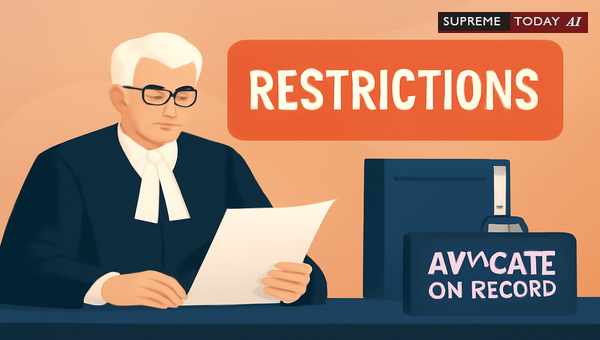
In the intricate world of the Indian legal system, hold a prestigious position, recognized for their expertise and standing at the Bar. However, a common question arises: Can a senior advocate appear universally in court, or only for the ? This query touches on critical restrictions designed to maintain procedural integrity and ethical standards. Understanding these limitations is essential for clients, junior advocates, and legal professionals alike.
This article delves into the rules governing ' court appearances, drawing from the , Bar Council regulations, and relevant judicial insights. Note that while this provides general information, it is not a substitute for personalized legal advice—consult a qualified lawyer for specific cases.
are designated under , which classifies advocates into and other advocates based on ability, standing at the Bar, or special knowledge or experience in law 2023 7 Supreme 149 2023 3 Supreme 706. This designation confers privileges like the right of (priority in speaking) but comes with strict restrictions.
The prescribes rules that cannot file a () or act in any court or tribunal without being assisted by an (AoR)2017 7 Supreme 510 2004 0 Supreme(SC) 1800. In essence, they cannot accept instructions directly from clients or appear independently. Instead, they argue cases briefed by an AoR, ensuring procedural compliance.
must appear alongside an . They are prohibited from:- Filing vakalatnamas independently.- Accepting direct briefs from clients.- Acting without AoR assistance in courts or tribunals.
This is reinforced in judicial observations: Necessarily, the senior advocate has to appear only through an Advocate on Record and he has to be engaged as such, without whom he cannot straightway make any appearance. It contemplates that he shall not file or act in any Court or Tribunal... 2015 0 Supreme(Ker) 1334 2010 0 Supreme(All) 3322.
The rationale? focus on advocacy and pleading, not routine procedural work, preserving their role as specialized counsel
.
While enjoy over other advocates, this does not permit solo appearances 2023 7 Supreme 149. They serve as counsel for the (AoR), who handles filings and client instructions.
empowers the Bar Council to impose restrictions, which it has: are barred from certain actions to uphold professional standards 2017 7 Supreme 510. Recent rules, like the Designation of Senior Advocate Rules, , emphasize evaluable performance but do not alter appearance restrictions 2025 0 Supreme(Del) 49.
Courts have consistently upheld these limits:- In challenges to designations, transparency is stressed, but core restrictions remain intact 2024 0 Supreme(Chh) 85.- was deemed constitutional, distinguishing based on assessable performance without expanding appearance rights 2025 0 Supreme(Del) 49.- rules declaring certain provisions aligned with guidelines in , reinforcing structured processes 2021 0 Supreme(Ori) 14.
Further, under the , only designated qualify for specific roles, underscoring the formal designation's importance 2019 0 Supreme(Del) 99.
In mediation or committee contexts, ' roles are similarly circumscribed, often requiring association support 2025 Supreme(Online)(Cal) 4965 2014 0 Supreme(All) 474.
For clients:- Engage an AoR first; they brief the senior advocate.- Expect senior counsel for high-stakes arguments, not routine matters.
For junior advocates/AoRs:- Briefing seniors enhances case strength but requires compliance.- Manage expectations: seniors argue, you handle procedure.
Recommendations:- Always appoint an AoR when hiring a senior advocate to avoid procedural lapses.- Educate clients on these dynamics for realistic expectations 2017 7 Supreme 510.
Designation processes have evolved for fairness. guidelines in (via ) bind High Courts, prohibiting arbitrary powers like Orissa's sub-rule (9) 2021 0 Supreme(Ori) 14. Committees must ensure transparency, especially involving figures like the Advocate General 2024 0 Supreme(Chh) 85.
Retired judicial officers face tailored criteria, but appearance rules persist post-designation 2025 0 Supreme(Del) 49.
cannot appear universally; they are restricted to arguing for the (AoR), as per Advocates Act Section 16 and Bar Council rules 2023 7 Supreme 149 2017 7 Supreme 510 2004 0 Supreme(SC) 1800 2023 3 Supreme 706. This framework balances expertise with procedural safeguards.
Key Takeaways:- Always pair with AoR: No independent appearances.- Privileges with limits: yes, direct client briefs no.- Stay compliant: Review rules like designations for eligibility.- Seek advice: Rules may vary by court; professional consultation recommended.
By understanding these nuances, legal stakeholders can navigate courts effectively. For more on Indian legal practices, explore our blog.
References:- 2023 7 Supreme 149 2023 3 Supreme 706 2017 7 Supreme 510 2004 0 Supreme(SC) 1800 2015 0 Supreme(Ker) 1334 2010 0 Supreme(All) 3322
2025 0 Supreme(Del) 49 2024 0 Supreme(Chh) 85 2021 0 Supreme(Ori) 14
This article is for informational purposes only and does not constitute legal advice.
#SeniorAdvocate #IndianLaw #CourtRules


But I do not think it affects the rule which, I trust, is universally observed that counsel must be retained by the proctor and not by the client. ... An advocate in Ceylon is not in the same position as an advocate in Quebec, for his functions are limited to advocacy and pleading. ... Advocates in Quebec appear to be in the same position as proctors of the Suprem....

Rule 2(b) mandates that a Senior Advocate shall not appear without an Advocate-on-record in the Supreme Court and shall not appear without a junior in any other court in India. ... Thus, as per the said Rule so far as Supreme Court is concerned, a Senior Advocate can not appear without the #HL_START....
If the retainer is not followed by a brief and fee, the counsel is at liberty to appear on the other side upon retainer and fee. An advocate cannot decline a fee capriciously. ... -An advocate is not at liberty to decline a fee capriciously. Have you served notice on the advocates whose malpractice you suggest?] I do not say there has been any malpractice. ... [Moncreiff, J.- " Jun....
If an advocate, by virtue of his standing at the Bar, his ability or special knowledge, deserves designation as a senior advocate, the question which arises is, by making such an advocate appear for an interview, are we not compromising on the dignity of the advocate? ... Another restriction is that he shall not appear without an #HL_....

of Senior Advocate Rules, 2024’ lay down that the point assignment criteria shall not be applicable to retired judicial officers. ... of Senior Advocate Rules, 2024’ lay down that the point assignment criteria shall not be applicable to retired judicial officers.” ... Designation as a Senior Advocate confers upon such individual a status if n....

A lot of advocates prefer to remain as an Advocate-on-Record or advocates in the High Court and District Courts as the designation as Senior Advocate carries many inhibitions in the role that they can perform, i.e., they have to appear with an instructing counsel, not draft and file pleadings, and not ... (4) An advocate of the Supreme Court who was a senior#....

Even if they were allowed to appear on behalf of their employers all such Law Officers who are till now appearing on behalf of their employers shall not be allowed to appear as advocates. ... The contention advanced by learned Senior Counsel for the petitioner is that not only did the petitioner have more than seven years standing prior to taking up the assignment of a Senior Analyst Par....

The petitioner has not challenged the recommendation of the committee and decision of respondent No.1 of not finding the petitioner suitable for designation as Senior Advocate. ... Some Advocates who were also working in Advocate General office were also in the Committee which was not earlier notified as the present Advocate General was also designated as Seni....

The aforesaid application has been filed praying for engagement of some other advocate as mediator in place and instead of Mr. Amales Ray, Senior Advocate. 2. It appears that the order dated 25th April, 2025 engaging Mr. ... As an interim measure, it is ordered that none of the writ petitioners who are the practicing advocates will not be restrained, inconvenienced by the Siliguri Bar Association in any manner whatsoever w....

For aught we know, the legislature felt that for the implementation of the legislation, it would not subserve the public interest if lawyers were allowed to appear, plead or act on behalf of the non tribal transferees. ... A person enrolled as an advocate under the Advocates Act is not ipso facto entitled to a right of audience in all Courts unless Section 30 of that Act is first brought into force. ... He expressed concer....

(9) Notwithstanding the above noted procedure for designation of an Advocate as Senior Advocate, Full Court on its own can designate an Advocate as Senior Advocate even without any proposal from Hon’ble Judges or application from the Advocate if it is of the opinion that by virtue of his/her ability or standing at the Bar said Advocate deserves such designation.” A cursory reading of the aforesaid Rule makes it clear that sub-rules-(1) & (2) correspond to paragraph-73.4 of th....

The contention that the term “Senior Advocate” must be read as a senior lawyer is unpersuasive. In the present case, respondent no.3 is not designated as a Senior Advocate. In terms of Section 16 of the Advocates Act, 1961, there are only two classes of advocates, namely, Senior Advocates and Other Advocates. Thus, in terms of Sub-rule (5) of Rule 4 of the SC/ST Rules, only a Senior Advocate can be appointed for conducting a case.

Accordingly, the aforesaid rules have been framed and it restricts and bars a senior advocate with certain conditions. It contemplates that he shall not file vakalat or act in any Court or Tribunal or before any person or authority as mentioned in Section 30. The expression "to act" has been defined very comprehensively and takes in, every act as normally being expected or being done by a regular legal practitioner or advocate. Necessarily, the senior advocate has to appear only thro....
As number of Advocates, during the course of arguments, raised serious objection about the constitution of Elders Committee, we deem it proper to provide that the Elders Committee shall be constituted strictly in accordance with Rule 7 of the Bye-Laws. In the event, any Senior Advocate is not available, for any reason, then, the next Senior Advocate, on the basis of its seniority as Senior Advocate, will be the member of Elders’ Committee. (e) After the preparation and public....

"Necessarily, the senior advocate has to appear only through an Advocate on Record and he has to be engaged as such, without whom he cannot straightway make any appearance. It contemplates that he shall not file vakalatnama or act in any Court or Tribunal or before any person or authority as mentioned in Section 30. The expression "to act" has been defined very comprehensively and takes in, every act as normally being expected or being done by a regular legal practitioner or ....


An indispensable Tool for Legal Professionals, Endorsed by Various High Court and Judicial Officers
Please visit our Training & Support
Center or Contact Us for assistance

Scan Me!
India’s Legal research and Law Firm App, Download now!


For Daily Legal Updates, Join us on :



 Back to top


