Searching Case Laws & Precedent on Legal Query.....!
Analysing the retrieved Case Laws
Scanned Judgements…!



Searching Case Laws & Precedent on Legal Query.....!
Analysing the retrieved Case Laws
Scanned Judgements…!
Section 60(3) NDPS Act - Provides that in NDPS offences, the Special Court must decide whether seized articles, including vehicles, are liable for confiscation, regardless of whether the accused is convicted, acquitted, or discharged. The court's primary focus is on the confiscation matter, not necessarily on release ["2022 0 Supreme(Tri) 213"], ["2024 0 Supreme(MP) 5"].
Owner as a Petitioner - The owner of a seized vehicle, who is not an accused, can file a petition for release, typically under Section 451 of the Cr.P.C., but such petitions are often considered secondary procedures. The NDPS Act's provisions take precedence, requiring a separate process for release or confiscation, with the owner’s rights protected if they prove innocence or lack of knowledge of misuse ["2025 Supreme(Online)(Mad) 70257"], ["2024 0 Supreme(Mad) 2624"], ["2023 0 Supreme(Mad) 2861"].
Ownership and Innocence - The petitioner, as the registered owner, has the right to seek interim release of the vehicle if they can prove they were not involved, had no knowledge, or took reasonable precautions against misuse. The courts have recognized that owners not accused or implicated can seek release, but the decision depends on judicial assessment of ownership, knowledge, and involvement ["2025 Supreme(Online)(Mad) 70257"], ["
Bhola Singh @ Ayush Singh Son of Markandey Singh VS State of Bihar - Crimes
"], ["2024 0 Supreme(MP) 5"].Procedural Aspects - While general provisions under Cr.P.C. (Section 451) allow owners to seek return of seized property, NDPS-specific procedures under Sections 60(3) and 63 of the NDPS Act govern confiscation and release. The courts have emphasized that the owner’s claim must be considered within the framework of the NDPS Act, and that the owner’s rights are protected if they demonstrate non-involvement ["2022 0 Supreme(Tri) 213"], ["2025 Supreme(Online)(MP) 9914"].
Jurisdiction of the Court - The Special Court has jurisdiction to decide on the release of vehicles, but such orders are subject to the provisions of the NDPS Act. The court can release the vehicle to the owner if it finds no involvement or knowledge of misuse, but it must also consider the possibility of confiscation and the procedural safeguards ["2024 0 Supreme(Pat) 740"], ["2024 0 Supreme(MP) 5"].
Legal Precedents and Principles - Courts have held that vehicles not involved in the offence or used without owner’s knowledge should be released on interim basis, provided the owner files an appropriate application and proves their innocence. The law aims to balance the rights of innocent owners with the state’s interest in confiscation ["2025 Supreme(Online)(Mad) 70242"], ["2024 0 Supreme(Mad) 2624"].
A petitioner who is the registered owner of a vehicle seized under the NDPS Act, but not an accused, can file a release petition—typically under Section 451 of Cr.P.C.—to seek interim custody of the vehicle. However, such petitions are subject to the provisions of the NDPS Act, especially Sections 60(3) and 63, which authorize the court to decide on confiscation and release based on the owner’s innocence and lack of knowledge of misuse.
Main points:- The owner’s right to seek release exists but is not absolute; it depends on proving non-involvement.- The Special Court has jurisdiction to consider such petitions, but must adhere to the legal framework of the NDPS Act.- The procedural safeguards ensure that innocent owners are protected and vehicles are not wrongly confiscated.
Insights:- The law recognizes the owner’s rights and provides mechanisms for interim release, emphasizing the importance of establishing innocence.- The decision hinges on whether the owner can demonstrate they were unaware of misuse and took reasonable precautions.
References:- Section 60(3) and 63 of the NDPS Act- Sections 451 of Cr.P.C.- Judicial precedents and legal commentary on vehicle release in NDPS cases (e.g., ["2022 0 Supreme(Tri) 213"], ["2025 Supreme(Online)(Mad) 70257"], ["2024 0 Supreme(Mad) 2624"], ["2025 Supreme(Online)(MP) 9914"], ["2024 0 Supreme(Pat) 740"])
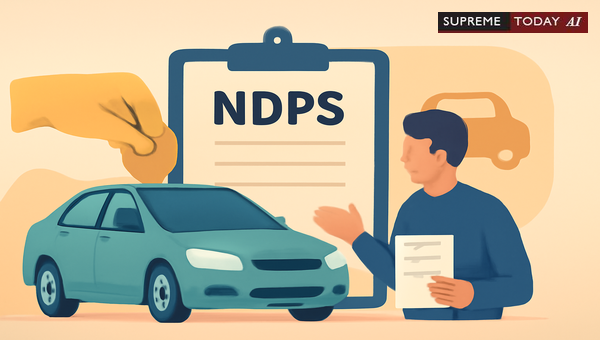
In the high-stakes world of narcotics enforcement under India's , vehicles used in drug trafficking are often seized, leaving innocent owners in a bind. Imagine you're the registered owner () of a vehicle seized during an NDPS raid, but you're neither an accused nor involved in the crime. The key question arises: Can the petitioner, as of the NDPS but not an accused, file a ?
This blog dives deep into the legal landscape, drawing from court judgments and principles to clarify your rights. We'll explore eligibility, conditions, exceptions, and practical steps, helping vehicle owners navigate this complex area. Note: This is general information based on precedents; consult a lawyer for case-specific advice.
Courts have consistently held that the of a vehicle seized under the can seek its release, provided no has been passed2021 0 Supreme(Raj) 386 2022 0 Supreme(Raj) 2418. Ownership via the Registration Certificate is typically sufficient to establish standing, even if the owner is not implicated in the offense.
Several judgments affirm this: If no confiscation proceedings are pending, the vehicle may be released to the 2022 0 Supreme(Pat) 1180 2022 0 Supreme(Pat) 981. The legal documents establish that registered owners have this right, emphasizing protection for innocent parties 2021 0 Supreme(Raj) 386.
For instance, in cases where the vehicle was used without the owner's knowledge, courts prioritize to prevent undue hardship 2024 0 Supreme(Kar) 357. Here, the court noted: The vehicle in question was hired by some private party... without the knowledge of the owner of the vehicle. It ruled that the can grant if lack of knowledge is proven, overriding denials by lower courts under and 457.
The judiciary's stance is clear: Absence of a is pivotal, allowing RC owners to file petitions successfully 2021 0 Supreme(Raj) 386 2018 0 Supreme(Tri) 76 2022 0 Supreme(Ori) 44. Courts stress safeguarding innocent owners' rights, often permitting release during on (bail-like conditions) or bonds 2022 0 Supreme(Raj) 2418.
Key principles include:- under and 63, read with : Special Courts retain powers to release vehicles, focusing on the owner's innocence 2024 0 Supreme(Kar) 357.- No bar for non-accused owners: Even if proceedings are ongoing, release is favored absent confiscation 2022 0 Supreme(Raj) 2418.- Protection against depreciation: Vehicles left idle depreciate, justifying release 2020 0 Supreme(Mad) 1220 2020 0 Supreme(Mad) 1291 2020 0 Supreme(Mad) 2031. Courts have observed: The vehicle was being kept idle in the police station premises, which would lead to its depreciation in value.
These principles underscore that ownership alone suffices for petitioning, promoting fairness.
Release isn't automatic; courts impose safeguards:- Bonds or : Often required for or 2012 0 Supreme(P&H) 312 2017 0 Supreme(Raj) 2247.- No alienation: Vehicles can't be sold or misused during custody 2020 0 Supreme(Mad) 1291.- Cooperation with authorities: Owners must aid investigations 2020 0 Supreme(Mad) 2031.
Even if the owner is an accused, absence of confiscation allows petitions 2022 0 Supreme(Raj) 2418. In non-NDPS parallels, like forest offenses, courts direct release to non-accused owners post-report to magistrates, without compounding 2021 0 Supreme(Telangana) 179: The petitioner is not an accused and he is only an owner of the subject vehicle.
Under sand mining cases, absconding accused doesn't bar owner release 2021 0 Supreme(Ker) 218: Mere fact that the accused had absconded cannot be a reason for rejecting the petition filed by the owner.
While favorable, exceptions exist:- Pending confiscation: Limits immediate release 2018 0 Supreme(Tri) 76.- Owner's knowledge/involvement: May sway decisions, though ownership typically prevails 2022 0 Supreme(Ori) 44.
Courts balance prosecution needs with owner rights, often conditioning release to prevent evasion. In hired vehicle scenarios, proven lack of complicity is crucial 2024 0 Supreme(Kar) 357.
To strengthen your case:1. Substantiate ownership: Attach RC, insurance, etc.2. Prove no confiscation: Highlight absence of proceedings.3. Cite precedents: Reference judgments like those emphasizing innocent owners 2021 0 Supreme(Raj) 386 2022 0 Supreme(Raj) 2418.4. Propose conditions: Offer bonds/ proactively.5. File promptly: Approach or via writs.
Yes, as of an NDPS-, you can generally file a even if not an accused, absent a . Courts favor interim release to bona fide owners, protecting against loss while ensuring justice 2021 0 Supreme(Raj) 386 2018 0 Supreme(Tri) 76 2022 0 Supreme(Ori) 44.
Key Takeaways:- Prioritize lack of knowledge and ownership proof.- Expect conditions like bonds for .- Act swiftly to avoid depreciation 2020 0 Supreme(Mad) 1220.- Draw from broader precedents on seized property release.
This analysis draws from established rulings, but outcomes vary. This is not legal advice—seek professional counsel tailored to your situation. Stay informed, protect your assets, and leverage these rights effectively.
Key Supporting Judgments:- 2021 0 Supreme(Raj) 386 2022 0 Supreme(Raj) 2418 2022 0 Supreme(Pat) 1180 2018 0 Supreme(Tri) 76 2022 0 Supreme(Ori) 44 2024 0 Supreme(Kar) 357 2021 0 Supreme(Telangana) 179
#NDPSAct, #VehicleRelease, #LegalRights


Section 60 (3) of the NDPS Act which provides that in the trial of offences under the NDPS Act, whether the accused is convicted or acquitted or discharged the Special Court shall decide whether any article or thing seized under this act is liable to confiscation under a href=". ... Learned counsel for the petitioner pointed out that first such request was made before t....

In the present matter, the petitioner is the registered owner; he is not an accused in Crime No.362 of 2024. The allegation is that the Accused No.1 used the vehicle to sell ganja. ... Laxman, learned counsel for the petitioner, submitted that the petitioner is the registered owner and not an accused#HL_END....

However, the seized vehicle is not liable to be confiscated if the owner of the seized vehicle can prove that the vehicle was used by the accused person without his knowledge or connivance and that he had taken all reasonable precautions against such use of the seized vehicle by the accused person. ....
petition filed by the petitioner, though he claims to be the owner of the vehicle, but which has been disputed, for the simple reason that it is only the owner of the vehicle, who could file a petition under sub-section (3) of Section 60 of the NDPS Act seeking release of the animal or conveyance, which ... #HL_START....

The vehicle in question was hired by some private party for transporting their goods. The accused/driver committed an offence by transporting the drugs, without the knowledge of the owner of the vehicle. Yet, the DDC is not releasing the vehicle. ... Therefore, the petitioner is before this Court. 4. Learned counsel for the petitioner contended that th....

The prosecution has stated that the petition is not maintainable, and that if the vehicle is returned to the petitioner, he will not produce it in future. ... There is no provision in the NDPS Act which declares that a vehicle, once seized in an NDPS case, cannot be released on interim custody. On the contrary, Sections 60(3) and 63 o....

However, the seized vehicle is not liable to confiscation if the owner of the seized vehicle can prove that the vehicle was used by the accused person without the owner‟s knowledge or connivance and that he had taken all reasonable precautions against such use of the seized vehicle by the ....

Act, I am not inclined to allow this petition for release of seized motorcycle. ... Learned counsel for the petitioner submits that learned NDPS Special Court has failed to appreciate the law regarding release of the vehicle to interim custody of the owner of the vehicle allegedly involved in NDPS C....
Therefore, the petitioner was arrested and the vehicle was seized along with contraband. The petition filed under Section 451 of Cr.P.C. is not at all maintainable for the release of the property when the petitioner's vehicle was seized along with contraband under the NDPS Act. ... The learned counsel appearing for the petit....

If the owner of the vehicle is not an accused in that case, a separate and independent proceeding has to be drawn for confiscation in terms of the express provisions in Section 60(3) of the NDPS Act to protect an innocent owner before confiscating his vehicle or conveyance. ... The procedure of confiscation has been made under Section 60(3) of the NDPS....

Therefore, the question of compounding the offence does not arise. Thus, the petitioner has to approach respondent Nos.6 and 7 seeking release of subject vehicle by way of filing appropriate application. They have already submitted a report to the Magistrate. The petitioner is not an accused and he is only an owner of the subject vehicle.

Moreover, the alleged commission of the crime was on 16.08.2020. 2. The vehicle was seized in connection with Crime No.327/2020 registered at the Karuvarakundu Police Station alleging commission of offences under the Kerala Protection of River Banks and Regulation of Removal of Sand Act, 2001 and Section 379 of I.P.C. Learned Counsel for the petitioner submitted that the only reason for rejection of the petition is the objection raised by the learned Public Prosecutor that the accused had absc....
In such circumstances, he has filed this Writ Petition seeking for release of the seized vehicle. According to him, the second respondent has failed to respond to the said representation.
According to him, the respondents have failed to respond to the said representation. In such circumstances, he has filed this Writ Petition seeking for release of the seized vehicle.
According to him, the respondents have failed to respond to the said representations. In such circumstances, he has filed this Writ Petition seeking for release of the seized vehicle.


An indispensable Tool for Legal Professionals, Endorsed by Various High Court and Judicial Officers
Please visit our Training & Support
Center or Contact Us for assistance

Scan Me!
India’s Legal research and Law Firm App, Download now!


For Daily Legal Updates, Join us on :



 Back to top


