SupremeToday Landscape Ad

AI Overview

AI Overview...

  • Preceding Notice and Enquiry Procedure - Generally, disciplinary rules emphasize that a charge sheet should precede a show cause notice, especially when serious or major punishments are involved. For instance, the charge sheet as per the extant rule should preceed a show cause ["2023 Supreme(Online)(CAT) 3164"]. Similarly, a charge-sheet or show cause notice in disciplinary proceedings should not ordinarily be quashed ["2024 0 Supreme(All) 739"], and the enquiry is not yet started, hence it is prayed that enquiry needs to be set aside ["2022 Supreme(Online)(Kar) 33269"]. The sequence typically involves issuing a charge sheet first, followed by a show cause to the delinquent, allowing for a fair opportunity to respond.

  • Legal Standards and Formalities - Issuance of notices, such as via registered post, is often mandated (issuing notice by registered post is mandatory ["2022 0 Supreme(Ker) 1116"]), and the content of notices must be based on legal and factual grounds. The absence of scientific norms or clear legal basis for issuing a show cause or charge sheet renders such notices potentially illegal or arbitrary (there are no scientific norms on the basis of which charge-sheet has been issued ["2024 0 Supreme(P&H) 923"]). Proper adherence to established rules ensures the legality of disciplinary actions.

  • Scope of Judicial Intervention - Courts generally refrain from quashing charge sheets or show cause notices unless issued by incompetent authorities, mala fide, or without following due process. Normally, no writ lies against a show cause notice or charge-sheet ["2022 0 Supreme(Ker) 1116"], and a charge-sheet or show cause notice in disciplinary proceedings should not ordinarily be quashed ["2025 Supreme(Online)(CAT) 10273"]. However, if procedural violations are evident, such as initiating proceedings without proper authority or in violation of principles of natural justice, courts may intervene.

  • Principles of Natural Justice and Fair Procedure - Fair opportunity, including proper notice, hearing, and consideration of evidence, is critical. It is noteworthy that the enquiry officer has not followed the procedure, which is required to conduct the enquiry ["2023 Supreme(Online)(Kar) 35512"], and without issuing any disagreement notice to the petitioner, straightaway passed the order of penalty ["2025 Supreme(Online)(Raj) 9881"]. Violations of natural justice, such as bypassing opportunity to defend or issuing notices without proper authority, can vitiate disciplinary proceedings.

  • Impact of Prior Acquittal or Pending Enquiries - Courts have held that once an individual is acquitted or the charges are dropped, initiating a fresh enquiry based on the same facts may be unjustified (when the petitioner is acquitted of the identical or same charge, the disciplinary authority could not have initiated enquiry ["2025 Supreme(Online)(Kar) 17564"]). Similarly, pending enquiries or non-completion within stipulated timelines can render subsequent notices or charges invalid.

  • Discretionary Nature of Writ Jurisdiction - Courts generally exercise caution, emphasizing that writs are discretionary and should not be used to interfere with disciplinary proceedings unless there is a clear violation of law or procedure (writ jurisdiction is discretionary ["2025 Supreme(Online)(Kar) 17564"]). The issuance of a charge sheet or show cause notice, while procedural, does not automatically create a cause of action unless procedural violations are evident.

Analysis and Conclusion:Disciplinary notices, including charge sheets and show cause notices, must follow a prescribed sequence—typically, the charge sheet should precede the show cause notice, and both should be issued based on lawful authority and established procedures. Courts tend to avoid quashing such notices unless issued by incompetent authorities, mala fide, or without adherence to principles of natural justice. The absence of scientific norms or legal basis for issuing notices renders them vulnerable to challenge. Proper procedural adherence, including opportunity to respond and following due process, is essential to uphold the legality of disciplinary actions. When procedural violations or violations of natural justice are established, courts may intervene, but generally, these notices are presumed valid unless challenged on specific grounds.

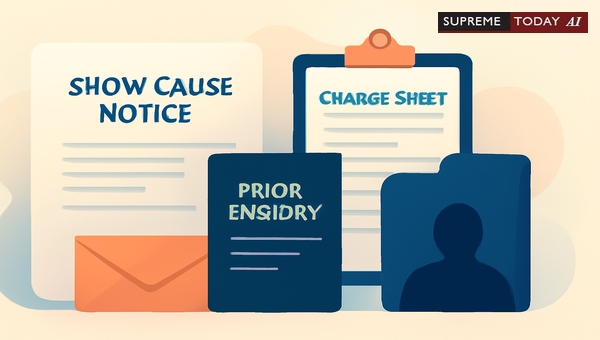
Need for Prior Enquiry Before Issuing Disciplinary Show-Cause Notices and Charge-Sheets in Employment

Is Enquiry Required Before Issuing a Show-Cause Notice in Disciplinary Proceedings?

In the realm of employment law, disciplinary actions often spark debates about procedural fairness. A common question arises: Whether Ashoka Notice or Affect Finding Enquiry is Required before Issuing a Short Sheet? Here, short sheet typically refers to a show-cause notice or charge-sheet, preliminary documents used in disciplinary processes against employees. Employers must navigate these carefully to avoid legal challenges, while employees seek protection under principles of natural justice.

This blog post breaks down the legal principles, judicial views, and practical recommendations, drawing from established case law. Note that while this provides general insights, it is not legal advice—consult a qualified lawyer for specific cases.

What is a Show-Cause Notice or Charge-Sheet?

A show-cause notice (often called a charge-sheet or short sheet in some contexts) is an initial step in disciplinary proceedings. It informs the employee of alleged misconduct and invites a response. Importantly, it does not impose punishment or adversely affect rights on its own. 2017 0 Supreme(Kar) 1092 2021 0 Supreme(Telangana) 42

Courts have clarified that such notices are procedural and do not require prior enquiry. They serve as a starting point, allowing the employee to defend themselves before any formal action. 2018 0 Supreme(AP) 749

Core Legal Principles: No Prior Enquiry Generally Required

Under standard disciplinary rules, a show-cause notice or charge-sheet alone does not constitute an adverse order affecting rights or imposing punishment. It is merely a preliminary measure. 2017 0 Supreme(Kar) 1092 2021 0 Supreme(Telangana) 42 2018 0 Supreme(AP) 749

  • Procedural Nature: Issuing it does not infringe on employee rights unless followed by punishment without due process. The employee must be given a chance to reply, and only if unconvincing does the process advance. 2021 0 Supreme(Telangana) 42
  • No Inherent Punishment: Courts emphasize that these documents do not stigmatize or penalize by themselves. An enquiry becomes essential only later for guilt determination. 2021 0 Supreme(Telangana) 53

This aligns with rulings stating, Holding of preliminary enquiry before issuing the Charge sheet is not necessary for holding Domestic enquiry. Absence of preliminary enquiry does not invalidate action. 2012 0 Supreme(Ker) 333

Preliminary enquiries may collect initial evidence but are not mandatory substitutes for full domestic enquiries. They help decide if formal proceedings are warranted. 2012 0 Supreme(Ker) 333

When is an Enquiry or Additional Notice Required?

While prior enquiry is not needed for the initial notice, certain scenarios trigger further steps:

  1. New Evidence Emerges: If fresh material surfaces, the Disciplinary Authority must frame new charges, provide them to the employee, evaluate the reply, and then appoint an Enquiry Officer. 2018 0 Supreme(Kar) 541

  2. Punitive or Stigmatic Orders: Before compulsory retirement, termination, or dismissal—especially if based solely on a show-cause notice without enquiry—these can be challenged as shortcuts avoiding proper procedure. 2013 0 Supreme(All) 351

  3. Final Adverse Orders: An enquiry ensures facts are examined and defenses heard before impacting service rights or reputation. 2006 0 Supreme(Del) 1332

For instance, in cases where dismissal occurred without providing the enquiry report, courts ruled it illegal, violating natural justice. The denial of the enquiry report constituted a breach of natural justice, preventing the petitioner from effectively defending himself. 2024 Supreme(Online)(MP) 37861 2024 0 Supreme(MP) 611

Judicial Views on Fairness and Natural Justice

Indian courts consistently uphold that show-cause notices do not adversely affect rights independently. Courts have consistently held that a show-cause notice or charge-sheet does not, by itself, adversely affect rights or constitute a punishment. 2021 0 Supreme(Telangana) 42 2021 0 Supreme(Telangana) 53

  • Scope of Interference: High Courts under Article 226 intervene if enquiries lack natural justice or evidence. However, if procedures are followed, findings stand unless perverse. 2024 Supreme(Online)(MP) 37861
  • Preliminary vs. Full Enquiry: Preliminary enquiry is not a substitute for full-fledged enquiry. No need for it before charge-sheet, but full enquiry is vital post-response. 2012 0 Supreme(Ker) 333

In CISF cases, even without prior knowledge of theft, dereliction warranted dismissal after proper process—no reappraisal if not disproportionate. 2005 0 Supreme(Ker) 337

Termination without notice, charge-sheet, or enquiry has been struck down, reinforcing procedural safeguards. 2006 0 Supreme(Del) 1253 2003 0 Supreme(P&H) 1162

Exceptions and Limitations

Not all orders demand enquiry:

Part-time workers also enjoy protections; abrupt termination without process violates Industrial Disputes Act. 2006 0 Supreme(Del) 1253

However, failure to supply enquiry reports or apply mind renders orders invalid. The court found that the disciplinary authority failed to apply its mind and did not provide the petitioner with the enquiry report. 2024 Supreme(Online)(MP) 37861

Practical Recommendations for Employers and Employees

For Employers:

  • Use show-cause notices as preliminary tools, not punishment proxies.
  • Conduct formal enquiries before punitive actions.
  • Frame fresh charges for new evidence. 2018 0 Supreme(Kar) 541

For Employees:

  • Respond thoroughly to notices.
  • Challenge if enquiry reports are withheld or processes skipped.

Key Takeaways

In summary, while short sheets kick off proceedings without upfront enquiry, fairness demands rigorous steps thereafter. This balances efficiency with rights protection.

Disclaimer: This article offers general information based on precedents like 2017 0 Supreme(Kar) 1092, 2018 0 Supreme(Kar) 541, 2013 0 Supreme(All) 351, 2006 0 Supreme(Del) 1332, 2021 0 Supreme(Telangana) 42, 2021 0 Supreme(Telangana) 53. Laws vary; seek professional advice for your situation.

#DisciplinaryProceedings, #ShowCauseNotice, #LabourLaw
Chat Download
Chat Print
Chat R ALL
Landmark
Strategy
Argument
Risk
Chat Voice Bottom Icon
Chat Sent Bottom Icon
SupremeToday Portrait Ad
logo-black

An indispensable Tool for Legal Professionals, Endorsed by Various High Court and Judicial Officers

Please visit our Training & Support
Center or Contact Us for assistance

qr

Scan Me!

India’s Legal research and Law Firm App, Download now!

For Daily Legal Updates, Join us on :

whatsapp-icon Back to top