


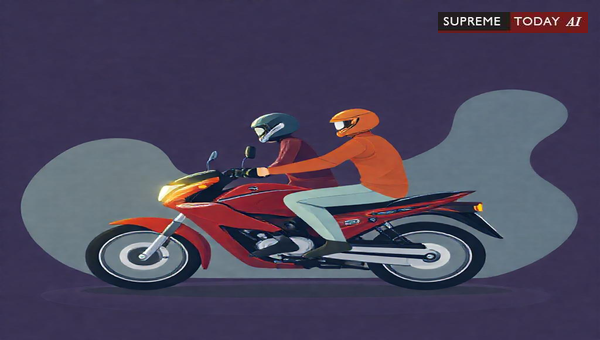
When a Pillion Rider Dies After Falling From a Two-Wheeler, Who Bears the Liability for Compensation?
A recurring and distressing scenario before in India involves a pillion rider who falls off a two-wheeler — sometimes because the rider loses balance, drives rashly, or swerves (guidiness) — and later succumbs to the injuries. The grieving family files a compensation claim, and the central questions become: is the driver of the two-wheeler liable for the death, and can the insurance company be made to pay?
The Driver's Liability for Rash and Negligent Riding
The starting point is well settled: if the accident was caused by the of the two-wheeler rider, the driver — and through the driver, the owner of the vehicle — is liable to compensate the dependents of the deceased pillion rider. Falling off a bike due to guidiness is, in legal terms, typically an allegation that the driver lost control or handled the vehicle negligently. If evidence such as witness testimony, the FIR, or a motor vehicle inspection report establishes that the driver's negligence alone caused the fall, the Tribunal will fix liability on the owner.
Indian courts have repeatedly confirmed this position. In cases where a pillion rider died after the motorcycle rider lost balance or drove negligently, the owner was directed to pay the compensation awarded by the Tribunal 2026 0 Supreme(HP) 215. Where the accident was caused by the two-wheeler driver attempting to overtake vehicles and colliding with an oncoming car, courts have held the two-wheeler's side solely responsible for the entire compensation 2022 0 Supreme(Mad) 478. Similarly, where a rider drove rashly with a pillion rider aboard, lost balance, and the pillion rider fell and died, the negligence was attributed entirely to the rider 2022 0 Supreme(Mad) 754.
Is the Pillion Rider a Under ?
Here is where the law becomes nuanced. The , specifically , governs the scope of compulsory insurance coverage. The and various High Courts have consistently held that:
- A pillion rider on a two-wheeler is not a within the meaning of .
- A pillion rider is treated as a under a statutory (also called a ).
- The insurer's statutory obligation does not extend to the death or bodily injury of the owner or the pillion rider.
In , the held that the liability of the insurance company is not extended to a pillion rider unless the requisite premium for covering his or her risk has been paid, and that a pillion rider is not to be treated as a when the accident results from the rash and negligent riding of the scooter itself 2012 8 Supreme 32. This was reaffirmed in , which drew a clear line between the two policy types: only when the owner takes a by paying extra premium can a pillion rider claim compensation from the insurer 2024 0 Supreme(Mad) 10.
Practical Consequence: Owner Pays, Insurer Usually Escapes
The combined effect of these principles is generally as follows:
- Under an : The insurer is not liable for the pillion rider's death, even where the driver was negligent. The owner must personally satisfy the compensation award. Several appellate decisions have set aside Tribunal awards against insurance companies precisely because a liability-only policy does not cover a pillion rider, who is a 2022 0 Supreme(Mad) 478 and 2025 0 Supreme(Telangana) 1533.
- Under a Comprehensive or : If the owner paid additional premium to cover occupants, the insurer may be liable. Courts have held that a pillion rider, as an occupant of the two-wheeler, is entitled to compensation under a 2025 0 Supreme(Mad) 3731.
- : In some cases involving gratuitous passengers, courts have directed the insurer to first pay the claimants and then recover the amount from the owner. However, the has indicated that this equitable device under is not available to High Courts 2026 0 Supreme(HP) 215.
Can the Pillion Rider Be Blamed for ?
Families defending a claim, and insurers resisting it, often argue that the pillion rider contributed to the accident — for instance, by riding on a bike carrying more than the permitted number of persons in violation of of the Motor Vehicles Act. The case law here cuts both ways:
- The has held that a pillion rider cannot be held vicariously responsible for the driver's negligence; requires a specific inquiry into the injured person's own conduct and cannot simply be inferred from the rider's driving 2007 0 Supreme(MP) 1031.
- The , in , observed that merely riding on a motorcycle carrying more than two persons does not by itself constitute — at most, it makes the pillion rider a party to a violation of law 2026 Supreme(Online)(Raj) 11420.
- However, where overloading has a real with the accident — for example, a motorcycle carrying three pillion riders lost control and hit a lorry — courts have deducted a percentage of compensation for ; in one such case involving four persons on a bike, 25% was deducted 2021 0 Supreme(Mad) 1220.
Insurers also bear the burden of proving with concrete evidence; a statutory violation alone does not establish negligent causation 2019 0 Supreme(Kar) 692.
What Claimants Should Keep in Mind
- Establish through evidence (FIR, charge sheet, eyewitnesses, vehicle inspection) that the fall and death resulted from the driver's rash and negligent handling of the two-wheeler.
- Check the insurance policy type carefully. If it is an Act/, the claim is best pursued against the owner personally; if it is a comprehensive or covering occupants, the insurer can be made directly liable.
- Do not assume the pillion rider's presence on the bike automatically reduces compensation — must be specifically proven with a causal link.
Key Takeaways
When a pillion rider falls off a two-wheeler and dies because of the driver's rash and negligent riding, the driver and owner are liable to compensate the deceased's dependents. The insurance company, however, is generally not liable under a statutory because a pillion rider is not a under — unless a comprehensive or with the requisite additional premium was in force. cannot be presumed from merely being a pillion rider; it requires proof of a causal contribution to the accident. The outcome in any specific case will depend on the evidence and the exact policy terms, so anyone dealing with such a claim may wish to seek advice tailored to their circumstances.
#MotorVehiclesAct #PillionRider #AccidentCompensation #InsuranceLiability #RashDriving









