


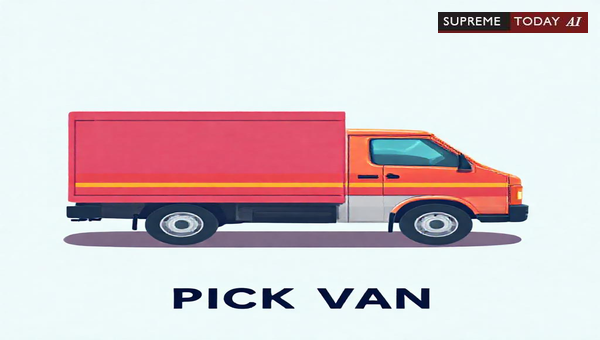
Does a Pickup Van Under 1750 kg Require a Permit in Motor Accident Cases Under the Motor Vehicles Act
A recurring question in motor accident litigation is whether a pickup van registered or used as a , with a weight below 1750 kg, requires a permit to ply on public roads. The answer has significant consequences: the presence or absence of a permit often determines whether the insurance company can be held liable to pay compensation after an accident. This post examines how courts have resolved this issue under the .
The Core Legal Position
A pickup van below 1750 kg would fall within the definition of a under , which covers vehicles with a not exceeding 7,500 kgs. However, whether a permit is required depends not on weight alone, but on how the vehicle is actually being used.
- If the pickup van is used for , it functions as a , and a permit issued by the under of the Act is mandatory.
- If the vehicle is used purely for private purposes without hire or reward, it remains a non-transport , and no such permit is typically required.
The in clarified that a can be a transport or a non-, and the classification depends on actual usage:
Since a vehicle cannot be used as on a public road unless there is a permit issued by the for that purpose, and since in the instant case there is neither a pleading to that effect by any party nor is there any permit on record, the vehicle in question, would remain a . 1999 9 Supreme 478
The same principle was reiterated in a later decision:
Though it could be said to have been designed to be used as a or a , it cannot be so held on account of the contained in of the Act. 2017 0 Supreme(SC) 894 and 2024 8 Supreme 577
In short, mere design capability as a does not make a vehicle a — actual use for hire or reward does.
When the Insurer Must Prove the Permit Requirement
The that a vehicle was a requiring a permit rests squarely on the insurance company. Courts have consistently held that if the insurer neither pleads nor proves that the vehicle was plying as a under a valid permit, the vehicle remains a , and the insurer cannot escape liability on the ground of absence of a permit. 1999 9 Supreme 478 and 2024 8 Supreme 577
This reasoning was extended to delivery vans in another ruling, where the court observed that merely because an auto-rickshaw delivery van was constructed for carriage of goods, it did not cease to be a , and the insurer had failed to prove that a existed under . 2010 0 Supreme(Ori) 69
However, where a pickup van is registered and insured as a goods and the policy accepts commercial use, the permit requirement under (i) has been treated as applicable, and its absence may be questioned.
Santosh Jaiswal vs Harikrishna
2013 0 Supreme(All) 2258Driving Licence Considerations
A related and frequently litigated issue is the class of driving licence required:
- A person holding a valid licence to drive a is authorised to drive a light goods vehicle as well. 2008 1 Supreme 378
UNITED INDIA INSURANCE CO LTD., Vs SMT.BALAWWA W/O MAHAVEER HULAKUND
- But where the vehicle is genuinely used as a with a permit, a licence for a without the appropriate endorsement may not suffice. In one consumer case involving a pickup classified as a light commercial vehicle, the driver's non-transport licence was held ineffective to drive a , and the insurer's repudiation was upheld.
CASA BHAT VS UNITED INDIA INSURANCE CO. LTD.
Insurance Consequences of Misusing a
Permit issues frequently intersect with the carriage of passengers in goods vehicles:
- Goods carriers cannot legally transport passengers beyond permitted limits, and carrying violates both the statute and . 2022 Supreme(Online)(Mad) 52909 and 2020 Supreme(Online)(MAD) 13156 and 2020 Supreme(Online)(MAD) 11487
- Courts have held that the insurer bears no statutory liability to compensate travelling in a goods vehicle in violation of permit and ; liability in such cases is typically fixed on the vehicle owner. 2024 0 Supreme(Mad) 47 and 2020 0 Supreme(Mad) 103
Bajaj Alliance General Insurance Co. Ltd. , Rep. By its Regional Manager VS Ranjani
- Some state rules, such as , impose additional conditions on carriage of persons in goods vehicles. 1982 0 Supreme(Guj) 10
Practical Takeaways
- Private use: A pickup van below 1750 kg used privately is a and generally does not need a transport permit.
- Commercial use: Carrying goods for hire or reward triggers the permit requirement under ; operating without one may attract penalties and complicate insurance claims.
- Litigation strategy: Insurers must prove both the character and the absence of a permit to repudiate a claim; mere registration as a is not conclusive. 1999 9 Supreme 478 and 2010 0 Supreme(Ori) 69
- Driver compliance: Ensure the driver's licence class matches the vehicle's actual usage — licence for private use, and appropriate endorsement for permitted transport use. 2008 1 Supreme 378
CASA BHAT VS UNITED INDIA INSURANCE CO. LTD.
Conclusion
A pickup van below 1750 kg does not automatically require a permit merely because it is built to carry goods. The requirement under arises only when the vehicle is actually used as a for hire or reward. In accident claims, if the insurance company fails to prove that the vehicle was a permitted , courts treat it as a and hold the insurer liable. Owners should nonetheless obtain the necessary permits for any commercial operation to avoid penalties and coverage disputes. This information is general in nature and specific cases may vary depending on facts, state rules, and registration details.
#MotorVehiclesAct #MotorAccidentClaims #PickupVanPermit #TransportVehicle #InsuranceLiability









