Searching Case Laws & Precedent on Legal Query..!
Scanned Judgements…!



Searching Case Laws & Precedent on Legal Query..!
Scanned Judgements…!
Inability to Stop Legal Proceedings Against a Statute - Several sources indicate that legal actions or proceedings cannot be halted solely based on the existence or interpretation of a statute. For example, a case from Varanasi mentions that certain proceedings are pending in court and cannot be stopped ["SHAH ANISH AHMAD Vs State - Allahabad"]. Similarly, in the context of transfers, it is emphasized that transfers are incidents of service and do not confer a right to remain at a specific location; they can only be challenged on grounds such as punitive motive or mala fide intent ["2024 Supreme(Online)(CAT) 132"].
Statutes and Legal Actions Are Usually Not Stoppable Without Proper Grounds - Courts generally require valid reasons such as mala fide conduct or punitive motives to challenge actions related to statutes or administrative decisions. For instance, transfer orders can only be assailed if done mala fide or as punitive measures ["2024 Supreme(Online)(CAT) 132"].
Legal Proceedings and Investigations Continue Despite Challenges - In criminal and investigation contexts, proceedings such as investigations, complaints, or criminal cases against individuals continue unless legally halted on valid grounds. For example, investigations in police stations or criminal cases under sections like 463, 467, 468, etc., are ongoing and not stoppable solely by procedural objections ["SHAH ANISH AHMAD Vs State - Allahabad"], ["2026 Supreme(Online)(Mad) 322"].
Judicial Decisions and Appeals Are Bound by Legal Procedures - Courts may dismiss certain defendants or actions with costs or proceed with cases depending on procedural adherence, but cannot stop the entire legal process based solely on the statute's existence. For example, dismissing defendants with costs or continuing proceedings is within judicial discretion, but stopping the case entirely requires specific legal grounds ["
TAMBIMUTTU v. RATNASINGHAM et al.
"].Statutory Interpretation and Vagueness - Courts examine the words of statutes, not their labels, to determine their applicability or divisibility. Recent statutes are upheld as constitutional if they meet legal standards, and courts do not generally stop enforcement based on perceived vagueness unless constitutional issues are proven ["2024 Supreme(US)(ca9) 42"], ["2024 Supreme(US)(ca2) 223"].
Conclusion - The overarching theme from the sources is that statutes themselves are generally not stoppable or immune from legal proceedings unless specific legal grounds such as mala fide, procedural violations, or constitutional challenges are established. Courts process cases and investigations based on legal merits, not merely on the existence of statutes ["SHAH ANISH AHMAD Vs State - Allahabad"], ["2024 Supreme(Online)(CAT) 132"], ["SHAH ANISH AHMAD Vs State - Allahabad"].
References:- ["SHAH ANISH AHMAD Vs State - Allahabad"]- ["2024 Supreme(Online)(CAT) 132"]- ["SHAH ANISH AHMAD Vs State - Allahabad"]- ["2026 Supreme(Online)(Mad) 322"]- ["
TAMBIMUTTU v. RATNASINGHAM et al.
"]- ["2024 Supreme(US)(ca9) 42"]- ["2024 Supreme(US)(ca2) 223"]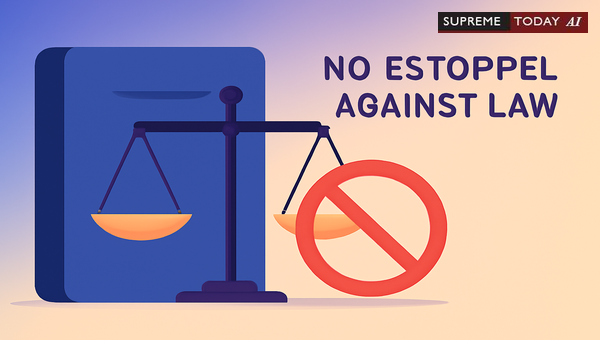
In the complex world of legal disputes, parties often rely on admissions, promises, or prior conduct to bind their opponents. But what happens when those claims clash with clear statutory provisions? A fundamental principle in Indian jurisprudence answers this: there cannot be against a statute. This doctrine ensures that the remains supreme, preventing courts from being swayed by erroneous admissions on points of law.
If you've ever wondered, There Cannot be Against Statute, you're touching on a cornerstone of evidence and procedural law. This blog post delves into the principle, its statutory basis, landmark cases, and real-world applications, drawing from authoritative sources to provide clarity.
is a rule of evidence that generally prevents a party from denying facts they previously admitted or acted upon. However, it has clear limits when statutes are involved. Under , an erroneous admission on a point of law does not bind the court. The court must apply the true view of the law, regardless of conflicting claims by parties. 1997 0 Supreme(Pat) 604
This principle is succinctly captured as: There can be no against law and statute. Courts are not precluded from enforcing statutory provisions even if parties have made inconsistent assertions. 1997 0 Supreme(Pat) 604
As reinforced in precedents, the law must prevail over any admissions. In , the apex court emphasized adherence to statutes irrespective of party claims. 1997 0 Supreme(Pat) 604
Indian courts have consistently applied this doctrine across diverse contexts, from tax disputes to land acquisitions and commercial laws.
In a case involving the , the court held: It is trite that, there cannot be any against Statute. The principle of cannot be invoked to defeat the plain provisions of a Statute. Non-compliance with preconditions like filing under Section 8 could not be waived via , as it went to inherent . 2022 0 Supreme(Ker) 894
Addressing Fair Price Shop vacancies under the , the court ruled: In the first place, there can be against a statute. Legitimate expectations or prior selections could not override mandatory statutory reforms under Sections 3-6 and 12. 2022 0 Supreme(SC) 1415
In income tax matters, the observed: First, there cannot be any against the statute. This applied to adjustments under Section 245, prioritizing statutory powers over equity arguments. 2021 0 Supreme(Guj) 930
was limited similarly in land disputes: It is settled in law that if the statute provides a particular thing to be done there cannot be any against the statute. Citing , courts rejected claims against statutory obligations. 2011 0 Supreme(All) 2120
These rulings illustrate the doctrine's breadth, from civil appeals 2022 0 Supreme(Ker) 894 to 2022 0 Supreme(SC) 1415, ensuring statutes dictate outcomes.
Consider a scenario where one party admits to a fact that contradicts a statute, like waiving a mandatory filing requirement under the MSMED Act. The opposing side cannot invoke to enforce that waiver. The court will prioritize the statute's plain language, such as supplier definitions under Section 2(n) or payment liabilities under Sections 15-16. 2022 0 Supreme(Ker) 894
In criminal contexts, though less directly, procedural statutes like demand strict compliance. cannot excuse non-compliance, as seen in quashing proceedings for lacking reasoned orders. 2018 0 Supreme(Gau) 289
For businesses, this principle protects against informal promises undermining statutory duties, such as in excise or sales tax cases referenced in bail matters. 2024 Supreme(Online)(MP) 16144
In your case, if opposing claims contradict statutes—say, admissions ignoring filing deadlines or statutory preconditions—courts will uphold the law. Highlight relevant provisions early, counter arguments with Evidence Act Section 17, and cite precedents like . 1997 0 Supreme(Pat) 604
Prepare by:- Identifying Statutory Hooks: Pinpoint sections that override admissions.- Gathering Precedents: Use and High Court rulings for persuasion.- Anticipating Defenses: Rebut pleas with quotes like there cannot be any against Statute. 2022 0 Supreme(Ker) 894
This approach strengthens arguments, as courts are obligated to apply statutes irrespective of party conduct.
The doctrine of no against statute safeguards legal certainty, ensuring justice aligns with legislative intent. From Evidence Act foundations 1997 0 Supreme(Pat) 604 to modern applications in MSMED 2022 0 Supreme(Ker) 894, NFSA 2022 0 Supreme(SC) 1415, and beyond, it remains unyielding.
Key Takeaways:- Statutes always trump admissions on law.- is evidentiary, not jurisdictional.- Cite Section 17, Evidence Act, and apex court rulings proactively.- Equity cannot defeat plain statutory duties.
Disclaimer: This post provides general information on Indian legal principles and is not specific legal advice. Consult a qualified lawyer for your circumstances. Laws may evolve, and outcomes depend on facts.
References: 1997 0 Supreme(Pat) 604 2022 0 Supreme(Ker) 894 2022 0 Supreme(SC) 1415 2021 0 Supreme(Guj) 930 2011 0 Supreme(All) 2120 2018 0 Supreme(Gau) 289
#NoEstoppelAgainstStatute, #IndianLaw, #LegalPrinciples


Cannt. ... Cannt. District Varanasi, pending in the court of 6th Additional District Judge, Varanasi within the stipulated period.

New Cannt. ... New Cannt. Prayagraj as yet. Transfer is an incident of service, no right has accrued to an employee to stay at a particular place. Transfer order can be assailed only on the following grounds:- 1. If it has been done by way of punitive measure. 2. If it is mala fide.

Abdul Rahman R/o Village- Shah Toli, Danapur Cannt., P.S.- Danapur, District- Patna. ... ... Petitioner/s Versus The State of Bihar Bihar ... ...

Complaint Case No. 113 of 2010, under sections 463,467,468 and 120-B I.P.C, police station Cannt

PROSECUTRIX VICTIM THROUGH POLICE STATION CANNT. DIST.

It is further submitted that a status report has been received from the Sub Inspector of Police, Police Station GRP CANNT, Varanasi Section, Prayagraj, Uttar Pradesh, wherein it is stated that, upon receipt of the complaint, investigation is in progress and that, despite earnest efforts, the detenu has
under Sections 420, 467, 468, 471, 120-B I.P.C., Police Station Cannt

The action as aganist the other defendants will be dismissed with costs. ... The action will then proceed between the plaintiff and the defendants aganist whom plaintiff chooses to continue the action, but these defendants will be entitled to the costs of the trial date in the Court below and of this appeal in any event. All other costs will abide the result.
5 Considering the facts and circumstances of the case and also the fact that respondent was enlarged on bail vide order dated 16.6.2023 but thereafter another offence under section 49A of Excise Act has been registered aganist him, already nine criminal cases have been found against him, he is
Prayer in AS(MD). 222/ 2019 : To allow this first appeal aganist the decree and judgement passed in O.S.No.81/2013 on the file of the III Additioinal District Judge, Tirunelveli Dated 07.02.2019.

The principle of estoppel cannot be invoked to defeat the plain provisions of a Statute. Where a Statute imposes a duty by a positive action, estoppel cannot prevent it. As regards estoppel by conduct found by the learned District Judge, we are not in a position to endorse. It is trite that, there cannot be any estoppel against Statute.

In the first place, there can be no estoppel against a statute...'

In the last, we may only observe that the writ applicant has raised issues relating to financial hardships. First, there cannot be any estoppel against the statute. We are also not impressed by the submission canvassed on behalf of the Revenue as regards estoppel.

"The provision, prescribed by Section 156 (3) cannt be read in isolation. The decision held in the case of Sakiri Basu (supra) makes it abundantly clear that prior compliance of the provison, prescribed by Section 154 (1) and 154 (3) Cr.P.C. is necessary. The same has to be read along with the provisions prescribed by Section 154 and 155 Cr.P.C. The relevant part of paragraph-110 of the said decision reads as follows :
Mangalam Timber Products Ltd., the apex court while considering the question of promissory estoppel held that it is applicable even in case of unwritten contract. It is settled in law that if the statute provides a particular thing to be done there cannot be any estoppel against the statute. CJ 568; M/s Bhadauria Gram Sewa Sansthan, Fatehpur vs. Assistant Commissioner, Sales Tax, Allahabad Division and others, the said judgment has held that in view of Section 115 of the Evidence Act there cannot be any estoppel against the statute. In (2004) 1 Supreme Court Cases 139; Stat....


An indispensable Tool for Legal Professionals, Endorsed by Various High Court and Judicial Officers
Please visit our Training & Support
Center or Contact Us for assistance

Scan Me!
India’s Legal research and Law Firm App, Download now!


For Daily Legal Updates, Join us on :



 Back to top


