Searching Case Laws & Precedent on Legal Query.....!
Analysing the retrieved Case Laws
Scanned Judgements…!



Searching Case Laws & Precedent on Legal Query.....!
Analysing the retrieved Case Laws
Scanned Judgements…!
Release of Seized Mobile When Principal Object of Crime - The courts generally recognize that when a mobile phone or other material object is the prime instrument or primary evidence of a crime, its release is not necessary or appropriate. The emphasis is on proper preservation and safeguarding of such items to prevent tampering or loss, especially when they are central to the investigation or trial. Authorities must follow procedural safeguards under the Cr.P.C., ensuring that seizure is justified and that the mobile's relevance to the crime is established. For instance, courts have held that mobile phones used as tools or evidence in crimes should not be released merely upon request, particularly when they are integral to the investigation (e.g., case references: 2024 0 Supreme(Kar) 529, 2023 0 Supreme(Ker) 1023).
Seizure Without Lawful Authority and Unrelated Items - Seizure of items like passports, ID cards, or mobile phones without clear legal authority or when they are not connected to the crime is challenged. Courts have emphasized that such seizures should be justified by the relevance to the case; otherwise, they should be released. For example, in Davood S/o Shamsudheen VS State of Kerala - Crimes
Procedural Safeguards and Rights of the Accused/Individuals - The judiciary underscores that procedural fairness requires following due process before seizing or retaining mobile phones, especially when the items are not directly linked to the crime or when the individual is not a suspect or witness. Seizing phones of journalists or individuals not involved in the crime, without proper legal procedures, is deemed unlawful (2023 0 Supreme(Ker) 542, 00500053589). The courts also recognize the importance of protecting individuals' rights against arbitrary seizure.
Seizure of Mobile Phones as Evidence in Conspiracy Cases - When mobile phones are used to establish conspiracy or communication among accused persons, courts have upheld their seizure as lawful and essential for investigation. Verification of subscriber details and technical analysis of communication records support their relevance. The case 2023 0 Supreme(Del) 4267 highlights that not all conspirators need to participate from inception; participation at different stages with a common purpose suffices, and mobile evidence can be critical in establishing conspiracy.
Conclusion - The general legal stance is that mobile phones and similar objects, when central to the crime or investigation, should not be released solely on the grounds of ownership or absence of direct involvement, especially when their retention is justified by their relevance to the case. Seizures must adhere to procedural safeguards, and items unrelated to the crime or seized without lawful authority should be promptly returned. The courts balance investigative needs with individual rights, emphasizing that the primary object of the crime and the role of the seized item determine whether its release is necessary or not.
References:
Davood S/o Shamsudheen VS State of Kerala - Crimes
, 2024 0 Supreme(Ker) 56: Courts' rulings that items like passports and mobile phones not involved in the crime should be released, emphasizing lawful seizure.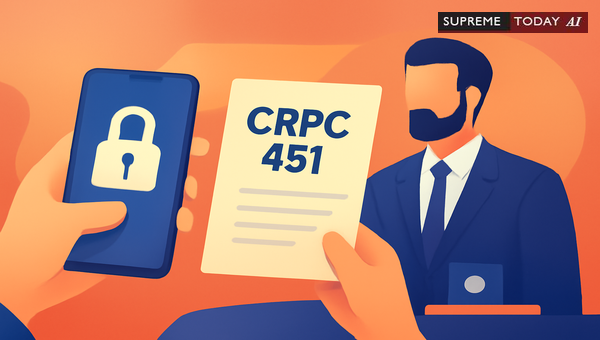
In today's digital age, mobile phones are often at the heart of criminal investigations, storing critical like messages, calls, and media. But what happens when an accused person seeks the release of their seized phone on (bond) under ? A recent ruling by Justice Devan Ramachandran highlights that such release is generally not necessary if the mobile phone is the 2008 0 Supreme(Ori) 1065.
This decision underscores the tension between an accused's property rights and the prosecution's need to preserve evidence. If you're facing a similar situation or curious about legal protections, this post breaks down the ruling, precedents, exceptions, and practical insights. Note: This is general information, not legal advice. Consult a qualified lawyer for your specific case.
The question at the forefront is: Unnecessary Seizure of Mobile Phones Ruling by Justice Devan Ramachandran. In the referenced case, the court rejected a petition for the release of a seized mobile phone, emphasizing its role as crucial evidence 2008 0 Supreme(Ori) 1065. The phone contained potential vital for investigation and trial, making retention essential to prevent jeopardizing the case.
Courts typically hold that releasing a seized mobile phone on bond is not necessary when the device itself is the prime object of the offence. Its retention ensures the integrity of the investigation and trial process 2024 0 Supreme(Jhk) 594. Key reasons include:- The phone as crucial evidence: Tampering risks are high if released prematurely.- admissibility: Under , data from mobiles requires certification, often necessitating the original device 2008 0 Supreme(Ori) 1065.- Balancing rights: Accused property rights must yield to prosecution needs when the device is central to the crime 2024 0 Supreme(Jhk) 594.
When a mobile phone is used for threats, blackmail, or storing offence-related data, courts prioritize its safekeeping. In the primary case, the court noted the phone's potential to hold relevant to the case and the need for further investigation, upholding denial of release 2008 0 Supreme(Ori) 1065.
Similarly, precedents affirm this: the mobile handset and vehicle seized during investigation, which have been used in the commission of the offence, need not be released on bond when the investigation is ongoing, especially when they are the prime objects of the crime 2024 0 Supreme(Jhk) 594. This principle extends to phones integral to the offence, preventing evidence loss.
Mobile data—texts, photos, videos—is admissible only with proper certification under the Evidence Act. Courts stress that in a seized mobile phone are integral and may be needed ongoing 2008 0 Supreme(Ori) 1065. Premature release risks tampering or destruction, compromising justice.
Supporting this, courts issue directions for proper preservation of seized objects before release, whether at crime stage or post-charge sheet: Having said thus, this Court felt the necessity of issuance of general directions insofar as the release of the seized material objects and also for proper preservation of the material objects before its release either at the crime stage or after the charge sheet is filed 2024 0 Supreme(Kar) 529. Directions can require production as needed during proceedings.
and the consistently uphold retention:- In conspiracy cases, mobile evidence proves communication: It is also not necessary that all the conspirators should participate from the inception of conspiracy to its end. If there is unity of object or purpose, all participating at different stages of the crime will be guilty of conspiracy 2023 0 Supreme(Del) 4267.- Stolen phones as material objects: During arrest, a mobile phone was seized under after being identified as stolen 2023 0 Supreme(Ker) 1023.- Tower data links accused: The tower location of the said phone was within the vicinity of scene of offence... mobile in question was seized from the possession of the appellant 2020 0 Supreme(Bom) 295.
These cases reinforce that phones as aren't released lightly 2024 0 Supreme(Jhk) 594.
Accused rights to property are acknowledged but subject to non-interference with probes. Release on may undermine evidence if the device is primary 2024 0 Supreme(Jhk) 594. However, courts protect against overreach:- Unrelated items: Passports or IDs not crime-linked should be returned: Seeking release of his passport, ID card and mobile phone... seizure of the passport... was not at all involved in the crime
Davood S/o Shamsudheen VS State of Kerala - Crimes (2024)
2024 0 Supreme(Ker) 56.- No implication in crime: Phones seized from non-suspects or journalists without basis are unlawful: The grievance of the petitioner is that his mobile phone is seized by the police without implicating him in any crime and he is not a witness also 2023 0 Supreme(Ker) 542.Release isn't always denied:- Post-investigation: If no longer needed, courts may allow with conditions 2024 0 Supreme(Kar) 529.- Data preservation: Forensic copies enable device safekeeping without full release.- Case-specific: Depends on evidence link; unrelated phones returned promptly
Davood S/o Shamsudheen VS State of Kerala - Crimes (2024)
.- Interim custody: Vehicles or non-prime items may be released: rejecting the prayer... to release the mobile... However, the prayer to release the motorcycle.
In heinous crimes, retention persists: the mobile phone of the petitioner... is necessary for conduct of investigation, and also having regard to the heinous nature of the crime 2025 Supreme(Online)(TEL) 5281.
Justice Devan Ramachandran's ruling clarifies: When a mobile phone is the prime object of the offence, its release on is generally not necessary—retention safeguards justice 2008 0 Supreme(Ori) 1065. Courts balance rights via precedents, allowing exceptions for unrelated items or completed probes 2024 0 Supreme(Jhk) 594
Davood S/o Shamsudheen VS State of Kerala - Crimes (2024)
.Digital evidence demands caution; procedural fairness prevents abuse. Stay informed on evolving laws, but always seek professional advice. For more on property releases or evidence rules, explore our legal insights.
#MobileSeizure #CourtRuling #CriminalLawIndia


Having said thus, this Court felt the necessity of issuance of general directions insofar as the release of the seized material objects and also for proper preservation of the material objects before its release either at the crime stage or after the charge sheet is filed or when the properties are deposited ... Wherever necessary direction can also be issued to produce the same as and when required durin....

No. 1260 of 2022 before the Sessions Court, Ernakulam, under section 451 Cr.P.C. seeking release of his passport, ID card and mobile phone, which were all seized by the police at the time of his arrest. ... It was also contended that the seizure of the passport by the second respondent itself was done without authority of law as it was not at all involved in the crime. The articles seized#HL_END....

No. 1260 of 2022 before the Sessions Court, Ernakulam, under section 451 Cr.P.C. seeking release of his passport, ID card and mobile phone, which were all seized by the police at the time of his arrest. ... It was also contended that the seizure of the passport by the second respondent itself was done without authority of law as it was not at all involved in the crime. The articles seized#HL_END....
The grievance of the petitioner is that his mobile phone is seized by the police without implicating him in any crime and he is not a witness also in any criminal case. ... Telecasting every information even if it is hearsay is not journalism. Simply because, the Journalist has got some information about the crime, the mobile phone cannot be seized, wi....

Learned Public Prosecutor submits that since the petitioner has used the mobile handset and the vehicle in commission of the offence hence, the learned Sessions Judge, Bokaro has not committed any illegality in rejecting the prayer for release of the mobile handset and the vehicle. ... Case No. 135 of 2022 by which the learned Sessions Judge, Bokaro rejected the prayer for release of the mobile#....
Hence, the petition is part allowed rejecting the prayer of the petitioner to release the mobile of Gionee Company bearing IMEI No. 8676450205 and its sim of mobile No. 9628877640. However, the prayer to release the motorcycle bearing No. ... order in accordance with law regarding prayer for release of the seized vehicle as an interim custody………... ... U.P. 52 AF 8259 and a mob....

the mobile phone of the petitioner, which was seized in connection with the aforesaid crime, is necessary for conduct of investigation, and also having regard to the heinous nature of the crime, the said mobile phone is necessary to be withheld, otherwise the petitioner may threaten the victim and her ... Though the petitioner claims of the respondents not#HL_....
He was arrested in connection with Crime No.201 of 2009 of Kolathur Police station. In his body search, MO1 mobile phone was found. It was revealed that the said mobile phone was stolen from the house of PW1. Under Ext.P1 Seizure Mahazar, MO1 was seized to which PW2 is a witness. ... PW2 is a witness to Ext.P1 and the seizure of the mobile phone from the possession of the petitioner. He stated regarding t....

He was arrested in connection with Crime No.201 of 2009 of Kolathur Police station. In his body search, MO1 mobile phone was found. It was revealed that the said mobile phone was stolen from the house of PW1. Under Ext.P1 Seizure Mahazar, MO1 was seized to which PW2 is a witness. ... PW2 is a witness to Ext.P1 and the seizure of the mobile phone from the possession of the petitioner. He stated regarding t....

It is also not necessary that all the conspirators should participate from the inception of conspiracy to its end. If there is unity of object or purpose, all participating at different stages of the crime will be guilty of conspiracy." 9. ... The High Court has not given any justifiable reason for not abiding by the aforesaid mandate while ordering the release of the r....

According to him, as per the allegations of the prosecution, a mobile phone of the 2nd accused was seized by the police in another crime and during examination of it some videos of the petitioner and other accused using narcotic substances on different occasions between 26.03.2020 to 25.04.2020 in a Flat namely 'Vista Flat', Edachirakara, Kakkanad were found. The mobile phone was seized and the crime in question was registered.

Taking into consideration the criminal background of the appellant, possibility of commission of further offence by him cannot be ruled out and, therefore, he does not deserve to be released on bail. The mobile used in the commission of the offence is required to be seized. Another offence under Section 135 of the Maharashtra Police Act has been registered vide CR No.3142/2011 with Bhadrakali Nasik city police station and similar offence vide CR No.99/2008 with Sarkarwada Nas....

The tower location of the said phone was within the vicinity of scene of offence at the time of incident. It is also established on record that mobile in question was seized from the possession of the appellant at the time of his arrest. It appears that the holder of the mobile phone was within the vicinity of scene of offence.

However, no attempt was made to lift any incriminating evidence from the spot. Even after the direction by the Mobile Unit of Scene of Crime, the cot was not seized.

Even if that is not possible, the Investigating Officer can give a missed call from the seized mobile to his own mobile number and find out the mobile number of the seized mobile. After doing this, he should record it in the Mahazar truthfully. If the Code number is typed, the mobile number will stand displayed on the screen.


An indispensable Tool for Legal Professionals, Endorsed by Various High Court and Judicial Officers
Please visit our Training & Support
Center or Contact Us for assistance

Scan Me!
India’s Legal research and Law Firm App, Download now!


For Daily Legal Updates, Join us on :



 Back to top


