Searching Case Laws & Precedent on Legal Query.....!
Analysing the retrieved Case Laws
Scanned Judgements…!



Searching Case Laws & Precedent on Legal Query.....!
Analysing the retrieved Case Laws
Scanned Judgements…!
Section 306 of IPC - Insufficient Evidence of Instigation Multiple cases (e.g., Sanju @ Sanjay, 2023 0 Supreme(MP) 644; 2024 0 Supreme(MP) 629; 2023 0 Supreme(Chh) 608) emphasize that mere words like go and die do not automatically constitute instigation under Section 306 IPC. The courts require clear evidence of active instigation or aid, not just the deceased's response or implied intent.["2023 0 Supreme(MP) 644"], ["2024 0 Supreme(MP) 629"], ["2023 0 Supreme(Chh) 608"]
Essential Ingredients for Offense under Section 306 IPC The core requirement is proving that the accused intentionally abetted or instigated the deceased to commit suicide (e.g., 2024 0 Supreme(Ker) 1491, 2024 0 Supreme(Ker) 1484, 2023 0 Supreme(Raj) 349). Courts stress that mere suspicion or trivial acts without clear mens rea or active instigation do not suffice.["2024 0 Supreme(Ker) 1491"], ["2024 0 Supreme(Ker) 1484"], ["2023 0 Supreme(Raj) 349"]
Role of Evidence and Material Courts highlight the importance of concrete evidence, such as direct instigation, active aid, or a clear link between acts and the deceased's suicide. In absence of such evidence, framing charges under Section 306 is improper (e.g., 2025 0 Supreme(Guj) 928, 2023 0 Supreme(Telangana) 997).["2025 0 Supreme(Guj) 928"], ["2023 0 Supreme(Telangana) 997"]
Legal Standards for Framing Charges The courts have repeatedly held that framing a charge under Section 306 IPC requires establishing the accused’s specific intent to instigate or aid suicide, not merely correlational circumstances or emotional distress (e.g., 2022 0 Supreme(MP) 375, 2000 3 Supreme 554).["2022 0 Supreme(MP) 375"], ["2000 3 Supreme 554"]
Discharge and Quashing of Charges When evidence is insufficient to prove instigation or abetment, courts have discharged accused persons or quashed charges under Section 306 (e.g., 2023 0 Supreme(Raj) 349, 2023 0 Supreme(Telangana) 997). The absence of necessary ingredients results in the non-applicability of Section 306.["2023 0 Supreme(Raj) 349"], ["2023 0 Supreme(Telangana) 997"]
Misapplication of Section 306 Many judgments stress that acts like quarrels, demands, or emotional disputes without active instigation do not meet the criteria for Section 306. The courts require a direct link to the accused’s intent to provoke suicide (e.g., 2025 0 Supreme(Guj) 928, 2010 0 Supreme(SC) 1075).["2025 0 Supreme(Guj) 928"], ["2010 0 Supreme(SC) 1075"]
Additional Considerations The presence of other offences like dowry death or Section 498A, while related, do not automatically imply abetment under Section 306 unless the specific ingredients are established. Also, the law does not consider mere emotional distress or family disputes as sufficient for conviction under Section 306.["2000 3 Supreme 554"], ["1994 0 Supreme(SC) 629"]
Conclusion:To successfully prosecute under Section 306 IPC, the prosecution must prove that the accused actively instigated or aided the deceased’s suicide with clear intent. Words or acts that do not demonstrate active instigation or a direct link to the act of suicide are insufficient, and courts tend to discharge or quash charges when these ingredients are not established.
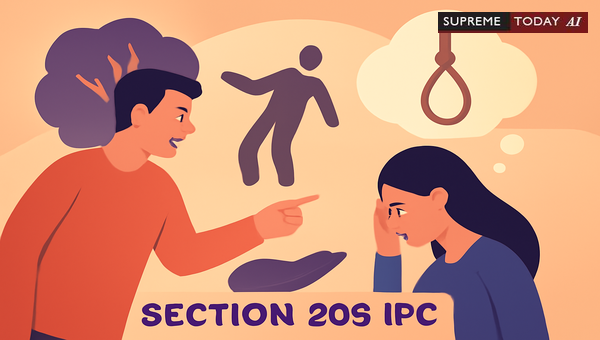
In the realm of criminal law, particularly cases involving suicides, a common question arises: How to Made S.306 of Ipc against of Accused Mare Quarrel is Not Sufficient S.306 Ingredient? Translated more clearly, individuals often wonder if a mere quarrel or verbal altercation between parties is enough to charge or convict someone under Section 306 of the (IPC) for . The short answer is no. have repeatedly held that simple disputes or heated exchanges do not meet the stringent ingredients required for this serious offense. This blog post delves into the legal principles, key judgments, and evidentiary standards that underscore this position, helping you navigate the nuances of such cases.
Note: This article provides general information based on judicial precedents and is not a substitute for professional legal advice. Consult a qualified lawyer for case-specific guidance.
punishes , which falls under the broader definition of abetment in . To establish liability, the prosecution must prove:- : Direct provocation or urging the deceased to commit suicide.- : Positive acts that enable or encourage the act.- : Clear intent on the part of the accused to drive the deceased to suicide. 2023 0 Supreme(Guj) 862
Mere harassment, emotional distress, or routine marital discord does not suffice. As courts emphasize, the intention of the legislature... is clear that in order to convict a person under there has to be a clear to commit the offence. It also requires an active act or direct act which led the deceased to commit suicide. 2024 2 Supreme 737
A quarrel—whether verbal abuse, arguments in the heat of anger, or family disputes—is typically viewed as an emotional outburst rather than deliberate incitement. Courts have consistently ruled that such incidents lack the '' or '' needed for conviction under .
In , the clarified: Without a on the part of the accused to instigate or aid in committing suicide, conviction cannot be sustained. The case highlighted that words spoken in anger during a quarrel do not imply intent to push someone to suicide. 2024 2 Supreme 737
Similarly, stated: Mere harassment without there being any positive action proximate to the time of occurrence on the part of the accused which led or compelled the person to commit suicide, conviction in terms of is not sustainable. 2025 6 Supreme 557
More recently, reinforced: Conviction under is not sustainable on the allegation of harassment without there being any positive action proximate to the time of occurrence on the part of the accused, which led or compelled the person to commit suicide. 2021 0 Supreme(Bom) 533
In , the court reiterated: Mere verbal abuse or quarrel, without proof of or overt act, does not satisfy the ingredients of abetment under . 2023 0 Supreme(MP) 644
These rulings establish that isolated quarrels, even if harsh, do not cross the threshold unless linked to deliberate intent.
Other judgments echo this stance, emphasizing the absence of abetment in scenarios dominated by quarrels or minor disputes.
In a case involving property disputes and alleged remarks by an aunt, the court quashed charges under , noting: Whatever accused petitioner is said to have uttered to her was at best an outburst of an angry mind... it was not designed to instigate her to put an end to her life by committing suicide. The suicide note did not indicate that utterances were the sole or humiliating trigger. 2017 0 Supreme(Raj) 155
Another decision acquitted an accused where the wife's dying declaration did not implicate him in abetment: An offence u/s 306, IPC would stand only if there is an 'abetment' for the commission of the crime. Accordingly... offence u/s 306, IPC is not made out against the appellant/accused. 2012 0 Supreme(Chh) 326
In a matrimonial cruelty case, the court stressed: To convict the appellant/accused under the prosecution is required to prove the basic ingredients of ... mere cruelty or ill-treatment does not necessarily constitute , and the prosecution must establish and instigation. 2009 0 Supreme(Chh) 349
These cases illustrate a pattern: without evidence of (defined as to goad or urge forward -- to provoke, incite, urge or encourage to do an act), no charge under holds. 2007 0 Supreme(MP) 233
It's crucial to differentiate Section 306 () from Section 498A (cruelty by husband or relatives). While quarrels might support 498A claims in marital contexts, they rarely sustain 306 without more. One judgment noted: Separate charges are necessary for distinct offences under Sections 306 and 498A IPC; failure to provide a charge results in a failure of justice. In that live-in relationship case, acquittal under 306 stood, but improper 498A conviction was set aside due to procedural lapses. 2024 0 Supreme(Ker) 1135
While mere quarrels are insufficient, context matters:- Pattern of conduct: Repeated harassment forming a course of may qualify. 2024 2 Supreme 737- Proximate threats or coercion: If a quarrel includes direct threats like go die with intent, coupled with prior behavior, it could establish . 2023 0 Supreme(Guj) 862- Facilitative acts: Providing means for suicide or locking someone in despair elevates it beyond words.
Courts demand clear and convincing evidence of and overt acts, not mere words or emotional outbursts. 2023 0 Supreme(Guj) 862
In summary, a mere quarrel or verbal dispute does not fulfill the ingredients of . Indian jurisprudence prioritizes and over emotional flare-ups. As seen in landmark cases like S.S. Cheena and others, convictions demand more than discord—they require proof of deliberate pushes toward suicide. 2024 2 Supreme 737 2021 0 Supreme(Bom) 533
Understanding these distinctions can prevent misuse of , which carries up to 10 years' imprisonment. If facing such charges or investigating a case, seek expert legal counsel promptly. Stay informed, but remember: laws evolve, and outcomes depend on facts.
References:1. 2024 2 Supreme 737: Requirements for abetment under .2. 2023 0 Supreme(Guj) 862: Definition of abetment under .3. Additional cases: 2017 0 Supreme(Raj) 155, 2012 0 Supreme(Chh) 326, 2009 0 Supreme(Chh) 349, 2024 0 Supreme(Ker) 1135, 2007 0 Supreme(MP) 233.
#IPC306, #AbetmentOfSuicide, #IndianLaw


In the case of Sanju @ Sanjay (supra) the accused allegedly told the deceased "to go and die". Yet Apex Court opined that it does not constitute the ingredient of "instigation". ... In view of the foregoing analysis no offence under Section 306 of the IPC is made out against the petitioner even if the allegations levelled against him are assumed to be true. ... The act of the petitioner,....

In the case of Sanju @ Sanjay (supra) the accused allegedly told the deceased "to go and die" yet Apex Court opined that it does not constitute the ingredient of "instigation". ... State of MP in CRR No.3155/2011 decided on 09.07.2019, held that there is no evidence regarding instigation which is one of the most important ingredient under section 107 of the IPC to constitute the offence under section #HL_....

Reverting to the facts of the present case, in light of principle of law laid down by the Supreme Court in Ramesh Kumar (supra), it is quite vivid that necessary ingredient is not available on record to attract the offence under Section 306 of the IPC. ... It is further submitted that no ingredients has been made out for an offence under section 306 of the IPC and if th....

306 not attracted against applicant No. 2 -- error committed in framing charge u/s. 306/34 of IPC -- set aside. ... -- error committed in framing charge u/s. 306/34 of IPC -- set aside. ... 306 -- in absence of establishing necessary ingredients for attracting S. 306, applicants cannot be compelled to face trial unnecessarily ... The act of applicants ....

Learned counsel for the petitioners submitted that even if the entire prosecution case is admitted, offence under S.306 IPC is not made out in this case. 15. ... In the prosecution under S.306, IPC, much more material is required. The Courts have to be extremely careful as the main person is not available for cross -examination by th....

Learned counsel for the petitioners submitted that even if the entire prosecution case is admitted, offence under S.306 IPC is not made out in this case. 15. ... In the prosecution under S.306, IPC, much more material is required. The Courts have to be extremely careful as the main person is not available for cross - examination by th....

Consequently, they should not have been charged with offence u/s. 306 IPC. I am conscious that even strong suspicion can be the basis to frame charge. In this case, no such circumstance is found. Consequently, the revision petition is allowed and the order of learned Addl. ... They are discharged from the offence under Section 306 IPC. ... (Supra) does not constitute t....

, 306 of IPC and Section 3 (2) (v) of the SC/ST (POA) Act 1989. ... Section 306 of the IPC reads as under: "306. Abetment of suicide.

The case in general terms is not sufficient. (Emphasis supplied.) Here in this case, it is not made clear as to what was the subject of quarrels on the day of the incident, what was the issue, who initiated the quarrel, in what context both were quarrelling, and who was at fault for the quarrel. ... Assuming that the allegations are true, even otherwise, the case under Section ....

of charge under S.306 existed in the case, same would suffice. ... The mere omission on the part of the trial Judge to mention Section 306 IPC with Section 498-A IPC does not preclude the court from convicting the accused for the said offence, when found proved. ... Marriage is sine qua non, to attract an offence punishable under Section 498A of IPC. B....

Thus, in my view, the charge u/s 306 IPC framed against the petitioner is totally groundless and no case is made out, even prima facie, for framing charge against the petitioner u/s 306 IPC.

An offence u/s 306, IPC would stand only if there is an 'abetment' for the commission of the crime. Accordingly, in the present case offence u/s 306, IPC is not made out against the appellant/accused.
8. To convict the appellant/accused under Section 306 IPC the prosecution is required to prove the basic ingredients of Section 306 IPC. Sections 306 and 107 of the Indian Penal Code read as under: "306.

Safidon, a prima facie case under S. 306/34, I. P. C. is made out against the S. H. O., P. S. Safidon is directed to register a case accordingly. from F. S. L. Madhuban and in view of the report earlier submitted by D. S. P.
4. Learned counsel for the applicants submitted that even on accepting all the facts, alleged by the prosecution, as they are, no offence u1s. The necessary ingredient of offence u/s. 306 of IPC is 'abetment'. 107 of IPC are present, which are required for constituting the offence of abetment to commit suicide. According to him, in the absence of material on record, constituting the ingredients of aforesaid offences, no charge u/s. 306 of IPC could be framed against the appli....


An indispensable Tool for Legal Professionals, Endorsed by Various High Court and Judicial Officers
Please visit our Training & Support
Center or Contact Us for assistance

Scan Me!
India’s Legal research and Law Firm App, Download now!


For Daily Legal Updates, Join us on :



 Back to top


