Searching Case Laws & Precedent on Legal Query.....!
Analysing the retrieved Case Laws
Scanned Judgements…!



Searching Case Laws & Precedent on Legal Query.....!
Analysing the retrieved Case Laws
Scanned Judgements…!
BANDA K.A. v. ANGURALA et al.
"], where daughters married in diga transferred property to brothers, and later, their claims for shares were contested or limited.Courts have held that in the absence of a formal partition, the property remains undivided, and siblings, including daughters, may be entitled to share. For example, ["2023 Supreme(Online)(Pat) 4243"] notes that no partition has taken place between the parties, and the daughter claims a 1/5 share as a sister among five siblings.
Share Sharing Among Brothers and Sisters:
Lakshman Sah VS Chandrakala Devi - Current Civil Cases
"] and ["DINGIRI MENIKA et al v. APPUHAMY
"] emphasize that brothers share equally and failing brothers and sisters of the whole-blood, to the brothers and sisters uterine of the half-blood.DINGIRI MENIKA et al v. APPUHAMY
"] which mentions that Sawer expressly prefers males to females.In cases of no partition, siblings, including daughters married in diga, are generally entitled to their share unless they have explicitly renounced or transferred their rights, as seen in ["1987 0 Supreme(AP) 325"] and ["1957 0 Supreme(Ker) 248"].
Impact of Marriage and Diga (Out-of-Family Marriage):
UKKU BANDA et al v. UKKU BANDA
"] notes that married in diga daughters may not be heirs unless they are readmitted into the family.The legal recognition of daughters' rights varies with context; some cases recognize their entitlement to maintenance or a share if no formal partition has occurred, while others restrict their rights based on marriage in diga or prior transfers.
Legal and Court Interpretations:
Analysis and Conclusion:Overall, the sources indicate that daughters, whether married or unmarried, have a statutory right to inheritance in ancestral and joint family property, but this right is often subject to the nature of their marriage (in diga or not), prior transfers, and whether a formal partition has occurred. Married daughters in diga may lose their rights unless they are readmitted or claim through legal proceedings, and their claims are often contested based on prior transfers or partitions. Brothers and sisters of the whole blood generally share equally, with legal provisions favoring male heirs but also recognizing female siblings' rights, especially in undivided property. The legal landscape is nuanced, with court judgments emphasizing the importance of actual partition, participation, and transfer deeds in determining inheritance rights for daughters and sisters.
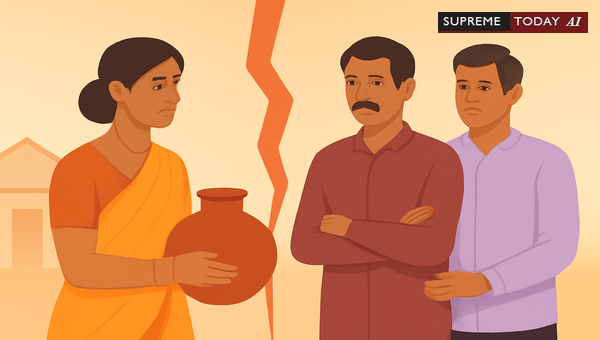
In Indian families, property disputes often arise during partition, especially when it comes to the shares of brothers, sisters, and married daughters. A common query revolves around whether a married daughter can claim a share in ancestral or alongside her brothers and sisters, and how concepts like (woman's personal property) factor in. This blog post delves into the legal framework under the Hindu Succession Act, key judicial precedents, and practical considerations to help you understand these rights.
Important Disclaimer: This article provides general information based on Indian law and case precedents. It is not legal advice. Consult a qualified lawyer for advice specific to your situation, as outcomes depend on facts like marriage dates, property type, and family circumstances.
The phrase captures a frequent concern: Does a married daughter lose her inheritance rights in family partition? Traditionally, under Hindu law, daughters were sometimes seen as 'married out' of the family, limiting their claims to (joint family) property. However, amendments and rulings have evolved this landscape.
Typically, brothers might claim larger shares in ancestral property, while sisters (married or unmarried) and daughters seek equality. —gifts given to a daughter at marriage—remains her absolute property, separate from partition claims. Let's break down the law.
The Hindu Succession Act governs inheritance for Hindus. Two major amendments reshaped daughters' rights:
Married daughters wed before 1985 were often excluded from shares, prioritizing brothers' claims unless specific conditions applied.
Effective , daughters became coparceners by birth with equal rights, irrespective of marriage date or timing of the father's death. This overrode earlier exclusions.
Courts have clarified these rights through landmark cases:
In another case, courts affirmed, Married daughters are entitled to a share in joint family properties, and their marital status does not negate their legal rights to inheritance 2025 0 Supreme(Kar) 336. This reinforces post-2005 equality, dismissing appeals against daughters' shares in tenanted lands under (Paras 12, 16, 28) 2025 0 Supreme(Kar) 336.
However, procedural hurdles persist:- Partition suits require all necessary parties (brothers, sisters); omission leads to dismissal 2022 0 Supreme(AP) 455 2013 0 Supreme(AP) 470.- In succession disputes, full disclosure of heirs (e.g., brothers' sons, sisters' daughters) is mandatory under , to prevent concealment 2010 0 Supreme(P&H) 2336.
Traditional views, like sisters 'married out in diga' excluding them as heirs, have been outdated by codified law
. Modern rulings prioritize statutory equality over customs 2006 0 Supreme(Pat) 400.
In (no will):1. : Sons, daughters, widow—equal shares.2. Property: Post-2005, daughters equal to sons.3. Separate Property: Devolves per succession rules; brothers' sons/daughters next if no direct heirs 2006 0 Supreme(Pat) 400 2010 0 Supreme(P&H) 2336.
Pre-amendment, brothers often dominated joint property. Now, sisters (married) claim equally, as in cases upholding shares despite prior traditions 2025 0 Supreme(Kar) 336.
For validity, assess via G.O.Ms.No.350 conditions, like absence of brothers/sisters or spouse's willingness 2023 0 Supreme(Telangana) 249 2021 0 Supreme(AP) 52.
| Aspect | Pre-2005 Married Daughter | Post-2005/Recent Rulings ||--------|---------------------------|--------------------------|| Share | Generally excluded 1989 0 Supreme(AP) 347 1987 0 Supreme(AP) 246 | Equal to sons 2023 0 Supreme(AP) 846 || Dwelling House | Residence right, limited partition 1993 0 Supreme(AP) 376 | Enhanced claims || Suit Validity | All parties mandatory 2022 0 Supreme(AP) 455 | Same, but stronger daughter rights |
Married daughters may claim shares today, but pre-amendment cases limit them. Evolving jurisprudence favors equality, yet procedures matter.
Final Note: Property laws intersect family dynamics—seek expert guidance. Stay informed on amendments to protect rights.
#HinduSuccessionAct, #DaughtersInheritance, #PropertyPartition


Chandrakala was married in the year 1985 while Indira was married before her. He is on talking terms with the three sons of Ramji Sah. All the three brothers are together and there has not been any talk of partition between him and the brothers. ... Ramji Sah had sold some land of his share. No partition has taken place in his presence. This witness states that he knows about the disputed property since 30-35 years and as no partition has taken place....

The underlying principle is that the forfeiture by a marriage in diga of the rights of the diga married daughter to a share of the inheritance, may be set aside by her readmission into the family ". ... Thus, in 2 D3 executed on March 25, 1912, the two sisters for valuable consideration-transferred a half share in certain paternal lands to one of the brothers, Argurala. ... Similarly by 2 D4, executed on the same day, one of the brothers, Angurala, joined with one of ....
Chandrakala was married in the year 1985 while Indira was married before her. He is on talking terms with the three sons of Ramji Sah. All the three brothers are together and there has not been any talk of partition between him and the brothers. ... Ramji Sah had sold some land of his share. No partition has taken place in his presence. This witness states that he knows about the disputed property since 30-35 years and as no partition has taken place....

' sons' daughters, brothers' daughters' sons, brothers' daughters' daughters, sisters' sons' sons, sisters' sons' daughters, sisters daughters' sons, and sisters' daughters' daughters; (xv) widows of brothers' male issue to the second generation. ... (b) At a partition of joint family property among brothers, their mother, their unmarried sisters and the widows and unmarried daughters of their predeceased undivide....

The learned counsel would contend that there was an earlier division between the brothers in the year 2001 in respect of item Nos.1 and 2. The learned counsel would contend that the sisters are not entitled for any share, since there was a partition in the year 2001 itself. ... The suit is filed for the relief of partition and separate possession by the sisters against the brothers claiming that the suit schedule properties are ancestral and joint family properties of....
brothers, they share equally; failing brothers and sisters of the whole-blood, to the brothers and sisters uterine of the half-blood; and failing them, to the brothers and sisters of the half-blood by the father's side," &c I am not sure that the preference for males over females in succession ... - The learned District Judge has excluded from a share in the inheritance of Punchirala his half-sisters #HL_START....
Therefore, the plaintiff being a daughter, who was admittedly married in 1972, cannot claim any share in those properties. 18. ... Whether the Courts below were justified in granting share to the married daughters in respect of property at Sl. ... He further contended that the plaintiff, being a daughter, is not entitled to a share in the family properties, even pursuant to the amendment to the Hindu Succession Act . ... He was married to one Seetaba....
The standpoint of the two brothers of the Adigar and of their children was that the two sisters were married out in diga, and were not, therefore, heirs of the Adigar, and that the two brothers became solely entitled to the two lands in question and other property of the Adigar in the ... A purchaser from one of the heirs of X instituted a partition action on the footing that only the children of the brothers of X were the heirs of X, and that the sisters of....

F, G, Q R, AG, and IX are partition deeds executed by brothers in which provisions have been made for sisters either by giving them properties or by directing one of the brothers to give them certain amounts. Exts. ... His evidence is clear that although fathers and brothers give properties or, moneys to their daughters and sisters out of natural love and affection the daughters and sisters have no legal right to claim any share or streedhanam as a m....

Thiruvengadatha lyengar, (1915) ILR 38 Mad 556 : (AIR 1914 Mad 226) it has been held - ... "Provision ought to be made at partition not only for the Upanayanam of brothers and marriages of sisters but also for the marriages of brothers who have not been married and such provision ought ... He also contended that three of their sisters having been married by him by borrowing amounts from various sources, the other two brothers have to contribute their....

At the time of death of her father, the petitioner was a minor. They gave consent for the petitioner being given appointment on compassionate grounds. Her other sisters and brothers were married and living separately.

(1) Brothers son, (2) sisters son, (3) brothers daughter, (4) sisters daughter.
The respondents mother and widowed sister had poured kerosene on the appellant with an intention to set ablaze her. But fortunately she escaped and lodged a complaint against the respondent and his family members on 111. The appellant was denied proper food and treatment during the period of her pregnancy. The respondents family members made arrangement to get the respondents sisters daughter married to him.
(1) Brothers son, (2) sisters son, (3) brothers daughter, (4) -sisters daughter.

His sister, Taraba, PW-6 got married to Anirudhsinh, PW-5 and his younger sister Pavanba (deceased) got married in the same village with Harpalsinh, accused No. ( 3 ) THE prosecution case, in nutshell, can be stated as under:the informant - Bharatsinh Keshubhai filed a complaint on 20/12/1993 (Exh. 21) before the PSI of Joravarnagar, at Surendranagar. After giving the details about his status and his brothers and sisters, he has stated that his two sisters are married at village Katuda in Surendranagar District. 1. He brought Pavanba to his village Dhokada six months after ....


An indispensable Tool for Legal Professionals, Endorsed by Various High Court and Judicial Officers
Please visit our Training & Support
Center or Contact Us for assistance

Scan Me!
India’s Legal research and Law Firm App, Download now!


For Daily Legal Updates, Join us on :



 Back to top


