


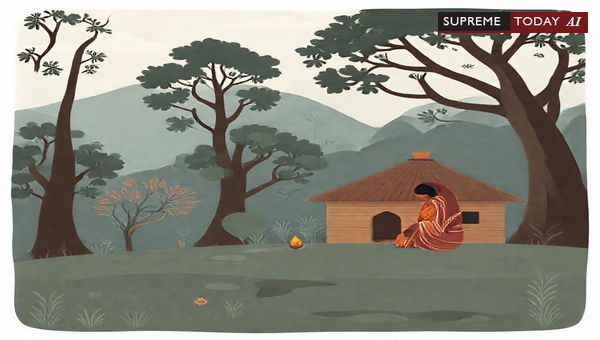
Married Daughter's Right to a Share in Father's in Scheduled Tribe Communities
One of the most frequently contested questions in Indian succession litigation is whether a married daughter belonging to a Scheduled Tribe community can claim a share in her father's . Families often argue that tribal custom bars daughters—especially married daughters—from inheriting, while daughters increasingly assert equal rights grounded in constitutional equality and modern succession principles. The answer depends on three key factors: the applicability of the , the proof of tribal custom, and the degree to which the community has been Hinduised.
The Starting Point: Section 2(2) Exclusion for Scheduled Tribes
Under , the Act does not apply to members of any Scheduled Tribe unless the Central Government notifies otherwise. This means succession within tribal communities is generally governed by their own rather than the statute.
Courts have consistently reaffirmed this position. In one matter involving the Sawara tribe, the Supreme Court confirmed that the Hindu Succession Act cannot apply to Scheduled Tribes unless notification under the Constitution permits it, and that such parties are instead governed by principles of 2025 2 Supreme 617. Similarly, where succession opened before the Act came into force, the Court held that so long as Section 2(2) stands unamended, parties remain governed by its exclusion 2023 1 Supreme 652.
However, the same judgment contained a powerful observation: When the daughter belonging to the non-tribal is entitled to the equal share in the property of the father, there is no reason to deny such right to the daughter of the Tribal community2023 1 Supreme 652. The Court urged the Central Government to reconsider the exemption in light of the guaranteed under .
The
The single most important principle emerging from case law is this: the party asserting that a custom excludes married daughters must prove it. There is no presumption that tribal custom bars female heirs.
In a dispute involving the Uraon community, daughters sought declaration of title to their father's property, while the defendants claimed that married daughters do not inherit under Uraon custom. Both lower courts dismissed the suit on this basis—but the higher court reversed, holding that the evidence was so sketchy and scanty to establish any custom excluding daughters in all circumstances
CHUIYYA VS MANGARI BAI - Madhya Pradesh (1999)
. The plaintiffs were granted a 1/4 share in the inherited property 2021 Supreme(Online)(Chh) 2740.For a custom to prevail, it must be shown to be:
- Ancient – established through long, continuous usage
- Certain – clearly defined and consistent
- Reasonable – not opposed to public policy or basic justice
- Proven by clear and unambiguous evidence – mere admissions or assumptions are insufficient 2021 Supreme(Online)(Chh) 2740
As one court put it, in derogation of general law must be proved by the party asserting it, and in tribal communities there is no inherent presumption that custom excludes female heirs 2025 Supreme(Online)(Chh) 18161.
When the Hindu Succession Act Does Apply: The Hinduisation Route
Even within a Scheduled Tribe, the Act may apply if the family or community has sufficiently adopted Hindu customs. Courts have held that members of a Scheduled Tribe can be governed by the Hindu Succession Act where they have become 2024 0 Supreme(Jhk) 181.
Once the Act applies, the fundamentally transforms a daughter's position:
- A daughter is a from birth, with rights equal to those of a son
- Marriage is irrelevant—Daughters possess the right of inheritance from birth, so it does not matter whether she is married or not, she will be entitled to an equal share2024 0 Supreme(Telangana) 204
- Whether the father was alive on the September 9, 2005 cut-off date does not matter so long as the daughter is alive post-2005 2024 0 Supreme(Telangana) 204
The 2005 Amendment also protects daughters against opportunistic defences. An alleged oral partition or family arrangement cannot defeat her claim unless actually proven, and providing dowry does not extinguish her inheritance rights—even if it is assumed that some dowry was provided to the daughters, that does not mean that the daughters cease to have any right in the family property 2024 0 Supreme(Telangana) 204.
Not All Custom Claims Fail: The Bhil Tribe Precedent
The outcome is not uniform, which is why proving or disproving custom is decisive. In a matter involving the Bhil caste, the courts found the prevailing custom to be that married daughters do not receive a share in their father's property unless their husbands live as (resident sons-in-law). The custom was accepted as proven, and the suit by married daughters was dismissed 2010 0 Supreme(MP) 471.
By contrast, official records of custom () can work in a daughter's favour. Where such a record showed that daughters married to near relations succeed to property, the court treated it as strong evidence and shifted the burden onto the challengers to rebut it 1916 0 Supreme(SC) 92. Notably, courts have also construed broad entries in customary manuals excluding married daughters as applying only to —for self-acquired property, daughters generally exclude even remote collaterals 1940 0 Supreme(SC) 50.
Constitutional Equality as the Backdrop
A recurring judicial theme is that denying tribal women equal succession rights sits uneasily with the Constitution. In the Muria tribe dispute, the court emphasized that female tribal heirs are entitled to parity with male members in , and that denying equal rights to tribal daughters is inconsistent with constitutional principles of equality 2025 Supreme(Online)(Chh) 18161. Another ruling noted that mere non-issuance of a notification cannot be used to deprive Scheduled Tribe women of their right to an equal share in family property 2023 0 Supreme(Mad) 959.
Key Takeaways
- Default position: Scheduled Tribes are excluded from the under Section 2(2), so nominally governs succession.
- No automatic exclusion: A married daughter cannot be denied inheritance merely by asserting tribal custom—the custom must be ancient, certain, reasonable, and proven with clear evidence
CHUIYYA VS MANGARI BAI - Madhya Pradesh (1999)
. - Hinduisation opens the statute: If the family has sufficiently adopted Hindu customs, the Act applies, and the 2005 Amendment gives the daughter equal coparcenary rights regardless of marriage 2024 0 Supreme(Jhk) 181 and 2024 0 Supreme(Telangana) 204.
- Burden allocation is decisive: The party claiming exclusion bears the burden; failure of proof means the daughter inherits 2025 Supreme(Online)(Chh) 18161 and 2021 Supreme(Online)(Chh) 2740.
- Custom can succeed when proven: As the Bhil cases show, a validly established custom permitting exclusion may still defeat the daughter's claim 2010 0 Supreme(MP) 471.
In practice, whether a married daughter of a Scheduled Tribe succeeds typically turns on evidence—pleadings, testimony, and customary records—rather than on any blanket rule. Anyone facing such a dispute may wish to consult a qualified advocate familiar with tribal succession law in the relevant state, since outcomes vary with the facts and the specific community's proven customs.
#WomensInheritanceRights #ScheduledTribes #HinduSuccessionAct #CustomaryLaw #DaughtersRights









