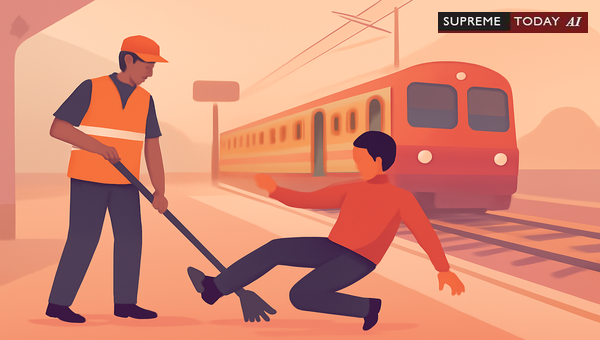
- Duty of Railway to Clean Platforms and Responsibility for Injuries - Main points and insights:
- The railway's obligation to maintain clean and safe platforms is implied but not explicitly detailed in the provided documents. However, the general principle is that railway authorities are responsible for ensuring passenger safety, including platform conditions ["2024 Supreme(Online)(RCT) 1037"].
- Several cases emphasize that the railway administration is liable for untoward incidents occurring on the premises, especially when negligence in maintenance or safety measures is established. For example, in cases where accidents happen due to unsafe conditions at unmanned level crossings, the railway can be held responsible if negligence is proved ["2023 Supreme(Online)(RCT) 554"], ["INDRCT00000055436"].
- The responsibility extends to areas within the station that are accessible to passengers, such as platforms, foot over-bridges, lifts, and escalators. If an incident occurs due to failure to maintain these areas or due to negligence, the railway can be held liable ["2025 Supreme(Online)(RCT) 4"].
- The courts have held that the railway's responsibility is particularly significant when accidents occur due to defective infrastructure or unsafe platform conditions, and negligence or failure to take adequate safety precautions can lead to liability ["2023 Supreme(Online)(RCT) 1008"].
- In cases involving injuries or death, the railway's liability is often determined under Section 124A of the Railways Act, 1989, which states that the railway administration is responsible for untoward incidents in the course of working, regardless of wrongful act or default, unless it can be proven that the incident was due to external factors or the victim's own negligence ["2023 Supreme(Online)(RCT) 554"], ["2025 Supreme(Online)(RCT) 1280"].
- The responsibility does not extend to incidents caused by external factors or when the injured or deceased was not in a designated or accessible area, or if the incident resulted from the victim's own negligence (e.g., crossing tracks improperly) ["2024 Supreme(Online)(RCT) 1037"], ["2023 Supreme(Online)(RCT) 554"].
The courts also recognize that safety measures, such as unmanned level crossings, require strict adherence to rules like Section 131 of the Motor Vehicle Act, which mandates drivers to stop at unguarded crossings to prevent accidents ["2023 Supreme(Online)(RCT) 554"].
Analysis and Conclusion:
- The railway department has a duty to ensure platform cleanliness and safety, and failure to do so can result in liability if an injury occurs due to unsafe platform conditions.
- The liability to clean platforms and prevent injuries is supported by legal principles that hold railway authorities responsible for maintaining safe environments, especially where negligence or unsafe conditions are proven.
- However, liability is also contingent upon establishing negligence or breach of duty; incidents caused solely by passenger negligence or external factors may exempt the railway from liability.
- In cases where injuries occur due to the railway's negligence—such as unsafe platform conditions, unmanned crossings, or defective infrastructure—the railway can be held responsible for damages and compensation ["2024 Supreme(Online)(RCT) 1037"], ["2023 Supreme(Online)(RCT) 1008"], ["2023 Supreme(Online)(RCT) 554"].
- Overall, the legal framework underscores the railway's obligation to maintain safety and cleanliness of platforms and to prevent untoward incidents, with liability arising primarily from negligence or failure to uphold safety standards.
References:- ["2024 Supreme(Online)(RCT) 1037"]- ["2023 Supreme(Online)(RCT) 1008"]- ["2023 Supreme(Online)(RCT) 554"]- ["2025 Supreme(Online)(RCT) 4"]- ["2025 Supreme(Online)(RCT) 1280"]