Searching Case Laws & Precedent on Legal Query.....!
Analysing the retrieved Case Laws
Scanned Judgements…!



Searching Case Laws & Precedent on Legal Query.....!
Analysing the retrieved Case Laws
Scanned Judgements…!
Mining Prohibition Within One Kilometer of Protected Areas - The courts have consistently held that mining activities are prohibited within a radius of one kilometer from the boundary of Protected Areas such as National Parks and Wildlife Sanctuaries. Even if the Ecological Sensitive Zone (ESZ) extends beyond this distance, the ban applies if the proposed mining falls within the ESZ. Conversely, if the ESZ is less than one kilometer, the ban extends up to one kilometer from the protected area's boundary. This clarification was issued in recent court directions, emphasizing that mining within this buffer zone is generally prohibited, with specific references to cases in Goa and general principles applicable elsewhere ["2023 0 Supreme(SC) 752"], ["2023 0 Supreme(SC) 756"], ["2023 0 Supreme(SC) 749"].
Specific Cases of Mining Near Wildlife Sanctuaries and Forests - Several instances highlight proposed or permitted mining activities within one kilometer of wildlife sanctuaries and reserve forests. For example, permits issued for stone quarries near Kuldhia Wildlife Sanctuary and Tenda Reserve Forest are contested on grounds that they lie within the one-kilometer buffer zone, which is considered unlawful under existing guidelines ["2024 Supreme(Online)(NGT) 1977"], ["2023 Supreme(Online)(NGT) 5052"], ["2024 Supreme(Online)(NGT) 458"].
Regulatory Guidelines and Legal Restrictions - Government orders, such as G.O.Ms.No.295, explicitly prohibit quarrying or mining within one kilometer of Reserve Forests, with violations occurring when activities are proposed or initiated within this zone. Additionally, pollution control guidelines specify that a safe distance of one kilometer should be maintained between crusher units and human habitations to prevent environmental and health hazards ["2023 0 Supreme(Mad) 3"].
Implications for Habitation and Environmental Conservation - The main insight is that habitation and mining activities are regulated to prevent environmental degradation and protect wildlife. The legal framework emphasizes a buffer zone of at least one kilometer around protected areas and forests, with violations subject to legal scrutiny and potential cancellation of permits ["2024 Supreme(Online)(TS) 17826"], ["2024 Supreme(Online)(TEL) 18784"].
Analysis and Conclusion:The consistent legal stance across multiple sources confirms that mining activities are generally restricted within one kilometer of protected areas, wildlife sanctuaries, and reserve forests. This buffer zone aims to conserve ecological integrity, prevent habitat disturbance, and ensure environmental safety. Any proposed mining within this zone is subject to legal challenges and regulatory restrictions, emphasizing strict adherence to environmental guidelines and court directives.
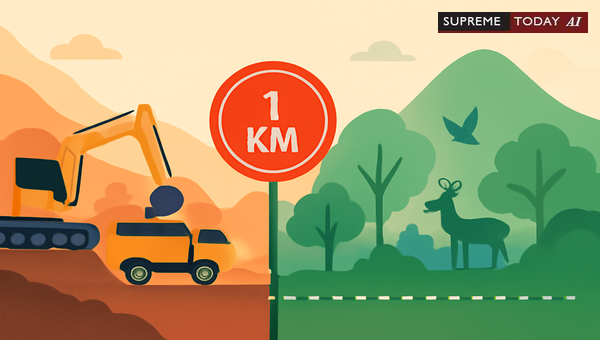
In India's rapidly developing landscape, mining activities play a crucial role in economic growth. However, they often clash with environmental conservation and human safety concerns, especially near human habitations. The pressing legal question arises: What is the impact of mining in human habitations? Particularly, can mining operations legally occur within one kilometer of villages, towns, or protected areas like national parks and wildlife sanctuaries?
Indian courts, particularly the , have addressed this through landmark orders emphasizing a . This blog post delves into the judicial stance, key principles, and practical implications, drawing from authoritative court documents. Note that this is general information based on precedents and not specific legal advice—consult a qualified lawyer for your situation.
Under Indian jurisprudence, mining activities within one kilometer of habitations or protected areas face strict restrictions. Courts have consistently upheld a safety zone of at least 1 km from the boundaries of National Parks, Wildlife Sanctuaries, or habitations to safeguard environmental integrity and human health. Mining within this zone is typically prohibited unless explicitly permitted by law or specific judicial orders. 2013 0 Supreme(SC) 552 2024 0 Supreme(Kar) 287 2015 0 Supreme(J&K) 414
This principle stems from the recognition that proximity poses risks like dust pollution, noise, habitat disruption, and threats to wildlife corridors—such as elephant paths. For instance, in cases involving quarries near forests, courts have noted violations when sites are within 1 km of reserves. 2024 Supreme(Online)(NGT) 5368
These points underscore a , prioritizing habitation safety over resource extraction.
The has explicitly established a 1 km safety zone in multiple rulings. For example, the order stated that no mining should be permitted within 1 km of protected areas. 2024 0 Supreme(Kar) 287 The order added nuance: while no absolute ban exists beyond 1 km up to 10 km, activities within the inner zone demand rigorous oversight by bodies like the . 2024 0 Supreme(Kar) 287 2015 0 Supreme(J&K) 414
In , the Court emphasized habitat protection, noting risks near sanctuaries. 2013 0 Supreme(SC) 552
Key statutes reinforce these judicial directives:- : Requires prior clearance for mining near sensitive zones. 2013 0 Supreme(SC) 552 2015 0 Supreme(J&K) 414- : Prohibits disturbances to sanctuaries, including those within 1 km. 2024 0 Supreme(Kar) 287
Courts have linked this to , holding that environmental protection is a . Polluting activities near habitations violate this without clearances. 2015 0 Supreme(J&K) 414
Related judgments highlight the 1 km threshold's application:
In a quarry proposal case, the Tenda Reserve Forest and Kuldhia Wildlife Sanctuary were within 1 km of the site, on an elephant path, raising safety alarms near habitations. The nearest authorized human habitation was also perilously close. 2024 Supreme(Online)(NGT) 5368
A over mining near bridges clarified compliance: activities within 1 km upstream/downstream were halted, but leases weren't automatically canceled absent willful disobedience. This shows enforcement focuses on cessation within zones, not blanket revocations. 2021 0 Supreme(UK) 294
Other cases, though not directly on mining, define habitations stringently—e.g., requiring separation of at least 1 km from other settlements and populations over 300 for certain eligibilities, illustrating judicial consistency on distance metrics. 2018 0 Supreme(J&K) 495 2018 0 Supreme(J&K) 615 2018 0 Supreme(J&K) 129 2017 0 Supreme(J&K) 1017
These examples demonstrate courts' holistic view: 1 km serves as a practical, protective benchmark across contexts.
While 10 km zones may allow mining post-assessment, the 1 km core remains sacrosanct absent explicit approval. 2015 7 Supreme 257 2025 0 Supreme(All) 33
To navigate these rules:- Maintain Buffers: Ensure at least 1 km separation from habitations/protected areas in proposals. 2013 0 Supreme(SC) 552- Secure Clearances: Obtain environmental and wildlife approvals before operations. 2024 0 Supreme(Kar) 287- Enforce Vigilance: Authorities must monitor and halt violations; miners should conduct site audits. 2015 0 Supreme(J&K) 414- Community Engagement: Involve locals early to address habitation impacts.
Indian courts have firmly established that mining within 1 km of human habitations or protected areas is generally unlawful without special permissions, prioritizing ecological and human safety. This 1 km safety zone, rooted in orders like those from 2006, reflects a balance between development and sustainability. 2013 0 Supreme(SC) 552 2024 0 Supreme(Kar) 287 2015 0 Supreme(J&K) 414
Key Takeaways:- Prohibited unless cleared.- Ties to fundamental rights and statutes.- Enforcement via judicial oversight.
Stay compliant to avoid penalties—mining's future lies in responsible practices. For tailored advice, reach out to legal experts.


Learned senior counsel submits that this Court has clearly held that mining within a distance of one kilometer from the boundary of the Protected Area is banned. ... We clarify that even if in a particular case, the ESZ is more than one kilometer, still, if the concerned area where mining is proposed falls within the ESZ, the mining a....

Learned senior counsel submits that this Court has clearly held that mining within a distance of one kilometer from the boundary of the Protected Area is banned. ... We clarify that even if in a particular case, the ESZ is more than one kilometer, still, if the concerned area where mining is proposed falls within the ESZ, the mining a....

Learned senior counsel submits that this Court has clearly held that mining within a distance of one kilometer from the boundary of the Protected Area is banned. ... We clarify that even if in a particular case, the ESZ is more than one kilometer, still, if the concerned area where mining is proposed falls within the ESZ, the mining a....

It is also stated that the Tenda Reserve Forest is situate within one kilometer of the proposed stone quarry and the Kuldhia Wildlife Sanctuary is also located within one-kilometer radius of the proposed Quarry which is on the elephant path. 9. ... Ltd; the nearest authorized human habitation (house of one Smt. ... The allegation of the Applicant in th....
It is also stated that the Tenda Reserve Forest is situate within one kilometer of the proposed stone quarry and the Kuldhia Wildlife Sanctuary is also located within one-kilometer radius of the proposed Quarry which is on the elephant path. 9. ... Ltd; the nearest authorized human habitation (house of one Smt. ... The allegation of the Applicant in th....
It is also stated that the Tenda Reserve Forest is situate within one kilometer of the proposed stone quarry and the Kuldhia Wildlife Sanctuary is also located within one-kilometer radius of the proposed Quarry which is on the elephant path. 9. ... Ltd; the nearest authorized human habitation (house of one Smt. ... The allegation of the Applicant in th....

It is also stated that the Tenda Reserve Forest is situate within one kilometer of the proposed stone quarry and the Kuldhia Wildlife Sanctuary is also located within one-kilometer radius of the proposed Quarry which is on the elephant path. 9. ... Ltd; the nearest authorized human habitation (house of one Smt. ... The allegation of the Applicant in th....

It was also stated that according to G.O.Ms.No.295 Industries (MMC.1) Department dated 03.11.2021, no quarrying or mining or crushing activities shall be carried out within one kilometer radial distance from Reserve Forest. 27. ... As a matter of fact, G.O.Ms.No. 295 Industries (MMC.1) Department dated 03.11.2021 prohibits quarrying activities within one kilometer radia....

The grievance of the petitioners is that the said permission granted by respondent No.3 in favour of respondent No.9 is contrary to the guidelines issued by the Pollution Control Board in the year 1997, according to which one kilometer is the safe distance between the crusher unit and human habitation ... lease on the adjacent lands of the petitioners within a period of three (03) weeks from the date of receipt of a copy o....
The grievance of the petitioners is that the said permission granted by respondent No.3 in favour of respondent No.9 is contrary to the guidelines issued by the Pollution Control Board in the year 1997, according to which one kilometer is the safe distance between the crusher unit and human habitation ... lease on the adjacent lands of the petitioners within a period of three (03) weeks from the date of receipt of a copy o....

It is not the case of the petitioner that mining activity was undertaken within one kilometer from any bridge. The direction nowhere provide for cancellation of mining lease.

The distance of the nearest habitation from habitation Kunah is less than one kilometer and the two habitations Kunah and Noor are separated by a natural boundary i.e. That being so, after examining the facts of the instant case, we find that habitation Kunah where the school in question is situated is known as a village i.e it has name and identify different from the revenue village which is ‘Kewa’. Nallah Both the habitations have their own Government schools sanctioned by ....

The distance of the nearest habitation from habitation Kunah is less than one kilometer and the two habitations Kunah and Noor are separated by a natural boundary i.e. That being so, after examining the facts of the instant case, we find that habitation Kunah where the school in question is situated is known as a village i.e it has name and identify different from the revenue village which is ‘Kewa’. Nallah Both the habitations have their own Government schools sanctioned by ....

The habitation should be atleast one kilometer away from other habitation. (iv) The habitation should have a population of more than 300 souls.
iv. The population of the habitation concerned is more than 300 persons. The habitation where the school in question is situated is away from the nearest habitation by atleast a distance of one kilometer; and


An indispensable Tool for Legal Professionals, Endorsed by Various High Court and Judicial Officers
Please visit our Training & Support
Center or Contact Us for assistance

Scan Me!
India’s Legal research and Law Firm App, Download now!


For Daily Legal Updates, Join us on :



 Back to top


