


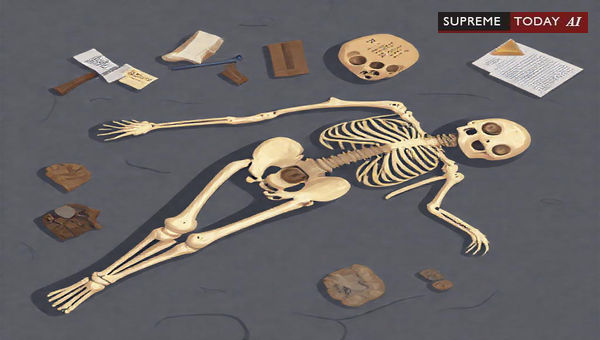
When Police Find a Four-Month-Old Body on a Missing Woman's Property, How Is Identity Legally Established?
A recurring and difficult scenario in Indian criminal trials involves a murder investigation where the police recover a decomposed or skeletal body from the premises of a lady who has herself absconded. The corpse is approximately four months old at excavation, its features are no longer recognizable, and yet the investigating agency concludes that the remains must be those of the missing woman. The question that naturally arises is: what is the legality of such a police conclusion, and is there any scientific or legal method to identify a body so long after death?
The Core Legal Problem: Presumption Versus Proof of Identity
The police conclusion that an unidentified, four-month-old body belongs to a specific absconding lady is, by itself, legally fragile. In criminal jurisprudence, identity of the deceased is a foundational fact. Where the body is skeletalized, visual recognition is impossible, and the prosecution must establish identity through independent forensic or circumstantial means. Courts have repeatedly held that a conviction resting on conjecture or surmise about the identity of remains cannot stand — when no expert was examined to establish that identification was forensically possible, the conviction has been held unsustainable 2007 8 Supreme 568.
Is Identification Possible After Four Months?
Yes — though the available methods narrow considerably with time. After roughly four months, a body will ordinarily be fully skeletal; as the courts have observed, by no norms would a dead body skeletalize within three to four days, as the process ordinarily takes at least a few weeks 2007 8 Supreme 568. The viable identification avenues include:
- of the skull with photographs of the missing person. This method has been judicially accepted: in one case, the identity of a deceased girl was established by a superimposition report of the FSL, where the Assistant Director certified that the skull could have belonged to the person in the photograph, even though the remains were recovered two months after the murder 2003 5 Supreme 202.
- Dental record comparison, where ante-mortem dental charts of the missing woman exist.
- DNA profiling from skeletal remains, though this is technically uncertain at four months, since amplified DNA cannot always be extracted from long bones and skull bones.
- Clothing, ornaments, and personal effects recovered with or near the remains. Courts have accepted identification through clothing even when DNA reports could not be generated — putrefied bodies were identified by witnesses by virtue of their clothes 2024 0 Supreme(AP) 994, and in another case a body recovered from a pond after a month was identified solely from the clothes worn by the corpse 2007 6 Supreme 164.
- Identification by family members through an inquest photograph, which has been accepted even for highly decomposed bodies 1991 0 Supreme(SC) 286.
Without a Positively Identified Body
A critical doctrinal point is that discovery of the dead body bearing physical evidence of violence has never been considered the only mode of proving the in murder. Very many cases are of such a nature where discovery of the dead body is impossible 2013 1 Supreme 409. In a trial for murder, it is not an absolute necessity or essential ingredient to establish ; the fact of death must simply be established like any other fact 1991 0 Supreme(SC) 286.
This means that even if the four-month-old remains cannot be conclusively linked to the absconding lady, the prosecution may still prove her death through a complete chain of . However, that chain must be unerring — must form a complete chain that unerringly points to the guilt of the accused, and 2024 0 Supreme(Ori) 376.
The Presumption Where the Body Is Found on the Premises
The fact that the remains were excavated from the house premises of the absconding lady is significant. Where a dead body is recovered from within a house and cannot be identified through DNA or other forensic means, courts may raise a — where the occupants alone could tell whose dead body it was, their failure to do so would entitle the Court to raise a presumption that the dead body was that of the deceased 2016 0 Supreme(Del) 1785. The circumstance, combined with exclusive possession of the premises and recovery of the victim's belongings, has historically supported conviction — as in a case where the deceased was seen with the accused in his house, the accused alone had exclusive possession, and her belongings were found there
Narain Rao Jamdar VS State
.But these circumstances operate as links in a chain, not as conclusive proof. Where vital links are missing — for instance, where the prosecution failed to establish that seized wearing apparels were actually those of the deceased, or where the doctor gave no basis for the opinion on time since death — convictions have been set aside despite the gravity of the crime, because suspicion, however grave, cannot substitute for proof
Maxi @ Maximus Soreng VS State of Odisha
.Risks of Delayed and Weak Identification
Timing and diligence matter enormously. Delay in identification raises suspicion unless satisfactorily explained — a five-month gap in holding an identification proceeding has led courts to hold the identification evidence unreliable and acquit the accused 1989 0 Supreme(All) 211. Similarly, where the prosecution failed to establish both the identity of the deceased and the cause of death, the conviction could not be sustained despite a burnt body being recovered 2024 0 Supreme(Telangana) 1241. Conversely, where the accused himself disclosed the burial spot and the body was dug up on his instance, with medical evidence establishing strangulation and the deceased's articles recovered on his instruction, the conviction was rightly sustained 2018 0 Supreme(MP) 416.
Practical Path Forward in This Scenario
- For the prosecution: Preserve the skeletal remains, obtain an report against available photographs of the missing lady, attempt DNA extraction, document every personal effect recovered at the scene, and secure testimony from relatives who can identify clothing or ornaments.
- For the defence: Challenge the absence of positive identification, test the FSL evidence rigorously, and point to gaps in the chain — the must go to the accused if identity remains unproven 2007 8 Supreme 568.
- Procedurally, an unidentified body should trigger an inquest under , with photographs, post-mortem, and transmission of details to the and public databases so missing-person records can be matched 2018 0 Supreme(Mad) 3874.
Key Takeaways
A four-month-old body found on the premises of an absconding lady can, in principle, be identified through , dental records, personal effects, or — less reliably — DNA from bones. If identification fails, the case does not automatically collapse, because may be proved circumstantially, and a presumption may arise against those in occupation of the premises where the body was found. But any conviction ultimately depends on a complete, unbroken chain of circumstances establishing identity and guilt . Outcomes in individual cases vary with the quality of forensic and testimonial evidence, and the above reflects general legal principles rather than advice on any specific case.
#MurderTrial #ForensicEvidence #CorpusDelicti #CriminalLaw #IndianPenalCode












