Searching Case Laws & Precedent on Legal Query!
Scanned Judgements…!



Searching Case Laws & Precedent on Legal Query!
Scanned Judgements…!
Suspension as a Non-Punitive Tool - Globally, suspension is recognized as an administrative measure, not a punishment, aimed at protecting public interest and maintaining discipline, not penalizing employees. It is a temporary, interim measure, not a penalty, though prolonged suspension can have punitive effects such as stigma, loss of income, and career stagnation ["2025 0 Supreme(Raj) 1637"], ["2025 0 Supreme(Raj) 1523"], ["2025 0 Supreme(Raj) 1519"], ["2025 0 Supreme(Raj) 1573"], ["2022 0 Supreme(Raj) 2309"].
Legal Position on Suspension - Courts consistently affirm that suspension is not a punishment but an administrative action. However, when prolonged or improperly applied, it can mirror punishment effects, including social stigma and financial hardship. The law mandates that suspension must be justified, based on objective evaluation, and not arbitrary or retaliatory ["2025 0 Supreme(Raj) 1637"], ["2025 0 Supreme(Raj) 1523"], ["2025 0 Supreme(Raj) 1519"], ["2025 0 Supreme(Raj) 1573"].
Restrictions and Conditions - Suspension should be exercised with caution and within legal bounds, such as under Rule 13 of the Rules of 1958, which stipulates conditions for suspension. Automatic suspension based on non-lawful circulars is unlawful, and suspension orders must be periodically reviewed and justified ["2025 0 Supreme(Raj) 1637"], ["2024 0 Supreme(Cal) 207"], ["2022 0 Supreme(Raj) 2309"].
Suspension and Disciplinary Proceedings - Suspension is meant to prevent influence on investigations and ensure discipline, not as a form of punishment. It should not be used as a punitive measure or to stigmatize employees indefinitely. The right to livelihood and dignity must be protected, and suspension should be lifted when its purpose is served or if it becomes punitive in effect ["2024 0 Supreme(Cal) 537"], ["2025 0 Supreme(Raj) 1523"], ["2025 0 Supreme(Raj) 1519"].
Prolonged Suspension as Disguised Punishment - When suspension extends due to delays not attributable to the employee, it can effectively serve as a collateral punishment, causing hardship and stigma, thus blurring the line between administrative measure and punishment. Courts have emphasized that such prolonged suspensions should be scrutinized and justified ["2025 0 Supreme(Raj) 1523"], ["2025 0 Supreme(Raj) 1573"].
Conclusion - Suspension, while legally distinct from punishment, can have punitive consequences if prolonged or misused. It must be applied judiciously, based on objective criteria, and not as a punitive tool. Authorities should periodically review suspension orders and ensure they serve administrative purposes, respecting the employee’s dignity and rights ["2025 0 Supreme(Raj) 1637"], ["2025 0 Supreme(Raj) 1523"], ["2022 0 Supreme(Raj) 2309"].
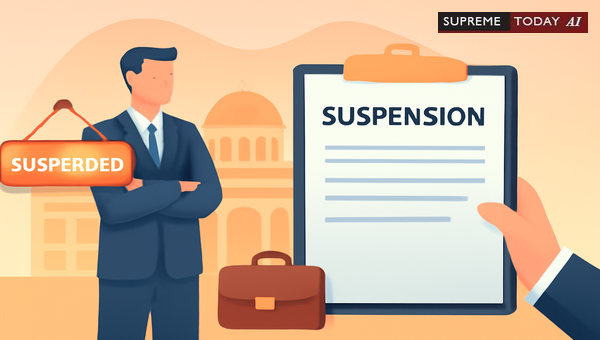
Imagine a government employee placed under suspension amid an investigation, only to remain in limbo for years without resolution. Is this fair, or does it cross into punitive territory? The question Suspension Cannot be Used as a Tool for Punishment strikes at the heart of employee rights in public service. Courts in India, particularly the , have repeatedly clarified that suspension is meant to be a temporary administrative step, not a disguised penalty. This blog explores the legal principles, judicial precedents, and practical guidelines to ensure fairness.
Suspension of a government servant is fundamentally an administrative and interim measure, not a . When it drags on beyond a reasonable period—especially without a final departmental or criminal verdict—it effectively becomes a disguised punishment, which courts have deemed impermissible. 2025 0 Supreme(Raj) 1662 2025 0 Supreme(Raj) 1523 1965 0 Supreme(Ori) 79 2025 0 Supreme(Raj) 1525
This principle upholds the and . Prolonged suspension can erode an employee's morale, status, and livelihood, turning a precautionary step into hardship. As noted in one ruling, As noticed in the aforesaid judgments, it is a settled law that suspension cannot be used as a tool for punishing a person. However, its ramifications which affect the moral of the concerned individual servant, his status in the society is also seriously affected. 2018 0 Supreme(Raj) 2311
Judgments consistently describe suspension as a temporary, non-punitive measure. For example, 1965 0 Supreme(Ori) 79 states: Suspension of workers pending enquiry is not a punishment. Such orders of suspension are meant only as security measures or precautionary ones taken in the interest of the Industry itself.
In government service contexts, this holds true. The in 2025 0 Supreme(Raj) 1662 emphasizes: Suspension, though not a punishment in theory, has in practice when prolonged, which contradicts its original purpose.
Other cases reinforce this. In 2022 0 Supreme(All) 1409, the court noted: Suspension cannot be used as a weapon to penalize the petitioner. Continuation of suspension must be in larger public interest. Similarly, 2021 0 Supreme(Raj) 740 warns that suspension should not be made in a perfunctory or routine manner and cannot be actuated on account of malice or bias. It cannot be used as a tool to punish an employee.
When trials or inquiries linger—common in India's overburdened system—suspension morphs into punishment. 2025 0 Supreme(Raj) 1523 observes: When trials drag on for years—a common reality in overburdened judicial system in India—suspension becomes a imposed without a finding of guilt.
A head constable's case illustrates this: Suspended since amid anti-corruption probes, the court revoked it after 1.5 years, stating no purpose in prolongation, especially with likely trial delays. 2018 0 Supreme(Raj) 2311
Even in non-criminal contexts, like a workman's transfer dispute, courts scrutinize if suspension aligns with public interest rather than penalty. 2024 Supreme(Online)(MAD) 40868
Courts have issued clear directives, typically applicable across service rules:
In 2025 Supreme(Online)(Ori) 5024, the court held that without prescribed punishment rules treating suspension period adversely, it cannot be punitive. Rajasthan rules also allow appeals against suspension. 2021 0 Supreme(Raj) 740
Exceptions exist: Suspension remains valid for grave charges like security threats, but only if timely. 2025 0 Supreme(Raj) 1662 2025 0 Supreme(Raj) 1523 1965 0 Supreme(Ori) 79
Broader precedents echo these themes. In a Panchayat service matter, suspension pending proceedings was upheld as interim, not punishment, but with calls for reasonableness. 2020 0 Supreme(Guj) 716
For NDPS convicts seeking sentence suspension, courts weigh custody undergone and delays, relaxing norms amid prison overcrowding—paralleling government servant concerns. 2023 0 Supreme(P&H) 377
In another, an executive officer's suspension amid charges was not quashed outright but remanded for competent review, stressing no malice-driven routine suspensions. 2021 0 Supreme(Raj) 740
These cases show courts' consistent vigilance against misuse.
To align with law:
Revoke or justify beyond timelines like or .
For Employees:
Authorities must avoid using suspension punitively, especially from inefficiencies. 2025 0 Supreme(Raj) 1662 2025 0 Supreme(Raj) 1523
Suspension cannot be wielded as a punishment tool—it's an administrative bridge to resolution. Prolonged without cause undermines rights, as affirmed across precedents. 2025 0 Supreme(Raj) 1662 2025 0 Supreme(Raj) 1523 1965 0 Supreme(Ori) 79 2025 0 Supreme(Raj) 1525
Key Takeaways:- Treat suspension as temporary and review regularly.- Prolonged cases demand revocation or strong justification.- Employees retain .
This post provides general insights based on judicial trends and is not legal advice. Consult a qualified lawyer for specific cases.
References:1. 2025 0 Supreme(Raj) 1662: Timely review essential; prolonged suspension as disguised penalty.2. 2025 0 Supreme(Raj) 1523: Precautionary measure; from delays.3. 1965 0 Supreme(Ori) 79: Not punishment; security measure pending enquiry.4. 2025 0 Supreme(Raj) 1525: Courts intervene against unjust extensions.
And others as cited.
#GovtSuspension, #ServiceRules, #SupremeCourtRulings


Analysis of position of law in other countries on this issue reveals that, across global jurisdictions (UK, USA, Australia, Canada, France), suspension is a universal administrative tool, not a punishment, designed to protect public interest rather than penalize the employee. ... State of Rajasthan, the court emphasized that while suspension is not a punishment, it can be more damaging than puni....

It is contended that in similar issue, this Court has already taken a view that order of suspension cannot be treated as such, as no such punishment is prescribed under PMR-824. ... But since no such order of punishment to treat the period of suspension as such is prescribed under PMR- 824, placing reliance on the said provisions and the decision as cited supra, this Court is of the view that no such orde....

Under such circumstances, in accordance with the settled legal principles, the guilt of the writ petitioner cannot be preconceived or prejudged to impose suspension as a punishment to him, on the ground that he has been charged with some offence. 24. ... In such a situation, the employer has the right to transfer the employee to such a post where the employee may not have any opportunity to influence any witness or tamper with any evidence ....

But then, apparently, illegality lies in retrospectivity of the suspension. For this irregularity of giving effect to the suspension from a date anterior to the order, the suspension per-se cannot be stayed and rigours of Rule 13(2) cannot be given a go bye. ... Legally, suspension is an interim measure, not a penalty, is the settled position, yet, when prolonged, its effects mirror thos....

It can be thus concluded that the order of suspension cannot be used as a punitive tool by the authorities/department. ... State of Rajasthan & Ors. reported in WLR 1992(S) Raj. 855, held as under:- "Though technically and legally suspension is not a punishment but the ground reality is that in worse than a punishment. ... issued by the State Government providing for ....

cannot be sustained. ... Power of suspension is there on every employer whether specified in any rule or not and it is the prerogative of the employer but that power cannot be allowed to be exercised arbitrarily. ... Unless suspension is a punishment as it is well settled law, that the persons suspended is kept away from the place of enquire so that the enquiry is not influenced or vitiated because of the....

Legally, suspension is an interim measure, not a penalty, is the settled position, yet, when prolonged, its effects mirror those of punishment or “disguised” punishment. 27. ... Suspension, though not a punishment in theory, has punitive consequences in practice: loss of income (beyond subsistence allowance), stagnation of career, and social stigma. ... General Principles - Suspension du....
Legally, suspension is an interim measure, not a penalty, is the settled position, yet, when prolonged, its effects mirror those of punishment or “disguised” punishment. 27. ... Suspension, though not a punishment in theory, has punitive consequences in practice: loss of income (beyond subsistence allowance), stagnation of career, and social stigma. ... General Principles - Suspension du....

In Rafiq Qureshi (9 supra), the Supreme Court has held that in an appeal against a judgment of conviction of an accused under the NDPS Act, 1985, punishment awarded by the Trial Court of a sentence higher than the minimum relying on the quantity of substance cannot be faulted even though the Court had ... It is also contended that in view of the stringent provision of Section 37 of the Act, mere passage of time cannot be a reason for #HL_ST....

When the workman was asked to report at Stores Department, he has denied to report at Tool Room and committed misconduct and thereby he was placed under suspension on 1/3/2005. ... Therefore, not entrusting any work to the workman in the Tool Room also go to show that workman is working in a wrong place in Tool Room instead of Store room. Therefore, contention of the workman that his transfer order was cancelled, #HL_START....

9. The petitioner is under suspension since 3.11.2022. Suspension cannot be used as a weapon to penalize the petitioner. Continuation of suspension must be in larger public interest. The continuation, if pose threat to an ongoing inquiry such delinquent employee need not be reinstated pending such inquiry.
A criminal case/departmental proceedings can take a long time to come to conclusion and therefore, it is only fair if the petitioner is posted somewhere else in order to avoid tampering with the evidence or interference with the proceedings of the case. 12. It can be thus concluded that the order of suspension cannot be used as a punitive tool by the authorities/department. An employee despite an order of suspension is considered a member of the department and therefore, re-c....
Vs. Ashok Kumar Aggrawal (supra), the suspension should not be made in a perfunctory or route manner and cannot be actuated on account of malice or bias. It cannot be used as a tool to punish an employee and due care and caution ought to be taken before placing a person under suspension.

He would also submit that it is open for the petitioner to prefer appeal before the Education Tribunal. The suspension is pending disciplinary proceedings that are contemplated and therefore suspension cannot be treated as punishment. Mr. Munshaw took the court through the conduct rules and the posts in question and submitted that what the DPEO had thought fit is to suspend the petitioner.
As noticed in the aforesaid judgments, it is a settled law that suspension cannot be used as a tool for punishing a person. However, its ramifications which affect the moral of the concerned individual servant, his status in the society is also seriously affected.


An indispensable Tool for Legal Professionals, Endorsed by Various High Court and Judicial Officers
Please visit our Training & Support
Center or Contact Us for assistance

Scan Me!
India’s Legal research and Law Firm App, Download now!


For Daily Legal Updates, Join us on :



 Back to top


