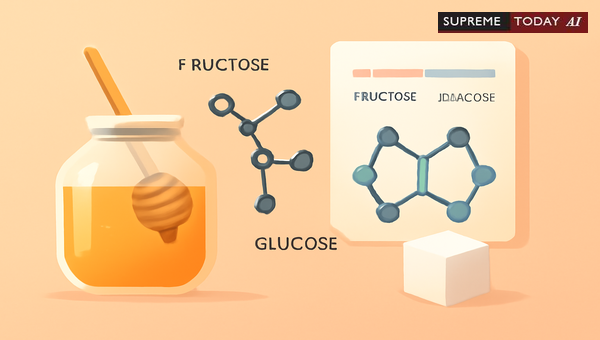
Fructose to Glucose Ratio in Sugar: Legal Perspectives
In the world of food regulation, patents, and consumer protection, the composition of sugars like fructose and glucose often plays a pivotal role. A common question arises: How the Fructose and Glucose Ratio Varies in Sugar? While scientific literature provides detailed biochemical data, legal documents—such as court judgments, patents, and regulatory classifications—focus more on definitions, commercial preparations, and disputes over adulteration or classification rather than precise ratio variations. This blog post delves into key legal findings, integrating insights from various cases to offer a comprehensive view. Note that this is general information and not specific legal advice; consult a qualified attorney for your situation.
Core Legal Findings on Sugar Composition
Legal texts typically define glucose (also known as dextrose or D-glucose) as a monosaccharide naturally occurring in fruits and honey, with the formula C₆H₁₂O₆. Fructose is similarly recognized as a distinct monosaccharide present in the same natural sources. However, these documents rarely specify how the fructose-to-glucose ratio varies across sugar types. Instead, they emphasize classification and chemical properties. For instance, glucose is described as the dextrorotatory form prevalent in nature
Collector of Central Excise, Chandigarh VS Sukhjit Starch & Chemicals Ltd. - Customs, Excise And Gold Appellate Tribunal (1994)
K. Aditya VS Images Dignostic & Pathology Centre - Consumer (2023)
.
The main takeaway from reviewed legal materials is clear: no specific scientific data on ratio variability in natural or processed sugars is provided. The focus remains on regulatory definitions rather than quantitative analysis
Collector of Central Excise, Chandigarh VS Sukhjit Starch & Chemicals Ltd. - Customs, Excise And Gold Appellate Tribunal (1994)
.
Invert Sugar: A Notable Exception with 1:1 Ratio
One area where a precise ratio emerges is invert sugar, a commercial product from sucrose hydrolysis. It consists of approximately equal parts glucose and fructose by weight, yielding a fructose-to-glucose ratio of roughly 1:1
Collector of Central Excise, Chandigarh VS Sukhjit Starch & Chemicals Ltd. - Customs, Excise And Gold Appellate Tribunal (1994)
. This
equimolar composition is highlighted in chemical and classification discussions, distinguishing it from natural sources where ratios may differ.
This 1:1 balance is commercially significant, as it affects properties like solubility and sweetness, often referenced in food processing patents and excise tariffs 2009 0 Supreme(Guj) 7.
Variability in Natural Sugars: Insights from Honey Cases
While broad sugar sources lack ratio details, honey provides contextual clues through consumer protection and adulteration disputes. Honey's carbohydrate profile features fructose (typically 30-44%) and glucose (25-40%), with variations depending on honey type
Jagdish Prasad Sharma VS Managing Director, Dabar India Ltd.
.
The content of fructose and glucose is different depending on the type of honey. Generally, fructose ranges from 30 to 44%, and glucose from 25% to 40%. These are fructose and glucose (the invert sugar in honey)Jagdish Prasad Sharma VS Managing Director, Dabar India Ltd.
.
This ratio influences crystallization: the balance between those two basic monosaccharides in the composition of honey is the main reason for honey crystallization
Jagdish Prasad Sharma VS Managing Director, Dabar India Ltd.
2025 0 Supreme(Gau) 150. In a key consumer case, pure honey was distinguished from adulterated versions by its tendency to crystallize due to glucose dominance in some varieties.
Pure honey does crystallize with the passage of time. It is only adulterated and contaminated honey which may not crystallize2023 Supreme(Online)(NCDRC) 636. The
National Consumer Disputes Redressal Commission dismissed a complaint against
Dabur India Ltd., affirming that crystallization rates vary (1-2 months to over 2 years) based on fructose-glucose balance, with finer crystals in faster-crystallizing honeys
2023 Supreme(Online)(NCDRC) 636.
Such cases underscore how ratio variability becomes legally relevant in proving purity under the Consumer Protection Act, 1986.
Regulatory Classification and Excise Disputes
Sugar classification under tariffs like the Central Excise Tariff Act often groups glucose and fructose together. Entry No. 17.02 covers other sugars, including chemically pure lactose, maltose, glucose and fructose in any form2009 0 Supreme(Guj) 7. Disputes arise over whether products like 'Vital Z' (containing sugars) are drugs or foods. Courts ruled it a drug under Entry 37-A, not equating Central Excise classifications directly with octroi levies 2009 0 Supreme(Guj) 7. The classification of the product under Central Excise Act or the tariff cannot be directly equated with the classification made for levying of the octroi2009 0 Supreme(Guj) 7.
Similarly, malto-dextrin (derived from glucose) falls under Heading 17.02 as an other sugar 2002 0 Supreme(All) 614. These rulings highlight that legal focus is on tariff entries, not compositional ratios.
Patents and Trademarks Involving Glucose and Fructose
Patent disputes reveal indirect ratio considerations. In a rejection under the Patents Act, 1970 (Sections 2(1)(j), 3(d)), a tofogliflozin tablet method failed for lacking novelty, with fillers including fructose, glucose listed
Chugai Seiyaku Kabushiki Kaisha vs Controller of Patents and Design
.
Patent applications must demonstrate novelty and inventive step; mere new uses of known substances fail under Section 3(d) without showing significant enhancement in therapeutic efficacyChugai Seiyaku Kabushiki Kaisha vs Controller of Patents and Design
.
Trademark cases further illustrate: In GLUCON-D vs. GLUCOSE-D, courts held no infringement, as GLUCOSE is a generic term for dextrose. The word GLUCOSE is a general word signifying grape sugar or Dextrose2005 0 Supreme(P&H) 1132. This protects common sugar descriptors without delving into ratios.
High fructose corn syrup appears in corporate schemes alongside dextrose, but without ratio specifics
Santstar Bioplymers Limited VS
.
Medical and Adulteration Contexts
In medical negligence claims, sugar administration (e.g., fructose) impacts blood glucose, but ratios aren't quantified
KAMLA PATNI VS APOLLO NURSING HOME
. Adulteration allegations in tea involve
sugar and glucose syrup, yet focus on illegality under food acts, not ratios
2022 Supreme(SRI)(CA) 441. Blood sugar monitoring via HbA1c indirectly relates to glucose levels, but not fructose ratios
2023 Supreme(Online)(NCDRC) 636.
Limitations and Recommendations
- Legal documents prioritize definitions and classifications over ratio data
Collector of Central Excise, Chandigarh VS Sukhjit Starch & Chemicals Ltd. - Customs, Excise And Gold Appellate Tribunal (1994)
. - Natural variations (e.g., honey) are noted qualitatively, with rare quantitative mentions
Jagdish Prasad Sharma VS Managing Director, Dabar India Ltd.
. - For precise ratios, scientific sources are recommended; legal texts suffice for regulatory compliance.
In disputes like honey purity or product classification, ratios may support arguments but aren't definitively stated.
Key Takeaways
- Invert sugar offers a clear 1:1 fructose-glucose ratio in commercial contexts
Collector of Central Excise, Chandigarh VS Sukhjit Starch & Chemicals Ltd. - Customs, Excise And Gold Appellate Tribunal (1994)
. - Honey shows typical ranges (fructose 30-44%, glucose 25-40%), legally tied to crystallization tests
Jagdish Prasad Sharma VS Managing Director, Dabar India Ltd.
. - Courts address sugars via tariffs, trademarks, and adulteration laws, rarely quantifying ratios.
Understanding these nuances aids food businesses, manufacturers, and consumers navigating regulations. Always seek professional advice for case-specific guidance.
References:-
Collector of Central Excise, Chandigarh VS Sukhjit Starch & Chemicals Ltd. - Customs, Excise And Gold Appellate Tribunal (1994)
,
K. Aditya VS Images Dignostic & Pathology Centre - Consumer (2023)
,
2025 0 Supreme(Gau) 150,
Jagdish Prasad Sharma VS Managing Director, Dabar India Ltd.
,
2009 0 Supreme(Guj) 7,
2005 0 Supreme(P&H) 1132,
2023 Supreme(Online)(NCDRC) 636,
Chugai Seiyaku Kabushiki Kaisha vs Controller of Patents and Design
,
2002 0 Supreme(All) 614,
Santstar Bioplymers Limited VS
,
2022 Supreme(SRI)(CA) 441,
KAMLA PATNI VS APOLLO NURSING HOME
.
#SugarRatioLaw, #HoneyAdulteration, #FoodRegulation