Searching Case Laws & Precedent on Legal Query..!
Scanned Judgements…!



Searching Case Laws & Precedent on Legal Query..!
Scanned Judgements…!
When fraud is alleged in relation to an arbitration agreement or dispute, courts generally scrutinize whether the fraud affects the very existence or validity of the arbitration agreement itself. If the fraud pervades the entire contract or renders the arbitration agreement void, then the dispute may be considered non-arbitrable, and courts may refuse to appoint an arbitrator. Conversely, if the fraud pertains only to specific claims or performance, arbitrators may still have jurisdiction to decide the substantive issues. ["2012 0 Supreme(MP) 475"], ["01100083047"], ["2019 0 Supreme(SC) 688"]
Courts have emphasized that allegations of fraud alone are not automatically sufficient to deny arbitration. The key consideration is whether the fraud allegation impacts the validity of the arbitration agreement as a whole. For example, when an allegation of fraud is made with regard to arbitration agreement itself, such a dispute is generally recognised as a dispute, which is in the realm of non-arbitrability ["2026 2 Supreme 559"]. However, the manner of mentioning the price in sale deeds than the one agreed for sale of flats is not a serious fraud which cannot be decided by arbitrator ["2025 0 Supreme(Kar) 1758"].
The Supreme Court has clarified that issues of fraud that vitiate the arbitration agreement are non-arbitrable and should be decided by courts, especially if the fraud is of such a nature that it invalidates the entire contract or agreement ["2025 0 Supreme(Cal) 429"], ["2014 0 Supreme(MP) 301"]. On the other hand, allegations of fraud that are specific to particular claims or acts within a valid arbitration agreement may be referred to arbitration, and courts will generally appoint an arbitrator unless the fraud allegations fundamentally challenge the agreement itself ["1935 0 Supreme(Lah) 259"], ["2022 0 Supreme(Del) 1997"].
The appointment of an arbitrator in cases involving allegations of fraud depends on whether the court finds that the fraud affects the core validity of the arbitration agreement. If the court concludes that the dispute is arbitrable, it will appoint an arbitrator, provided no other jurisdictional bar exists. Conversely, if the fraud allegations challenge the existence or validity of the arbitration agreement itself, courts tend to decline appointment and refer the matter to the judiciary ["2012 0 Supreme(MP) 475"], ["2026 2 Supreme 559"].
In summary, courts can appoint arbitrators even if fraud is alleged, provided the allegations do not go to the root of the arbitration agreement's validity. When fraud is alleged to have affected the formation or existence of the arbitration agreement itself, courts are more likely to refuse arbitration and handle the matter directly ["2012 0 Supreme(MP) 475"], ["2019 0 Supreme(SC) 688"]. The determination hinges on whether the dispute is arbitrable and whether the fraud allegations impact the core validity of the arbitration clause or agreement.
References:
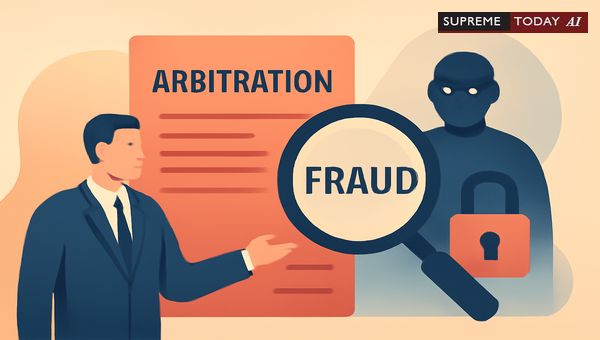
In the world of commercial disputes, arbitration offers a swift, private alternative to lengthy court battles. But what happens when one party cries ? A common question arises: When is practised, whether arbitrator can be appointed? This issue strikes at the heart of arbitration's effectiveness under the (the Act). Allegations of can complicate proceedings, yet courts generally favor arbitration unless specific exceptions apply.
This blog post delves into the legal nuances, drawing from key judgments and principles. We'll examine when derails arbitration and when an arbitrator can still be appointed. Note: This is general information based on case law and not specific legal advice. Consult a qualified lawyer for your situation.
The core principle is clear: Allegations of , even serious ones, do not inherently prevent arbitrator appointment unless the directly undermines the or involves non-arbitrable criminal conduct. Courts under typically refer disputes to arbitration, leaving probes to the tribunal unless exceptional circumstances exist. Mere assertions without proof are insufficient to halt the process. 2001 0 Supreme(Del) 360
As one ruling states, Mere allegation of will not exclude arbitrability – Serious issue of involving criminal wrongdoing would, however, exclude arbitrability. 2001 0 Supreme(Del) 360
When crosses into criminal territory—such as forgery or record manipulation—courts often deem it non-arbitrable due to public interest. In a key case, the court held that disputes involving criminal offences like forgery and are not suitable for arbitration because they involve criminal conduct that requires adjudication by a public forum. 2012 0 Supreme(Del) 2450
Similarly, allegations of fake purchase orders and FIRs against employees were raised, but the court scrutinized documents before deciding on arbitration, emphasizing evidence over mere claims. 2022 0 Supreme(Bom) 883
Not all claims stop arbitration. Courts repeatedly affirm that unsubstantiated allegations don't suffice. For instance, Suffice to say that the allegations cannot be said to be so serious to refuse to refer the parties to arbitration. In any event, the arbitrator appointed can very well examine the allegations regarding . 2021 0 Supreme(Del) 2393 2021 1 Supreme 321 2019 0 Supreme(Bom) 1453
In another matter, despite claims of in sales terms, KYC forms, and invoices, the court found an existed via exchanged documents and referred the dispute to a sole arbitrator, holding defenses for the tribunal. This underscores that defenses like are typically arbitrable.
The exception arises if vitiates the agreement itself, e.g., . Courts may then refuse referral. Allegations that the arbitration clause or agreement itself cannot be said to exist in a clear case in which court finds that party against whom breach is alleged cannot be said to have entered into agreement. 2021 0 Supreme(Telangana) 98 2021 1 Supreme 321
However, if relates to contract performance, not formation, arbitration proceeds. 2018 0 Supreme(Del) 2145
Under , courts appoint arbitrators but assess arbitrability. They can intervene if suggests collusion or impartiality issues. 2006 0 Supreme(Del) 178 Yet, as in cases involving probes or investigations, if disputes fall within the clause, arbitration is favored despite claims. 2021 0 Supreme(Del) 2393
Even in , arbitration clauses don't render them non-maintainable; courts direct parties to tribunals. 2021 0 Supreme(Gau) 511
Several rulings reinforce this balance:- In a land sale dispute with claims via , parties appointed an arbitrator voluntarily, showing doesn't always preclude it. 1944 0 Supreme(SC) 8- allegations against family beneficiaries in agreements didn't prevent arbitrator appointment by court. 2014 0 Supreme(Cal) 653- Suits assailing contracts on grounds may go to court if independent, but contract-based disputes go to arbitration. 1966 0 Supreme(J&K) 11
These cases illustrate courts' reluctance to derail arbitration on flimsy pleas.
Arbitration may be refused in:- Criminal forgery or manipulation cases. 2012 0 Supreme(Del) 2450- voiding the arbitration clause. 2021 0 Supreme(Telangana) 98- Public law disputes against state entities involving malafide conduct. 2021 1 Supreme 321
Conversely, procedural or where the tribunal can probe remains arbitrable. 2001 0 Supreme(Del) 360
Parties can also infer agreements from correspondence, binding them despite defenses. 2022 0 Supreme(Bom) 883
In summary, allegations rarely bar arbitrator appointment unless they involve criminality or nullify the agreement. Courts promote arbitration as the preferred first authority, scrutinizing claims . 2021 0 Supreme(Gau) 511 This approach balances efficiency with justice, as tribunals adeptly handle most issues.
Key Takeaways:- Mere claims? Arbitrate.- Criminal or agreement-vitiating ? Court first.- Always substantiate allegations.
For businesses, understanding this empowers proactive dispute resolution. Stay informed on evolving case law under the Act.
#ArbitrationLaw #FraudDisputes #LegalInsights


In the event of the dispute, controversy or claim not settled amicably, it shall be referred to sole arbitrator to be appointed by Sahara India Pariwar and award given by such arbitrator shall be binding and non-appealable on both parties.” ... Road, Indore is appointed as sole arbitrator for deciding the dispute between the parties. The parties are directed to appear before the learned arbitrator on 17.9.2012. ... 12. The arbitration case is accordingly disposed of. ... A party which....

If fraud was practised and the decree obtained was the result of this fraud, relief must be granted whether the woman was or was not a pardanashin lady. Her status is only a piece of evidence in determining whether or not she was made the victim of fraud. ... The ratio decidendi of the District Judge appears to be that though fraud was practised on Mt. ... Umrao Begam has totally denied that she ever appointed Mian Abdul Hamid Akhta....

Therefore, it is not a disputed fact that this Court appointed the sole arbitrator on the basis of the stand taken by the parties and with their consent, appointed the sole arbitrator. It is also not in question whether the said statement was made by the learned counsel by the parties. ... Kaushik, Retd ADJ (Mobile No. 9910384663) is appointed as the sole Arbitrator for adjudication of the disputes and differences which have arisen between the parties in relation to t....

That under the agreement one Panna Lal was appointed arbitrator to divide up the estate and was given a period of four months within which to carry out the partition. ... He does not challenge the finding of the Court below that no fraud was practised on his client in regard to the agreement of the 5th July 1914. On this point we have no hesitation in saying that we fully agree with the Court below. ... We, therefore, are of opinion that the award is a complete award, that the arbitrator has not been gu....

Learned Judge, at the first instance, appointed Mr.Justice Ajit J.Gunjal as arbitrator. However, he declined to accept the appointment and therefore on an application, Justice A.C.Kabbin was appointed as arbitrator. ... By the Order dated 10.07.2014 Justice A.C.Kabbin was appointed as an arbitrator. From the record it is found that Justice A.C.Kabbin also did not choose to arbitrate the matter and ultimately Justice V.Jagannathan was appointed as an arbitrat....

The defendant's case was that he had never sold anything to the plaintiff; he had sold the occupancy but not the proprietary rights in his land to Ujagar Singh who was a real purchaser and not a benamidar for the plaintiff but who had practised a fraud upon him. ... The agreement is in these terms: ... "We, the parties, of our own accord have appointed S. Amar Singh, Police Inspector, CIA Railway Police, Lahore, as our sole arbitrator for settlement of all our disputes in this case. ... Compendiously, his contention was ....

Thus he has alleged that the fraud has been practised upon the Court as well as upon him even after the filing of the award in the Court. ... Ranka and Bhanwarlal Ranka and the alleged arbitrator Shri Jagdish Prasad as a result of which the impugned decree was obtained against him by fraud. ... It has been further stated by him that he did not receive any notice from the arbitrator nor appointed Shri Mukand Chand Ranka as his counsel, nor signed any Vakalatnama in his favour, nor made ....

stated, no inquiry can be made by the Arbitrator. ... Gujarat High Court, RC Technical Road, Ghatlodiya, Ahmedabad – 380061, (Mobile Number: 7574812176 and email address: vishnukumarppatel@gmail.com is appointed as sole Arbitrator to resolve the disputes between the parties in accordance with the Arbitration Centre (Domestic and International ... The cause of action for filing the applications seeking for appointment of Arbitrator is that the respondent had committed fraud in the firms and when it was d....

His Lordship on December 4, 2012, allowed both the applications and appointed Mr. Bimal Kumar Chatterjee, senior advocate and the present Advocate General of the State, as the learned arbitrator to adjudicate upon the disputes between the parties covered by the said agreements. ... It was alleged that the said Deepak Tandon practised fraud upon the company inasmuch as he did not disclose that his family members were the real beneficiaries of the said two agreements dated May 28, 2008 and June 4, 2008. ... Mukherjee, lear....

arbitrator. ... It seems to us that the crux of the matter in such cases is to see whether the suit brought by the plaintiff is itself independent of the contract and proceeds upon assailing the contract on grounds of fraud mistake, or mis-representation etc. or whether the suit is based on the contract itself. ... This being the situation, the question is as to whether or not, the matter should be determined by the court or by the arbitrator. In AIR 1949 C....

The primary contention as urged by Mr. Sasidhar is that the purchase orders are fake, as they are issued by the employee of the respondent against whom an FIR has been lodged, as also the invoices are issued by the employee of the applicant and hence there is no transaction between the applicant and respondent in relation to the invoices on the basis of which a claim is being made by the applicant against the respondent. In support of his submission, Mr.Sasidhar has drawn the Court’s attention to the various documents as also the detailed submissions as made in the reply affidavit. There is ....

In any event, the arbitrator appointed can very well examine the allegations regarding fraud." Suffice to say that the allegations cannot be said to be so serious to refuse to refer the parties to arbitration.

As per the decision of the Apex Court in Vidya Drolia and others–Vs-Durga Trading Corporation (supra) and from the admitted facts, the arbitral tribunal is the preferred first authority for dispute resolution of the parties as per the MoU dated 04.05.2000 and as such the petitioners are required to accept the same. This writ petition cannot be held to be non maintainable only because of the arbitration clause stipulated in the Memorandum of Understanding dated 04.05.2000 but in order to grant the relief/reliefs evidence both oral and documentary are required for which it would be proper and ....

Suffice to say that the allegations cannot be said to be so serious to refuse to refer the parties to arbitration. In any event, the arbitrator appointed can very well examine the allegations regarding fraud.”

Suffice to say that the allegations cannot be said to be so serious to refuse to refer the parties to the arbitration. The Supreme Court accordingly was pleased to set aside the order passed by the High Court and appointed an Arbitral Tribunal in the said proceedings though a writ petition arising out of the FIR was pending in the High Court. In any event, the arbitrator appointed can very well examine the allegations regarding fraud.


An indispensable Tool for Legal Professionals, Endorsed by Various High Court and Judicial Officers
Please visit our Training & Support
Center or Contact Us for assistance

Scan Me!
India’s Legal research and Law Firm App, Download now!


For Daily Legal Updates, Join us on :



 Back to top


