SupremeToday Landscape Ad

AI Overview

AI Overview...

  • Same-day Cross-Examination Is Critical - Courts emphasize that cross-examination should ideally be completed on the same day the examination-in-chief is recorded to ensure fairness and prevent undue delay. Delaying or deferring cross-examination for long periods is viewed as contrary to the principles of a fair trial ["2024 0 Supreme(MP) 323"], ["2023 0 Supreme(Del) 801"], ["2023 0 Supreme(Del) 5197"].

  • Consequences of Not Conducting Cross-Examination on Fixed Date - If cross-examination is not done on the scheduled date, courts generally close the opportunity, leading to forfeiture of the defendant's right to cross-examine that witness. For example, when counsel was absent or witnesses were not examined as scheduled, the courts held that the defendant's opportunity was effectively closed ["2023 0 Supreme(Chh) 2"], ["2025 Supreme(Online)(Raj) 14571"], ["2023 Supreme(Online)(All) 32675"].

  • Procedures When Cross-Examination Is Deferred or Not Done - Courts have sometimes allowed for the possibility of granting last opportunities, such as adjournments or specific directions to complete cross-examination on subsequent days, provided the parties act promptly and in good faith. However, long delays or repeated adjournments are discouraged as they undermine fairness ["2024 0 Supreme(MP) 323"], ["2025 Supreme(Online)(Tel) 23082"], ["2025 Supreme(Online)(Tel) 33244"].

  • Legal Remedies and Actions When Cross-Examination Is Not Done as Fixed - Courts may take measures such as closing the opportunity, closing evidence, or dismissing applications for recall if the defendant fails to cross-examine witnesses within the allotted time. In some cases, courts have given one last chance to complete cross-examination, but typically, failure to do so results in forfeiture of the right ["2024 0 Supreme(All) 202"], ["2024 0 Supreme(All) 600"], ["2022 Supreme(Online)(MAD) 16407"].

  • Court's Discretion and Fair Trial Principles - Courts recognize the importance of cross-examination as a vital tool for a fair trial. When cross-examination is not conducted on the scheduled date due to reasons like absence of counsel or witness unavailability, courts may either adjourn, give last opportunities, or close the opportunity, depending on the circumstances and whether the delay is justified ["2023 0 Supreme(Bom) 1971"], ["2023 0 Supreme(Del) 801"], ["2023 0 Supreme(P&H) 1652"].

Analysis and Conclusion:The prevailing legal stance is that cross-examination should be conducted on the fixed date, ideally on the same day as the examination-in-chief. If not done, courts tend to close the opportunity, considering it a violation of fair trial principles. However, courts may grant last opportunities or adjournments if justified reasons are provided promptly. Failure to utilize these opportunities often results in forfeiture of the right to cross-examine, which can adversely affect the accused's defense. Therefore, parties must act diligently and adhere to scheduled dates to preserve their rights ["2023 0 Supreme(Chh) 2"], ["2024 0 Supreme(MP) 323"], ["2023 0 Supreme(Del) 801"].

Consequences and Remedies for Failing to Conduct Cross-Examination on Fixed Court Dates

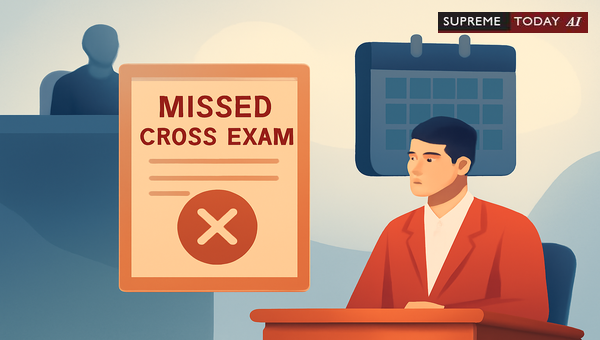
Missed Cross-Examination Date? Legal Options Explained

In the fast-paced world of litigation, missing a scheduled court date for cross-examination can feel like a major setback. But what exactly happens if cross-examination is not done on the day fixed? This common concern arises in both civil and criminal cases, where timely cross-examination is crucial for testing witness credibility and building a strong defense or case.

Cross-examination is a cornerstone of fair trials, allowing parties to challenge evidence under the Indian Evidence Act, 1872. However, life happens—illness, unavoidable delays, or logistical issues can disrupt schedules. Courts balance the need for justice with preventing abuse of process. This post breaks down the legal position, consequences, remedies, and practical tips, drawing from judicial precedents. Note: This is general information, not specific legal advice. Consult a lawyer for your case.

Why Adhering to Fixed Dates Matters

Courts fix dates for cross-examination to ensure trials progress efficiently, especially in action plan cases or commercial disputes. Delays from unnecessary adjournments are discouraged, as they can turn trials into a farce and violate the rule of law. For instance, guidelines emphasize that if examination-in-chief is complete, cross-examination should ideally finish on the same day or the next if it extends late. 2023 Supreme(Online)(Chh) 14374 2022 0 Supreme(Mad) 1592

Failure to appear without valid cause is treated seriously. Courts may view repeated absences as deliberate delay tactics, leading to strict measures. In one case under Section 138 of the Negotiable Instruments Act, petitioners repeatedly failed to cross-examine a key witness, resulting in the cross-examination being marked as 'Nil'. The court upheld this, stressing the abuse of process in delaying proceedings. 2023 0 Supreme(P&H) 455

Consequences of Not Conducting Cross-Examination on the Fixed Date

If a party or counsel misses the fixed date without sufficient reason, courts typically:

A key example is where the defense claimed part of PW 23's cross-examination was pending, but the court noted it was already completed on 07.10.2023, rejecting further requests. The trial court restricted questions to relevance under Section 39 of the Evidence Act, protecting privacy. 2024 0 Supreme(UK) 149

Court's Discretion and Possible Remedies

Fortunately, courts exercise wide discretion to ensure justice, especially if absence stems from genuine reasons like counsel illness. Common remedies include:

  1. Fixing a new date: Courts often reschedule, appointing a commissioner if needed, to ensure parties' presence. 2017 0 Supreme(Gau) 1257

    SWAROOP GOPAL VS GOLI VENKATESHWAR RAO - Consumer (2019)

  2. Recalling witnesses: Under Order 18 Rule 17 CPC, recall is possible but discretionary—not for filling evidentiary gaps or tactical delays. In a property dispute, defendants sought recall of D.W.3 due to counsel's sudden illness, but the court rejected it for lack of justification. 2025 0 Supreme(Ori) 457
  3. Providing one more opportunity: If default isn't deliberate, courts may allow subsequent cross-examination. However, gaps like a month's delay raise concerns of witness tampering. 2022 0 Supreme(P&H) 1078 2017 0 Supreme(Mad) 4072

In commercial divisions, case management is strict. One order directed PW-3's cross-examination over two days (16.12.2017 and 17.12.2017), mandating completion with re-examination on the same day. 2018 0 Supreme(Mad) 1238 2017 0 Supreme(Mad) 3995

Even in quasi-judicial proceedings like FEMA cases, the right to cross-examine is a natural justice principle. Courts allowed it for key witnesses but limited to 10 working days, confining questions to permissible law. 2013 0 Supreme(Del) 654

Precautionary Measures and Procedural Best Practices

To avoid pitfalls:- File timely exemption applications: Courts grant these for valid reasons but scrutinize old cases. 2023 0 Supreme(P&H) 455- Ensure witness and counsel availability: Day-to-day cross-examination is preferred in complex matters. 2013 0 Supreme(Del) 654- Avoid long deferrals: Post-examination-in-chief delays invite criticism, as cross should conclude promptly. 2023 Supreme(Online)(Chh) 14374

Courts discourage applications that misuse process, like seeking adjournments without cause. In patent infringement suits, trials must progress briskly without interlocutory interruptions. 2017 0 Supreme(Mad) 3995

Case Studies: Real-World Applications

  • Criminal Context: In a corruption case, delayed cross-examination of PW-2 fueled doubts about prosecution evidence, leading to acquittal due to unexplained gaps. 2017 0 Supreme(Mad) 4072
  • Civil Disputes: Illness claims were scrutinized; without proof, recall was denied to prevent trial disruption. 2025 0 Supreme(Ori) 457
  • NI Act Trials: Repeated no-shows resulted in 'Nil' cross-examination, petition dismissed under Cr.P.C. Section 482. 2023 0 Supreme(P&H) 455

These illustrate courts' fact-specific approach: justice facilitation without tolerating negligence.

Key Takeaways and Recommendations

If cross-examination isn't done on the fixed date:- Courts may reschedule or appoint a commissioner if reasons are valid. 2017 0 Supreme(Gau) 1257- Persistent defaults risk closing opportunities or adverse inferences. 2022 0 Supreme(P&H) 1078- Prioritize diligence—ensure presence to safeguard rights.

The court generally prefers rescheduling if default isn't intentional, promoting fair trials while curbing delays. Always document reasons for absence and seek prompt remedies.

For tailored guidance, consult a legal expert. Stay proactive in litigation to avoid turning procedural slips into substantive losses.

(Word count: approx. 1050. Sources cited are judicial documents for illustrative purposes.)

#CrossExamination #CourtRemedies #LegalProcedures
Chat Download
Chat Print
Chat R ALL
Landmark
Strategy
Argument
Risk
Chat Voice Bottom Icon
Chat Sent Bottom Icon
SupremeToday Portrait Ad
logo-black

An indispensable Tool for Legal Professionals, Endorsed by Various High Court and Judicial Officers

Please visit our Training & Support
Center or Contact Us for assistance

qr

Scan Me!

India’s Legal research and Law Firm App, Download now!

For Daily Legal Updates, Join us on :

whatsapp-icon Back to top