Searching Case Laws & Precedent on Legal Query.....!
Analysing the retrieved Case Laws
Scanned Judgements…!



Searching Case Laws & Precedent on Legal Query.....!
Analysing the retrieved Case Laws
Scanned Judgements…!
Burning Effigy - Offence under Section 285 of the Indian Penal Code (IPC) ["2015 0 Supreme(Mad) 2081"]]
Main Points and Insights:
Historically, the IPC did not include effigy burning as an offence, and constitutional protections under Article 19 may extend to such acts if no other mischief occurs ["2015 0 Supreme(Mad) 2081"].
Analysis and Conclusion:
The courts have clarified that the act of burning, when done intentionally or with knowledge of likely harm, can constitute offences under these sections, depending on the circumstances and intent ["2023 0 Supreme(AP) 1026"].
Analysis and Conclusion:
References:- Burning effigy is not explicitly an offence under the IPC; it is generally charged under Sections 285 or 286 if at all ["2015 0 Supreme(Mad) 2081"].- Burning of property or acts involving fire are punishable under Sections 302, 304 Part-II, or 436 IPC, depending on the case specifics and intent ["2023 0 Supreme(AP) 1026"], ["2025 0 Supreme(Guj) 1609"], ["2019 4 Supreme 758"], ["2009 0 Supreme(Jhk) 651"].
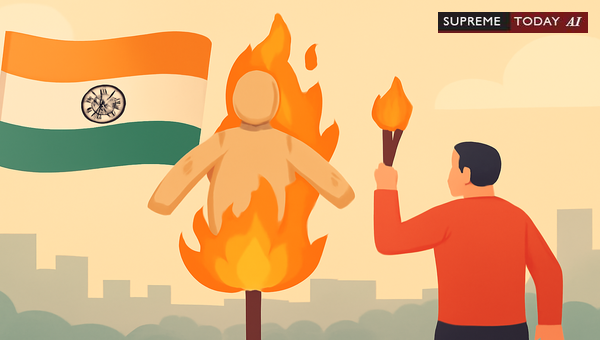
In the heat of political protests or public demonstrations, burning an effigy—often a symbolic representation of a person, institution, or national symbol—has become a common sight. But is burning effigy an offence under what section of which act? This question arises frequently amid heated debates on free speech versus national respect. While such acts may seem like protected expression, they can cross into criminal territory under specific Indian laws, depending on intent and context.
This article explores the legal framework, drawing from key statutes and judicial interpretations. Note: This is general information, not legal advice. Consult a qualified lawyer for specific cases.
The primary law addressing the burning of effigies, especially those representing national symbols like the Constitution, national flag, or revered figures, is the . Specifically, Section 2 penalizes the wilful insult or desecration of the Indian National Flag, Constitution, or any other national symbol. 2021 0 Supreme(Mad) 2774
Under Section 2, acts like burning a copy of the Constitution or an effigy embodying national honor are offences if done with malicious intent to dishonor or desecrate. The Act states that such conduct must be wilful, meaning deliberate and intentional, not accidental. 2021 0 Supreme(Mad) 2774 As judicial interpretations emphasize, 'insult' and 'desecration' emphasizes that such acts must be active, malicious, and with intent to offend or dishonour, not accidental or unintentional. 2021 0 Supreme(Mad) 2774
Key elements for prosecution:- (guilty mind): Evil intent to insult or dishonor.- (guilty act): Active desecration, such as burning with purpose.- Distinction from innocent acts: Only (bad faith) conduct is punishable. 2021 0 Supreme(Mad) 2774
In cases like Tamizhazhagan (supra), courts have clarified that 'wilfully' denotes deliberate and intentional conduct, and that the offence involves active disrespect or contempt. Burning an effigy with the purpose of desecration fits this if proven. 2021 0 Supreme(Mad) 2774
Effigies are often burned during protests against politicians or policies. While not explicitly mentioning effigies, the 1971 Act's principles apply by analogy to symbolic acts targeting national pride. The views such insults as —inherently wrong—requiring proof of intent. 2021 0 Supreme(Mad) 2774
For instance:- Burning a Constitution copy to protest amendments? Potentially Section 2 if intent is to dishonor the document itself.- Effigy of a leader resembling national symbols? Context matters; if it desecrates the flag or Constitution, it's covered. 2021 0 Supreme(Mad) 2774
Prosecution must demonstrate the act was not mere expression but aimed at insult. Without wilful malice, no offence. 2021 0 Supreme(Mad) 2774
Burning acts in other scenarios highlight distinctions. Under the (IPC), Section 436 addresses mischief by fire or explosive substance, punishing house-burning or property destruction. In one case, appellants were convicted under for setting fire to a house over a property dispute, but the conviction was set aside due to insufficient evidence: Conviction cannot be based on suspicion alone, and circumstantial evidence must form a complete chain pointing to the guilt of the accused. 2024 0 Supreme(Gau) 108 2025 0 Supreme(Ori) 743
Similarly, grievous burn injuries fall under IPC Sections 324 (simple hurt by fire) to 326 (grievous hurt), escalating to 304 (culpable homicide) or 302 (murder). Courts note: The offence of causing injury by burning is a broad spectrum which runs from s. 324 causing simple injury by burning through s. 326... to... murder itself. 2017 0 Supreme(Guj) 1042 2013 0 Supreme(Del) 1081
These IPC provisions apply if effigy burning damages property or endangers lives, but for symbolic insult, the 1971 Act takes precedence. Defacement laws like the , or Maharashtra's 1995 Act target property damage, not symbolic burning: They primarily address defacement and unauthorized display, not specifically burning of symbols or effigies. 2020 0 Supreme(Pat) 415 2014 0 Supreme(Bom) 1559 2017 0 Supreme(Bom) 122
In protest contexts, effigy burning might invoke IPC 153A (promoting enmity) if it incites communal tension, but the national honor angle dominates.
Not all effigy burnings are offences. protects freedom of speech and expression, including protest forms. If lacking intent to insult national symbols—e.g., purely political satire—it may be shielded:- If the act of burning is not done with the intent to insult or desecrate, but rather as a form of protest... it may not constitute an offence. 2021 0 Supreme(Mad) 2774- Accidental or non-malicious acts are exempt. 2021 0 Supreme(Mad) 2774
Courts balance rights: Symbolic protest is often tolerated unless it directly desecrates protected symbols.
Internationally, burning flags or effigies tests free speech limits, but India's framework prioritizes national honor. Domestically, related cases reinforce intent's role. For example, in acid attack murders, courts uphold Section 302 IPC when acts are imminently dangerous and likely to cause death, rejecting lack-of-intent defenses. 2012 0 Supreme(Del) 2249
In electricity theft cases, meter burning under Section 135 requires proof, with courts mandating lab testing: Respondent board has to send meter for testing... in presence of accused person. 2022 0 Supreme(Mad) 3666 This underscores evidence standards applicable to effigy cases.
Defacement Acts apply peripherally if property is harmed during protests. 2020 0 Supreme(Pat) 415
In conclusion, while effigy burning symbolizes dissent, crossing into desecration invites Section 2 liability. Understanding these nuances promotes informed expression and legal compliance. Stay informed, protest responsibly.
References:1. 2021 0 Supreme(Mad) 2774: Core on national honor insults.2. 2020 0 Supreme(Pat) 415, 2014 0 Supreme(Bom) 1559, 2017 0 Supreme(Bom) 122: Defacement laws.3. Various IPC cases on burning: 2024 0 Supreme(Gau) 108, 2025 0 Supreme(Ori) 743, 2017 0 Supreme(Guj) 1042, etc.
#BurningEffigy #NationalHonourAct #IndianLaw


lamp and that the evidence on record would prove the offence under Section 304 Part-II of the IPC instead of Section 302 of the IPC. ... of offence. ... The learned Sessions Judge, on hearing both sides and after considering the evidence on record, found the accused guilty of the offence under Section 304 Part-II of the IPC as against the original charge under Section 302 of the IPC, convicted him under Section 235(2) of the Cr.P.C. and after questio....

Lalsangliana (PW No. 14) then prepared a discloser statement as per section 27 of Indian Evidence Act and the same was a valuable piece of evidence to show the guilt of the accused. ... With regards to the disclosure statement under Section 27 of the Indian Evidence Act, which led PW No. 14 to the seizure of 5 litres of petrol from the shop of D.W. ... The learned Amicus Curiae also submits that the prosecution witnesses have failed to produce any evidence against the appellant who was innocent of committing the #HL_STA....

The present writ petition has been filed challenging an order of the second respondent in issuing a final assessment order arising under Section 135 of the Electricity Act, 2003. 2. ... When the petitioner has miserably failed to establish the prima facie cause of the burning of meter, the board is not expected to send it for testing as contemplated under Regulation Act. Hence, he prayed for dismissal of the writ petition. ... the theft of energy, such burning had taken place. ... After inspection, the....

As there was no power supply in the house at that time, an oil lamp was burning on the floor of the house. ... As already observed supra, the act of the accused is not a premeditated act and he never intended to kill her or commit murder of her and it is only on account of the fact that he kicked the oil lamp in a fit of anger, the incident took place. ... However, he did not find the accused guilty for the offence punishable under Section 302 of the IPC. ... 2.7 Dissatisfied with the said judgment of ....

The definition does not limit coverage to the burning of a stranger’s property plus the burning of one’s own property to defraud an insurer. Section 844(i) fits comfortably within the generic definition that we have articulated. ... Gamez, 89 F.4th 608, 610 (7th Cir. 2024), both adopt “the intentional or malicious burning of any property” as the definition of the generic offense. See also Brown v. Caraway, 719 F.3d 583, 589–91 (7th Cir. 2013) (willful or malicious burning). ... The parties’ shared assumption....
Act of Feb. 25, 1976, Ind. Pub. L. No. 148-1976 § 3. Before then, Indi- ana law had defined arson as intentionally setting fire to property. See Act of Feb. 16, 1972, Ind. Pub. L. ... Indiana case law, however, has stated that the corpus delicti of arson “consists of the burning of the property in question and a criminal agency as a cause of that burning.” Williams v. State, 837 N.E.2d 615, 618 (Ind. Ct. ... At sentencing, the question was whether Gamez’s three prior felony convictions triggered t....
See Act of March 26, 2002, Ind. Pub. L. No. 123-2002 § 36. In Gamez’s view, the inclusion of “destructive devices” makes the state law broader than generic arson. ... What we cannot decide today is a question on the meaning and requirements of Indiana law: whether Indiana arson re- quires a fire or burning. By its terms, the state’s criminal code does not require a fire or burning as an element of arson. ... At the sentencing hearing three years later, in July 2022, the government pointed to Gamez’s criminal history to sup- port a 15-year....

As per his version, he learnt regarding the burning of the house from his wife and daughter-in-law. ... punishable under Section 436 of IPC and on that count each of them were sentenced to undergo R.I. for two years. ... Similarly, while the I.O. had examined P.W.3 under Section 161 Cr.P.C., he has also not stated what in fact he has deposed before the Court. P.W.8 in that regard has stated as under:- “5. I examined P.W.3 on15.12.92. ... On the basis of the aforesaid allegations, police registered the case for the offence#HL_END....

Since there is no provision in the IPC, which makes the burning of effigies a punishable offence, the police invariably charge persons, who burn effigies, only for an offence under Section 285 or at the most under Section 286. ... A careful reading of Section 285 would show that the mere burning of an effigy, by itself, was not made a punishable offence under the IPC. In fact, there is not even a reference in Section 285, IPC to the....

Since the appellant had thrown a burning stove on the deceased, he would have known that his act was likely to cause burns resulting in death. In view of the facts and circumstances of the case, he can be said to have committed an offence under Section 304 Part II IPC. ... No. 349/2010 was registered at Police Station Amba Mata, District Udaipur for the offence under Section 326 of I.P.C. against the accused-appellant. The victim Smt. ... Ratan (Ex.P/13) shows that the accused-appell....

The question then arises, what was the offence which Ram Prasad can be said to have committed ? The offence of causing injury by burning is a broad spectrum which runs from s. 324 causing simple injury by burning through s. 326, namely, causing grievous injury by burning to the two major offences, namely, culpable homicide not amounting to murder and even murder itself. The Sessions Judge chose the lowest end of the spectrum which is surprising enough, because the burns were so extensive that they were certainly grievous by all account. The High Court placed the offence a l....

6. So far as the submission that proceedings can be drawn only under the provisions of the N.I. Act is concerned, suffice it to say that the ingredients of an offence punishable under section 138 N.I. Act are completely different from that punishable under section 420 I.P.C. The offence of cheating is a distinct and separate offence which is dependent on existence of a dishonest intention from the very beginning of a transaction, whereas the offence punishable under section 138 of the N.I.

The question then arises, what was the offence which Ram Prasad can be said to have committed? The offence of causing injury by burning is a broad spectrum which runs from s 324 causing- simple injury by burning through S 326, namely, causing grievous injury by burning to the two major offences, namely, culpable homicide not amounting to murder and even murder itself. The Sessions Judge chose the lowest end of the spectrum which is surprising enough, because the burns were so extensive that they were certainly grievous by all account. The High Court placed the offence a lit....

The Sessions Judge chose the lowest end of the spectrum which is surprising enough, because the burns were so extensive that they were certainly grievous by all account. The offence of causing injury by burning is a broad spectrum which runs from Section 324 causing simple injury by burning through Section 326, namely, causing grievous injury by burning to the two major offences, namely, culpable homicide not amounting to murder and even murder itself. The High Court placed the offence a little higher, namely, culpable homicide not amounting to murder. The question then ari....


An indispensable Tool for Legal Professionals, Endorsed by Various High Court and Judicial Officers
Please visit our Training & Support
Center or Contact Us for assistance

Scan Me!
India’s Legal research and Law Firm App, Download now!


For Daily Legal Updates, Join us on :



 Back to top


