SupremeToday Landscape Ad
AI Thinking

AI Thinking...

Searching Case Laws & Precedent on Legal Query.....!

Scanned Judgements…!

Checking relevance for Commissioner of Service Tax, Mumbai VS 3I Infotech Ltd. ...

Checking relevance for Ashwani Kumar Katoch VS Union Of India...

Checking relevance for Union Of India VS Dinanath Shantaram Karekar...

Checking relevance for Viveka Nand Sethi VS Chairman, Jammu And Kashmir. , Bank LTD. ...

Checking relevance for State Of M. P. VS Ram Ratan...

Checking relevance for Commissioner of Customs VS Canon India Pvt. Ltd. ...

Checking relevance for Ramchandra Keshav Adke VS Govind Joti Chavare...

Checking relevance for Commissioner Of Service Tax VS Naresh Kumar And Company Private Limited...

Checking relevance for Chandra Shekhar Singh VS State of Jharkhand...

Checking relevance for Chandra Shekhar Singh VS State of Jharkhand, through the Principal Secretary...

Checking relevance for U. P. State Sugar and Cane Devp. Corp. Ltd. Through Its M. D. VS Surendra Prasad Mishra...

Checking relevance for Jharkhand Gramin Bank VS Rekha Sinha...

2023 0 Supreme(Jhk) 1333 : In service law, a show-cause notice is issued before any decision is made to initiate a departmental proceeding. It serves as a preliminary step to provide the employee an opportunity to respond and defend themselves, allowing the disciplinary authority to assess whether the allegations have substance. If the response is satisfactory, no departmental proceeding is initiated. In contrast, a memorandum of charge (often referred to as an ''''Explanation Memo'''' in some contexts, though the term ''''memorandum of charge'''' is standard) is issued only after the disciplinary authority has decided to initiate proceedings. It formally outlines the charges against the employee and marks the actual commencement of the departmental proceeding. The court in this case held that the departmental proceeding is deemed to have commenced only with the issuance of the memorandum of charge, not merely with the issuance of a show-cause notice, as established by the Supreme Court in State of Andhra Pradesh and Ors. vs. CH. Gandhi (2013) 5 SCC 111.Checking relevance for S. Chandra Sekhar Reddy VS State of Telangana...

Checking relevance for Secretary, Min of Defence VS Prabhash Chandra Mirdha...

Checking relevance for Union of India VS Kunisetty Satyanarayana...

Checking relevance for UMC Technologies Private Limited VS Food Corporation of India...

Checking relevance for SUDHIR RANJAN HALDER VS STATE OF WEST BENGAL...

Checking relevance for GORKHA SECURITY SERVICES VS GOVT. OF NCT OF DELHI...

Checking relevance for P. Janaki VS The State of Tamil Nadu rep. By the Secretary to Govt. , Revenue Department & Others...

Checking relevance for Vikraman Nair VS State of Kerala...

Checking relevance for State Of A. P. VS Karumullah Khan...

Checking relevance for Usha Devi Sharma VS MCD...

Checking relevance for Girjesh Kumar Sinha VS Jharkhand Gramin Bank through its Chairman...

Checking relevance for Satya Narayan Singh VS State Of Bihar...


AI Overview

AI Overview...

  • Notice vs. Rule - Notice generally refers to the communication or alert given to parties about legal proceedings or actions, while a Rule is a formal regulation or guideline governing procedures in legal contexts. Several sources highlight that notices must be properly tendered or served according to specific Rules, which specify the manner, timing, and recipients of notices (e.g., Rules 8(3), 27(3), 28(3), 8(5), 8(6), 9(1)). The distinction between direct notice by parties and notice issued through official channels like the Registrar is emphasized, with rules ensuring proper service to uphold fairness ["

    SUDATH ROHANA AND ANOTHER V. MOHAMED ZEENA AND ANOTHER

    "], ["

    ATTANAYAKE V. COMMISSIONER GENERAL OF ELECTIONS

    "], ["

    MUKUNTHAN VS. PLEXUS COTTON LTD

    "].
  • Procedural Requirements - Many sources stress that compliance with Rules regarding notices is mandatory. For example, tendering a notice at least 15 or 30 days prior, verifying that notices are not returned undelivered, and issuing notices through proper channels are critical steps. Failure to adhere to these rules can invalidate proceedings, as seen in cases where notices fell short of statutory requirements or were not properly served ["2023 Supreme(Online)(Kar) 35183"], ["2023 0 Supreme(Telangana) 278"], ["

    ATTANAYAKE V. COMMISSIONER GENERAL OF ELECTIONS

    "].
  • Differences in Notice Types - There is a clear difference between notices issued directly by parties and those issued by courts or registrars. Rules like 8(3) and 8(5) specify procedures for serving notices via the Registrar, including verification steps and timelines, emphasizing the importance of official service for validity ["

    ATTANAYAKE V. COMMISSIONER GENERAL OF ELECTIONS

    "], ["

    MUKUNTHAN VS. PLEXUS COTTON LTD

    "].
  • Legal Implications of Non-Compliance - Non-compliance with notice rules can lead to the quashing of proceedings or notices, as courts have held that notices must meet specific criteria regarding timing, method, and recipients. For instance, notices issued with less than the prescribed days or not properly served can be deemed invalid ["2023 Supreme(Online)(Kar) 35183"], ["2024 0 Supreme(Guj) 1557"].

  • Judicial Notice and Service of Rules - Courts often take judicial notice of rules and regulations, treating them as having the force of law once published, which underscores the importance of following prescribed procedures for notices to ensure legal validity ["

    SIVASAMPU v. JUAN APPU

    "].

Analysis and Conclusion:The primary difference between a notice and a rule lies in their nature and function. A notice is a communication intended to inform or alert parties about legal actions or proceedings, requiring proper tendering or service to be effective. A rule is a formal regulation that prescribes how notices must be issued, served, and verified, ensuring procedural fairness and legal validity. Compliance with rules governing notices is essential; failure to do so can invalidate proceedings or lead to legal challenges. Therefore, understanding both the procedural requirements and the distinction between the two is crucial for lawful and effective legal processes.

Distinguishing Between Legal Notices and Subordinate Legislation Rules in Judicial Proceedings

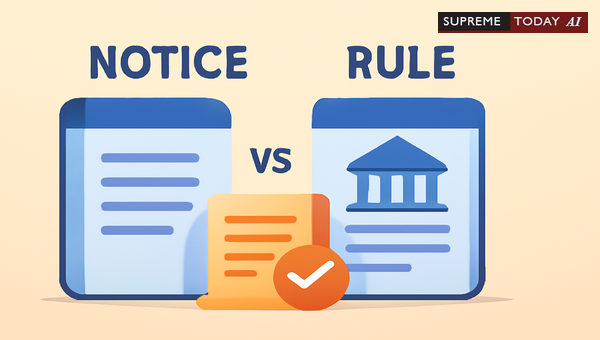
Notice vs. Rule: Understanding the Fundamental Legal Distinctions

In the realm of law, terms like notice and rule are frequently encountered, yet they serve distinctly different roles. Whether you're a litigant, business owner, or simply navigating legal proceedings, grasping the difference between notice and rule can prevent costly mistakes. This article delves into their definitions, purposes, formalities, and legal impacts, drawing from judicial interpretations to provide clarity.

What is the difference between notice and rule? At its core, a notice is a communication to inform parties about specific events or actions, while a rule is a binding regulation established under statutory authority. Let's explore this in detail.

Definitions and Nature

A notice is generally a direct and definite statement of a thing, or an intimation, warning, or announcement. 2003 2 Supreme 842 2017 0 Supreme(MP) 165 2022 0 Supreme(Ker) 144 It can be oral or written, aimed at alerting parties to facts like the filing of a suit or an award. Courts have recognized that even informal or oral notices may suffice if actual knowledge is established. 2023 0 Supreme(SC) 152 2022 0 Supreme(Ker) 144

In contrast, a rule constitutes subordinate legislation made under powers from a parent statute. It is a formal, enforceable directive prescribing procedures or standards. 2024 0 Supreme(Cal) 500 2013 0 Supreme(SC) 213 Rules must follow strict promulgation processes to gain legal force.

This distinction underscores that notices are communicative tools, whereas rules create ongoing legal frameworks.

Purpose and Function

Notices: Informing for Due Process

Notices primarily inform parties of impending actions, ensuring awareness of rights and obligations. Examples include notice of filing an award, meeting notices, or notices to quit. 2003 2 Supreme 842 2022 0 Supreme(Ker) 144 They uphold due process in proceedings.

For instance, under the Income Tax Act, 1961, a notice under Section 148 must be served personally; speed post is insufficient, highlighting strict service requirements. 2025 0 Supreme(All) 3109 The court emphasized that Notice under Section 148 must be served personally, not merely addressed, invalidating reassessments without proper delivery.

Rules: Regulating Conduct

Rules establish procedural or substantive standards for law enforcement. They regulate conduct within statutory scopes, such as rules of service or procedure. 2024 0 Supreme(Cal) 500 2021 0 Supreme(AP) 45 Unlike notices, rules have general, prospective application.

Formality and Publication Requirements

Notices offer flexibility: they may be oral or written, served via official channels, with the key being recipient knowledge. However, specific statutes demand rigor, as seen in execution proceedings under Order XXI Rule 22 of the Code of Civil Procedure (CPC), 1908, where notice to judgment debtors is mandatory only in stipulated cases to avoid undue prejudice. 2021 Supreme(Online)(KER) 871

Rules, however, demand formality. Publication in the Official Gazette is mandatory for validity, with the publication date deemed the effective date. 2024 0 Supreme(Cal) 500 2013 0 Supreme(SC) 213 Notification or notification in the Gazette is a formal, published act that confers legal effect and is mandatory for subordinate legislation such as rules. 2024 0 Supreme(Cal) 500

Failure to publish renders rules unenforceable, a stricter threshold than for notices.

Legal Effects and Enforceability

A notice lacks inherent legal force unless statutorily mandated; it's challengeable if improperly issued. Its role is informational, triggering awareness rather than imposing obligations directly.

Rules, once duly promulgated, carry the force of law. Non-compliance with them invites penalties, but procedural lapses like absent publication invalidate them entirely.

In compromise scenarios under CPC Order XXIII Rule 3, courts distinguish parts of the rule: What is the difference between the first part and second part of Rule 3? The first part refers to situations where an agreement or compromise is entered into in writing and signed by the parties. 2019 0 Supreme(Guj) 907 2019 0 Supreme(Guj) 970 2014 0 Supreme(Mad) 4394 2013 0 Supreme(Guj) 258 2013 0 Supreme(SC) 205 This illustrates rules' binding nature when properly executed.

Exceptions and Contextual Nuances

Exceptions exist: oral notices may hold in relaxed contexts if knowledge is proven. Similarly, rules not published per procedure are void. 2013 0 Supreme(SC) 213

In some cases, like care being taken phrasing in rules, courts interpret broadly when read with context, narrowing strict differences.

MENON v. PERERA

Yet, the formalities for rules remain stricter overall.

Tax and civil procedure cases reinforce this: personal service for notices under Section 282 of the Income Tax Act, versus gazette publication for rules. 2025 0 Supreme(All) 3109

Practical Recommendations

  • For Notices: Comply with statutory service methods (e.g., personal delivery where required) and document proof to avoid challenges.
  • For Rules: Confirm gazette publication and procedural adherence before reliance.
  • In Disputes: Scrutinize issuance validity—improper notices may halt proceedings, unpublished rules lack enforceability.

Note: This is general information based on judicial precedents and not specific legal advice. Consult a qualified lawyer for your situation.

Key Takeaways

| Aspect | Notice | Rule ||-----------------|---------------------------------|-----------------------------------|| Nature | Informational communication | Binding subordinate legislation || Form | Oral/written, flexible | Formal, written, published || Publication| Often not required | Mandatory in Official Gazette || Effect | Triggers awareness | Enforces law generally |

In summary, while both facilitate legal processes, notices communicate specifics informally, and rules legislate formally with publication mandates. Understanding this prevents procedural pitfalls. 2003 2 Supreme 842 2024 0 Supreme(Cal) 500

Stay informed on legal nuances to safeguard your interests—knowledge is your first line of defense.

#NoticeVsRule, #LegalBasics, #SubordinateLegislation

Chat Download
Chat Print
Chat R ALL
Landmark
Strategy
Argument
Risk
Chat Voice Bottom Icon
Chat Sent Bottom Icon
SupremeToday Portrait Ad
logo-black

An indispensable Tool for Legal Professionals, Endorsed by Various High Court and Judicial Officers

Please visit our Training & Support
Center or Contact Us for assistance

qr

Scan Me!

India’s Legal research and Law Firm App, Download now!

For Daily Legal Updates, Join us on :

whatsapp-icon Back to top