Searching Case Laws & Precedent on Legal Query..!
Scanned Judgements…!



Searching Case Laws & Precedent on Legal Query..!
Scanned Judgements…!
Right to Worship - The right to worship the deity is recognized as a civil right that belongs to the community or individuals, not necessarily requiring the deity to be a party to legal proceedings. The community has an equal right to worship and participate in religious functions, regardless of sub-sects or sectarian differences. The deity's worship is for the deity's benefit, and interference with this right can be challenged in civil courts. ["2022 0 Supreme(Kar) 445"], ["2023 0 Supreme(Mad) 1640"], ["2025 Supreme(Online)(Ker) 45891"]
Deity as a Necessary Party - The deity itself is not a necessary party in legal disputes concerning worship rights or temple management. Courts have emphasized that disputes over rituals, ceremonies, or worship rights can be adjudicated without involving the deity as a party, since the rights are personal and community rights, and the deity is considered an object of worship rather than a legal entity. ["2024 0 Supreme(Mad) 2257"], ["2022 0 Supreme(All) 689"]
Temple Definition and Worship Rights - A temple is defined as a place of public religious worship where a deity is installed. The presence or absence of a physical deity does not bar the recognition of a temple or the exercise of worship rights. The non-existence of a deity is not of evidentiary value in legal disputes, as the belief itself is protected under Article 25 of the Constitution if genuinely and conscientiously held. ["2025 0 Supreme(Ker) 2859"], ["2023 0 Supreme(Mad) 1640"], ["ASHISH AND 5 ORS vs MURTI SHRI RAMCHANDRA VIRAJMAN AND 20 ORS - Allahabad"]
Rituals and Ceremonies - Rights to perform specific rituals like Mandagapadi or Vidayatru Sevai are considered religious rights, which can be protected through civil law. Disputes over such rituals are civil in nature, and courts can adjudicate them without involving the deity as a party. The focus is on ensuring that worship and ceremonies are performed for the deity's benefit, not for individual or sectarian interests. ["2024 0 Supreme(Mad) 2257"], ["2025 Supreme(Online)(Ker) 45891"]
Management and Worship - The managerial rights of temples, including appointing pujaris and managing properties, are separate from the right to worship. Shebaits or management committees hold the authority to oversee temple affairs, and their actions are subject to civil law. Worship rights can be exercised by community members or designated persons without involving the deity as a party. ["2025 Supreme(Online)(MP) 6095"], ["2025 Supreme(Online)(Ker) 45891"]
Analysis and Conclusion:Legal disputes concerning worship rights and temple management do not require the deity to be a party to the suit. The rights to worship are personal and community rights, protected under constitutional provisions and civil law, and can be adjudicated independently of the deity's legal status. The deity itself is not a necessary party in such proceedings, and courts focus on safeguarding the worshippers' rights and temple functions without involving the deity as a litigant.
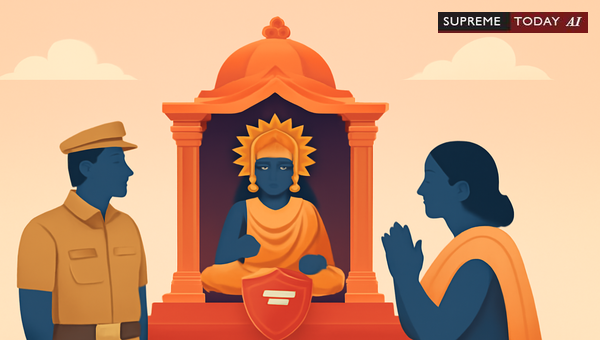
In India, where religious practices form the bedrock of cultural identity, disputes over temple access and worship rights frequently reach the courts. Imagine a community seeking to perform traditional rituals at a historic temple, only to face opposition from locals or authorities. Can they file for an to protect their right to worship, and crucially, must the deity itself be named as a necessary party? This question—Suit for for Protection of Worship Right: Is Deity a Necessary Party?—lies at the heart of many religious litigation cases.
This blog delves into recent judicial insights, examining whether courts mandate the deity's inclusion in such suits, the preference for police protection over formal injunctions, and broader principles from Indian jurisprudence. While courts uphold the fundamental right to worship, the remedies and party requirements vary by context.
The right to worship is enshrined under , guaranteeing freedom of religion subject to public order, morality, and health. When this right faces threats—such as interference during festivals—petitioners often approach courts for urgent relief.
In a key case, the court recognized the petitioner's and community's right to worship the deity at Kattu Karuppanasamy Kovil2017 0 Supreme(Mad) 250. Facing objections from the fifth respondent, the court intervened not with an explicit but by directing police protection to ensure the right could be exercised peacefully2017 0 Supreme(Mad) 250. This order highlights how courts prioritize practical safeguards over formal injunctive terminology.
The document does not mention granting a specific prohibiting interference. Instead, it emphasizes police protection as a means to uphold the right, especially during festivals 2017 0 Supreme(Mad) 250. The court's directive to respondents 1 to 4 to provide necessary police force underscores a pragmatic approach: maintaining order to facilitate worship without escalating disputes.
This aligns with Indian jurisprudence, where courts can grant injunctions to prevent violations of fundamental rights, including the right to worship, but often opt for police protection in community-sensitive matters 2017 0 Supreme(Mad) 250. Such orders serve a similar purpose to injunctions—preventing disturbances—without the procedural rigidity of a formal suit under Order 39 of the .
A pivotal question in worship rights suits is whether the deity, treated as a under Hindu law, must be joined as a party. The answer isn't absolute; it depends on the suit's nature.
When proceedings involve the deity's property, the deity is a necessary party. Any judgment without it would not bind the deity, per the 2009 0 Supreme(Ori) 129. For instance, in sales of temple land under the , the deity requires protection from its marfatdar as a perpetual/minor/disable person 2009 0 Supreme(Ori) 129. Courts must safeguard its interests, even allowing worshippers without proprietary claims to intervene.
In any Court proceeding wherever the property of the deity is involved the deity is a necessary party2009 0 Supreme(Ori) 129. This principle ensures the deity's title and rights remain intact.
However, in suits focused purely on worship access or administration schemes, the deity may not be indispensable. For example, in a suit where rules are sought to be framed for administration of the properties, the deity is not a necessary party1988 0 Supreme(Ker) 170. A Division Bench noted that if no one's interests beyond the parties are affected, the deity needn't be joined, especially among (managers) inter se.
Similarly, in scheme-settlement suits under , for temple properties like Kozhuvalloor Bhagavathi Temple, the deity is not a necessary party unless its interests are likely to be affected1988 0 Supreme(Ker) 170. Courts grant leave to sue without the idol, resolving non-joinder issues during trial.
Public access cases reinforce this nuance. Public right to worship does not automatically make a temple public, as mere visitor influx isn't conclusive 2004 0 Supreme(Ker) 146. Yet, where dedication for exists, like daily poojas and festivals, institutions qualify as public temples 2008 0 Supreme(Mad) 495.
Other rulings illustrate balanced approaches to worship amid restrictions:
In a forest reserve dispute, courts permitted worship under the , and , with conditions to protect ecology. Religious practices are important but cannot infringe on ecological protections2024 Supreme(Online)(MAD) 16379.
Petitioners sought permission for pooja on specific dates, with courts allowing timed access: members of the above community to visit the temple and worship the deity between 09.00 a.m. to 03.00 p.m.2024 Supreme(Online)(MAD) 16379.
Rights like for ceremonial worship during puja are upheld for specific communities 2017 0 Supreme(Mad) 250 2025 Supreme(Online)(Mad) 70032).
These cases show courts favoring conditional relief—time-bound access or police oversight—over blanket injunctions, without always requiring the deity as a party when the focus is worship facilitation, not property alienation.
Courts often prefer direct protective orders like police protection over injunctions in religious disputes to maintain peace [. This avoids protracted litigation while achieving the same goal: unimpeded worship.
Even non-proprietors, as devotees, may approach courts. A worshipper having no interest in the property may approach the authority or Court to protect the deity's interests 2009 0 Supreme(Ori) 129.
While explicit injunctions for worship protection aren't always granted, courts robustly defend religious freedoms through alternatives like police deployment 2017 0 Supreme(Mad) 250. The deity is a necessary party primarily in property-involved suits 2009 0 Supreme(Ori) 129, but not invariably in administration or access-focused ones 1988 0 Supreme(Ker) 170. This flexible approach balances devotion with order.
Key Takeaways:- Right to worship is fundamental, enforceable via protective orders.- Deity's joinder depends on proceeding type—mandatory for property, optional for schemes.- Police protection often substitutes injunctions in festivals/disputes.
This analysis is for informational purposes only and based on cited cases. It does not constitute legal advice. Consult a qualified lawyer for case-specific guidance.
References:- 2017 0 Supreme(Mad) 250, 2009 0 Supreme(Ori) 129, 1988 0 Supreme(Ker) 170, 2024 Supreme(Online)(MAD) 16379, 2008 0 Supreme(Mad) 495, 2004 0 Supreme(Ker) 146, 2025 Supreme(Online)(Mad) 70032
#WorshipRights #TempleLaw #DeityParty


Vatty and Siregondanahalli village, Gudikattu irrespective of sub-sects and the people of the said community have equal right to worship and have a right to participate in the functions and uthsavas of the deity during festivals and it was also ordered that it was just and necessary in the smooth management ... Before instituting any suit, it would be necessary for the people of the community i.e., Hori Kuruba Community to sit together and decide about the place of placing the #HL_STAR....

It is not for the benefit of any individual or for the benefit of any particular community but for the deity to be worshipped in all glory. If there is worship. keeping in mind the deity, then peace and harmony would prevail. If not there is no point in stating that there is a right to worship. ... A corresponding duty is cast upon every worshipper who enters the portals of that temple to enter with the object to worship the deity a....

"Temple" means a place of public and religious worship by Hindus where deity is installed under a building and includes a mutt also: Provided that any structure on the road side pavement or in a compound of a private building with or without deity shall not be considered as a Temple ... Necessary materials will have to be collected. ... He submitted that any structure in a compound of a private building with or without deity shall not be considered as a temple, church....
It is not in dispute that the case on hand involves the right to perform Mandagapadi. Mandagapadi is a ceremony of receiving the deity at a particular place during the festival. It is however not a mere ceremony or ritual. The purpose of Mandagapadi is to offer worship to the deity. ... The respondent herein/plaintiff filed the said suit seeking permanent injunction to restrain the revision petitioner/D2 from performing what is known as “Vidayatru Sevai” for Shri Namm....
If he is a party to the lis, he can challenge it as a matter of right. If he is not a party to the lis and still aggrieved by the decision, he can challenge it after getting leave of the Court. ... of Nalayira Divya Prabandham during Ceremonial Worship of Deity in the Temple. ... This Adhiapaka Mirasi right shall be exercised by the Members of the Southern Cult during Ceremonial Worship (Puja Service) of Deity in the Temple. ... In ....

The performance of religious worship as a pujari is not the same as the exercise of the rights of management. A manager may appoint one or several pujaris to conduct the necessary ceremonies. ... In an appropriate case, the court can do so of its own accord where it considers it necessary to protect the interest of the deity. ... A shebait is vested with the authority to manage the properties of the deity and ensure the fulfilment of the purpose for which the property was dedicated. As....
Right to worship is a civil right, of course in an accustomed manner and subject to the practice and tradition in each temple. ... Narendran, J.] was a party reiterated that politics has no role to play in the conduct of daily worship and ceremonies and festivals in temples. In the said decision, it was held that cultural or social activities unconnected with temple worship have no role to play in temple festivals. ... While the worship of the deity ....

(ii) The Hindu Law recognises dedications for the establishment of the image of a deity and for the maintenance and worship thereof. ... In the instant case, the endowment deed executed by Kedar Nath Mishra on 17.8.1949 clearly states that the property mentioned was dedicated to “Lord Ram Chandraji” and the deed further took note of the fact that the possession was also transferred to the deity and the doner did not keep any right with ... He had appointed Kailash Nath Agrawal to manage the affairs and....
and the doner did not keep any right with him. ... and claiming to be the next friend of the deity. ... whether it was installed or not. ... It is immaterial that the image of the deity has not been efficacious independently, even if the idol does not exist.

It was submitted by the petitioner that they may be permitted to worship the deity and perform the pooja and other rituals on 09.08.2024 and 10.08.2024. ... (MD)No.11295 of 2023, whereby, this Court had permitted the members of the above community to visit the temple and worship the deity between 09.00 a.m. to 03.00 p.m. ... the deity on 10.08.2024 between 9.00 a.m. and 4.00 p.m. ... They should carry very minimal things which are highly essential to worship the deity#HL_END....

It is not denied that the plaintiff has a right to worship whichever deity he pleases, however he is not a contender for the office held by defendant no. It is not denied that the plaintiff has a right to worship whichever deity he pleases, however he is not a contender for the office held by defendant no. It is not denied that the plaintiff has a right to worship whichever deity he pleases, however he is not a contender for the office held by defendant no. It is not denied that the plaintiff has a right to worship whichever dei....

More so, it would be violative of the principles of natural justice (Vide Udit Narain Singh Malpaharia Vs. Addl. In any Court proceeding wherever the property of the deity is involved the deity is a necessary party. Any judgment or order behind its back would not be binding on the deity in view of the provisions contained in the proviso to Order 1, Rule 9, CPC (hereinafter called the “CPC”).
2) Whether there is free access to public to worship the deity as a matter of right? 3) The important features required to consider the involvement of the public in the regular important activities of the institution. 1) Is there any dedication of property to perform public charity?

“It may thus be noticed that this court has invariably held that the mere fact that the members of the public used to visit the temple for the purpose of worship without any hindrance or freely admitted therein would not be a clear indication of the nature of the endowment. In Kunhunni Namboodiripad v. Cochin Devaswom Board (1964 KLT 1034) learned single judge of this court held that the prevailing impression in Kerala would seem to have been that Namboodiri temples were private. It is manifest that whenever a dedication is made for religious purposes and a deity installed in a tem....

But, in a suit where rules are sought to be framed for administration of the properties, the deity is not a necessary party. A Division Bench of the Calcutta High Court after referring to some decisions on the point held that where in a case none else except the parties to the suit were interested in the deity and when it was not suggested that the deity's interest would in any way be affected by adjustment of the rights of management among the shebaits inter se, the deity was not a necessary party to the suit. No doubt in suits where the right or title over the properties ....


An indispensable Tool for Legal Professionals, Endorsed by Various High Court and Judicial Officers
Please visit our Training & Support
Center or Contact Us for assistance

Scan Me!
India’s Legal research and Law Firm App, Download now!


For Daily Legal Updates, Join us on :



 Back to top


