SupremeToday Landscape Ad

AI Overview

AI Overview...

  • Compassionate Appointment Denial Due to Service Criteria - Main points and insights:
  • Several cases highlight that the primary reason for denial is the applicant's father having less than three years of service remaining at the time he was declared medically unfit or passed away. For instance, ["2024 Supreme(Online)(CAT) 16895"] states, the applicant's father had less than three years of service left at the time he was declared medically unfit, leading to rejection based on Railway Board guidelines.
  • Some authorities emphasize strict adherence to procedural timelines, such as applications not being filed within three years of the family member's death, as seen in ["2024 0 Supreme(Mad) 649"] and ["2024 0 Supreme(Mad) 2335"], although courts have sometimes considered delayed applications favorably, especially when made by minors upon attaining majority.
  • Several judgments underscore that delay in applying should not automatically disqualify claims, especially when the applicant was a minor at the time of the death, and representations were made promptly after attaining majority ["2024 Supreme(Online)(CAT) 16895"], ["2024 0 Supreme(Mad) 2335"].
  • Rejections often cite policy restrictions, such as denying benefits to second wives or children from subsequent marriages, based on policies discouraging bigamy, as discussed in ["2022 Supreme(Online)(MAD) 16614"] and ["2024 0 Supreme(All) 168"].
  • There are instances where the courts have directed authorities to reconsider cases, emphasizing that denials without proper reasoning or based on procedural lapses are illegal ["2025 Supreme(Online)(CAT) 5299"], ["2025 Supreme(Online)(CAT) 13675"], ["2025 Supreme(Online)(CAT) 927"].
  • Some decisions recognize that children of void or contested marriages, once legally recognized, should be eligible for compassionate appointment, and excluding them violates constitutional principles ["2024 Supreme(Online)(CAT) 179"].
  • A recurring theme is that the purpose of compassionate appointment is to provide immediate relief to families suffering financial hardship due to the death of the breadwinner, and procedural or policy barriers should not hinder genuine claims ["2024 Supreme(Online)(CAT) 8449"], ["2024 Supreme(Online)(CAT) 16371"].
  • The importance of considering dependency and the applicant's dependence on the deceased, especially in cases where the applicant is a minor or dependent, is emphasized, with courts sometimes ruling in favor of the applicant despite procedural delays ["2024 Supreme(Online)(CAT) 15432"].

  • Analysis and Conclusion:

  • The main contention revolves around whether procedural lapses, such as delayed applications or lack of certain documents, should bar legitimate claims for compassionate appointment. Courts have increasingly taken a liberal view, emphasizing the humanitarian purpose of such schemes and directing authorities to reconsider claims fairly ["2025 Supreme(Online)(CAT) 5299"], ["2025 Supreme(Online)(CAT) 13675"].
  • Denial based solely on technicalities, such as the applicant's age, marriage status, or procedural delays, is often challenged as unconstitutional or unjust, particularly when the applicant is dependent or the delay was reasonable given circumstances like minority ["2024 Supreme(Online)(CAT) 15027"], ["2024 Supreme(Online)(CAT) 179"].
  • Policies restricting benefits to first marriages or specific categories are scrutinized, with courts recognizing that such restrictions may violate constitutional guarantees and that children from legally recognized relationships should not be arbitrarily excluded ["2022 Supreme(Online)(MAD) 16614"], ["2024 Supreme(Online)(CAT) 179"].
  • Overall, the trend indicates that courts favor a broad, equitable interpretation of compassionate appointment schemes, ensuring families and dependents are not unjustly deprived of relief due to procedural or policy technicalities, especially when the purpose is to mitigate hardship and uphold constitutional rights.

References:- ["2024 Supreme(Online)(CAT) 16895"]- ["2024 0 Supreme(Mad) 649"]- ["2025 Supreme(Online)(CAT) 5299"]- ["2025 Supreme(Online)(CAT) 13675"]- ["2025 Supreme(Online)(CAT) 927"]- ["2024 Supreme(Online)(CAT) 179"]- ["2024 Supreme(Online)(CAT) 8449"]- ["2024 Supreme(Online)(CAT) 15027"]- ["2024 Supreme(Online)(CAT) 16371"]- ["2024 Supreme(Online)(CAT) 15432"]

Compassionate Appointment Challenges for Fathers with Three Children under Rajasthan Rules

Compassionate Appointment Denied for Father of Three Children: A Legal Breakdown

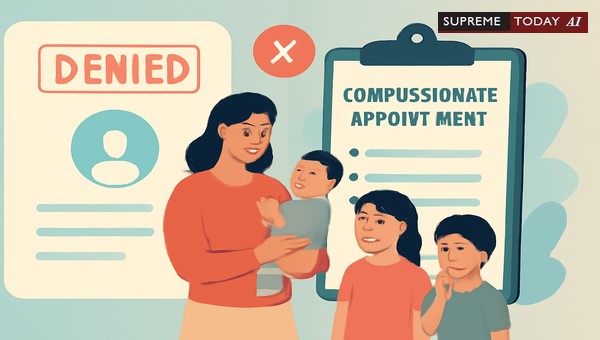
Losing a family breadwinner, especially a government servant, can plunge a family into financial distress. In such cases, compassionate appointments offer a lifeline by providing a job to a dependent. But what happens when the application is denied because the petitioner is the father of three children? This question—Compassionate Appointment Denial Due to Petitioner Applicant Father of Three Children—highlights a common yet contentious issue in Indian administrative law, particularly under schemes like the Rajasthan Compassionate Appointment of Dependents of Deceased Government Servants Rules, 1996.

In this post, we delve into the legal principles, eligibility hurdles, landmark cases, and practical advice. Note: This is general information based on precedents and should not be taken as specific legal advice. Consult a qualified lawyer for your situation.

Understanding Compassionate Appointments

Compassionate appointments are not a vested right but a benevolent measure to provide immediate financial support to the bereaved family after the sudden death of the breadwinner. The core purpose is to help the family tide over the sudden crisis resulting from the death of the bread earner. As emphasized in judicial rulings, these appointments alleviate immediate hardship, not long-term employment guarantees. 2008 0 Supreme(SC) 357 2014 2 Supreme 417

Authorities scrutinize applications rigorously. Denial often stems from failing eligibility criteria, such as family financial status or compliance with government guidelines on family size.

Key Eligibility Criteria and Denial Grounds

1. Financial Condition is Paramount

The family's overall financial health is the litmus test. If the family can sustain itself—through pensions, property, or other income—the request may be rejected. Courts have ruled that compassionate appointments are reserved for families in dire financial straits. 2008 0 Supreme(SC) 357 2014 2 Supreme 417

For instance, in one case, the court upheld denial after the family managed for 29 years post-death, stating there was no necessity to depart from the normal rule of appointment and show favor to one at the cost of interests of several others, ignoring the mandate of Article 14 of the Constitution. This underscores that delay or self-sufficiency weakens claims.

2. Family Size Restrictions

Government circulars, especially in Rajasthan, often restrict eligibility for applicants with more than two children. A father of three may face denial if this violates such guidelines. In Chagan Lal Nenama Case, the petitioner was denied due to having four children, and the court upheld it, stressing adherence to rules. 2022 0 Supreme(Raj) 677

The petitioner was denied compassionate appointment due to having four children, which was deemed a violation of the government circular. 2022 0 Supreme(Raj) 677

Similar logic applies to three children in some policies, prioritizing smaller families amid population control policies.

3. Legitimacy of Children and Constitutional Rights

Children from void or voidable marriages are legitimate under Section 16 of the Hindu Marriage Act, 1955. Denying benefits to such children violates Article 14 (equality). In the Mohan Singh Case, the court ruled denying compassionate appointment to legitimate children from a second marriage unconstitutional. 2022 0 Supreme(Raj) 2312

The Supreme Court has held that children born from void and voidable marriages are considered legitimate... Denying compassionate appointment to such children is unconstitutional. 2022 0 Supreme(Raj) 2312

However, this doesn't override family size or financial criteria.

4. Timeliness and Procedural Compliance

Significant delays justify denial, as the scheme targets immediate relief. Applications must include mother's consent if applicable, per G.O.Ms.No.350. Non-speaking orders (lacking reasons) can be challenged. 2025 Supreme(Online)(Tel) 75000 1996 7 Supreme 654

Learned counsel appearing on behalf of the petitioner submits that the impugned order is a non-speaking order, devoid of reasons... 2025 Supreme(Online)(Tel) 75000

Landmark Case Law Insights

  • Mohan Singh Case: Affirmed rights of all legitimate children, regardless of parental marriage status. Denial on legitimacy grounds fails constitutional muster. 2022 0 Supreme(Raj) 2312

  • Chagan Lal Nenama Case: Upheld denial for excess children, reinforcing policy adherence. 2022 0 Supreme(Raj) 677

  • Delay Cases: Post-29-year survival negates urgency. The family had managed to survive for 29 years, and there was no necessity... (Drawing from established precedents like 1989(4) SCC 468).

  • Marks for Dependents: In selection processes, extra marks for minor children (e.g., 15 marks for three minors) may factor in, but aren't decisive if other criteria fail. 2023 0 Supreme(J&K) 225 Learned counsel for the petitioner submitted that 15 more marks ought to have been awarded... in view of three minor children... 2023 0 Supreme(J&K) 225

These cases illustrate courts' balanced approach: empathy tempered by rules.

Integrating Financial and Family Assessments

Authorities assess:- Income sources: Pensions, rentals, agriculture.- Assets: Property, savings.- Dependents: Number and needs, but capped by policy.

If a father of three shows penury despite family size, approval chances rise with strong documentation. Conversely, self-sufficiency or policy violation seals denial.

From broader precedents: Compassionate appointment is intended to enable the family of the deceased employee to tide over the sudden crisis... This principle recurs, prioritizing crisis over entitlement.

Recommendations for Applicants

To bolster your case:1. Apply Promptly: Within 3-5 years ideally.2. Document Finances: Affidavits, income proofs showing indigence.3. Address Family Size: Argue necessity if children are minors/dependents.4. Challenge Non-Speaking Orders: Writ petitions under Article 226.5. Seek Legal Aid: For constitutional angles like Article 14.

Future applicants should align with Rajasthan Rules, 1996, emphasizing financial distress over mere relation to deceased. 2003 0 Supreme(Raj) 1273 2007 0 Supreme(Raj) 1593

Conclusion and Key Takeaways

Denials for fathers of three children often hinge on family size policies, financial stability, and timeliness—backed by robust precedents. While schemes like compassionate appointments provide vital support, they demand strict compliance. 2008 0 Supreme(SC) 357 2014 2 Supreme 417 2022 0 Supreme(Raj) 677

Key Takeaways:- Not a right; for immediate relief only.- Prove dire need; family size can disqualify.- Legitimate children protected constitutionally.- Timely, documented applications succeed.

References: 2008 0 Supreme(SC) 357 2014 2 Supreme 417 2022 0 Supreme(Raj) 2312 2022 0 Supreme(Raj) 677 1996 7 Supreme 654 2003 0 Supreme(Raj) 1273 2007 0 Supreme(Raj) 1593 2025 Supreme(Online)(Tel) 75000 2023 0 Supreme(J&K) 225

Facing denial? Gather evidence and consult experts. This analysis draws from judicial wisdom to guide, not dictate, your path.

#CompassionateAppointment #LegalAidIndia #GovtJobs
Chat Download
Chat Print
Chat R ALL
Landmark
Strategy
Argument
Risk
Chat Voice Bottom Icon
Chat Sent Bottom Icon
SupremeToday Portrait Ad
logo-black

An indispensable Tool for Legal Professionals, Endorsed by Various High Court and Judicial Officers

Please visit our Training & Support
Center or Contact Us for assistance

qr

Scan Me!

India’s Legal research and Law Firm App, Download now!

For Daily Legal Updates, Join us on :

whatsapp-icon Back to top