CrPC and the Role of the Collector in India
In the intricate web of India's legal system, the Collector—often serving as the District Magistrate—holds a crucial position at the intersection of administration and criminal justice. The query Crpc in Collector Ki Bhumika (CrPC in the Role of the Collector) highlights this vital dynamic. This blog post delves into how the Criminal Procedure Code (CrPC) empowers and protects Collectors, drawing from key legal provisions and real-world cases. Whether you're a legal professional, public servant, or citizen navigating disputes, understanding these roles can provide clarity on public order maintenance and administrative accountability.
Note: This article offers general information based on legal precedents and is not specific legal advice. Consult a qualified lawyer for personalized guidance.
Overview of the Collector's Role Under CrPC
The Collector is more than an administrative head; under the CrPC, they act as a frontline enforcer of public safety. As District Magistrate, the Collector can issue urgent orders and initiate proceedings to prevent breaches of peace. This role ensures swift action in crises, balancing authority with legal safeguards.
Key aspects include:- Public Order Management: Collectors intervene in potential disturbances.- Prosecution Safeguards: Protections against frivolous suits.- Complaint Initiation: Legitimizing actions in official capacity.
These functions stem from specific CrPC sections, as outlined below.
Key Legal Provisions Involving the Collector
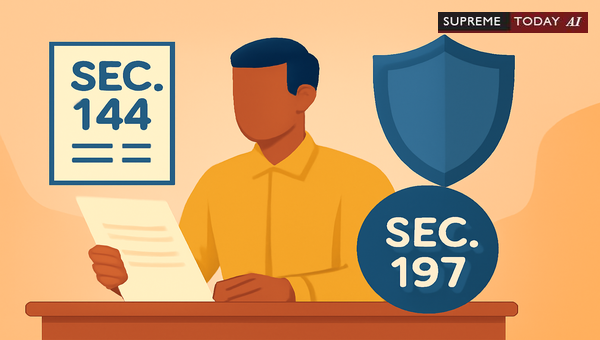
Section 197 CrPC: Sanction for Prosecution
Section 197 CrPC requires prior government sanction to prosecute public servants, including Collectors, for acts done in official duties. This shield prevents harassment through baseless litigation, allowing fearless duty performance. This section mandates that for the prosecution of public servants, including Collectors, sanction is required if the alleged act was performed in the discharge of their official duties. This protection is crucial in ensuring that public servants can perform their functions without the fear of frivolous litigation 2011 8 Supreme 700
In practice, this applies when Collectors enforce land laws or public policies, ensuring actions within scope are protected 2011 8 Supreme 700.
Section 144 CrPC: Preventive Orders for Public Tranquility
Empowering District Magistrates (Collectors), Section 144 allows prohibitory orders to avert imminent public order threats. Collectors can restrict assemblies or activities posing risks to peace. The Collector, as a District Magistrate, has the authority to issue orders under Section 144 to prevent imminent threats to public order. This provision allows the Collector to act swiftly in situations where there is a risk of disturbance to public peace 2009 0 Supreme(Ori) 381 2012 2 Supreme 36
This power is pivotal in riots, protests, or communal tensions, enabling immediate intervention.
Complaints by Public Servants
Complaints from Collectors or assistants are deemed official, bolstering legitimacy in legal actions. Complaints made by public servants, including those by the Collector or their assistants, are considered to be made in the discharge of their official duties. This principle supports the legitimacy of actions taken by Collectors in initiating legal proceedings against individuals or entities that violate laws 1962 0 Supreme(Mad) 25
Practical Implications and Case Insights
The Collector's CrPC role extends beyond theory into enforcement and disputes:
Enforcement of Law and Public Safety
Protection from Malicious Prosecution
- Section 197 safeguards ensure duty-bound actions face no undue legal threats 2011 8 Supreme 700.
Real cases illustrate these dynamics. In a tragic incident, Bhumika Sahu reported her brother's death to police, but no action followed until her Section 156(3) CrPC application to the Judicial Magistrate, Durg. Incident was reported to concerned Police Station but Police has not taken any action till complainant Bhumika Sahu filed an application dated 30.07.2020 under Section 156(3) of CrPC before the Judicial Magistrate, First Class, Durg... His body hanging was seen by Bhumika Sahu, sister of deceased
SMT. NEETU SAHU vs STATE OF CHHATTISGARH - Chhattisgarh
This underscores Collector's indirect role in criminal probes, where administrative oversight influences investigations
SMT. NEETU SAHU vs STATE OF CHHATTISGARH - Chhattisgarh
In employment disputes, Collectors handle appointments and cancellations. For instance, the Collector of Dhamtari appointed Bhumika Angare under a watershed project, later canceled, prompting a writ petition 2025 Supreme(Online)(CHH) 3379. Such cases highlight scrutiny of Collector's decisions in judicial reviews.
Land and mining disputes also involve Collectors. In Chandrapur, the District Mining Collector featured in family court matters over visitation rights for minor daughter Bhumika
PRAVIN SHIRPATRAO SHEWARE vs ALKA PRAVIN SHEWARE - Bombay
SHRI. PRAVIN S/O SHRIPATRAO SHEWARE vs SMT. ALKA D/O NAMDEO KHEDKAR - Bombay
.
Family welfare intersects too: Petitions under Section 125 CrPC for maintenance involved disputes, with courts invoking Section 482 for quashing proceedings 2023 Supreme(Online)(P&H) 10635
KAPIL AND ANOTHER Vs STATE OF HARYANA AND OTHERS - Punjab and Haryana
2024 Supreme(Online)(MP) 38496 2024 Supreme(Online)(MP) 28985Broader Administrative Overlaps
These examples show Collector's multifaceted CrPC interface, from preventive orders to supporting probes.
Challenges and Judicial Oversight
While empowered, Collectors' actions undergo review. Courts ensure procedural fairness, as in Section 482 CrPC quashing petitions or bail under Section 439. For the aforesaid reasons, this appears to be a fit case for this Court to invoke the inherent powers under Section 482 of t...
KAPIL AND ANOTHER Vs STATE OF HARYANA AND OTHERS - Punjab and Haryana
In maintenance disputes, Section 125 CrPC claims arise alongside administrative records 2023 Supreme(Online)(P&H) 10635
Conclusion and Key Takeaways
The Collector's role under CrPC is indispensable for public order, blending administrative prowess with legal authority. Provisions like Sections 144 and 197 empower decisive action while offering protections, as seen in diverse cases from criminal complaints to family matters.
Key Takeaways:- Seek sanction under Section 197 for prosecuting Collectors in official acts 2011 8 Supreme 700.- Use Section 144 judiciously for unrest prevention 2009 0 Supreme(Ori) 381 2012 2 Supreme 36.- Official complaints by Collectors carry presumptive validity 1962 0 Supreme(Mad) 25.- Judicial interventions via Sections 156(3), 125, and 482 ensure accountability.
For those affected, understanding these nuances aids navigation. Always consult legal experts for case-specific strategies.
References:- 2011 8 Supreme 700 2009 0 Supreme(Ori) 381 2012 2 Supreme 36 1962 0 Supreme(Mad) 25-
SMT. NEETU SAHU vs STATE OF CHHATTISGARH - Chhattisgarh
PRAVIN SHIRPATRAO SHEWARE vs ALKA PRAVIN SHEWARE - Bombay
SHRI. PRAVIN S/O SHRIPATRAO SHEWARE vs SMT. ALKA D/O NAMDEO KHEDKAR - Bombay
2023 Supreme(Online)(P&H) 10635KAPIL AND ANOTHER Vs STATE OF HARYANA AND OTHERS - Punjab and Haryana
2025 Supreme(Online)(CHH) 3379 2021 Supreme(Online)(CHH) 162 2024 Supreme(Online)(Chh) 4883 2024 Supreme(Online)(MP) 38496 2024 Supreme(Online)(MP) 28985
#CrPC #CollectorRole #IndianLaw