Searching Case Laws & Precedent on Legal Query.....!
Analysing the retrieved Case Laws
Scanned Judgements…!



Searching Case Laws & Precedent on Legal Query.....!
Analysing the retrieved Case Laws
Scanned Judgements…!
Declaration of Successor in Civil Court - Civil courts can declare a person as the legal successor or heir of a deceased individual, especially in matters involving inheritance, property rights, or legal heirship. Such declarations often require proof of relationship, succession certificates, or court orders based on evidence and applicable laws ["SOMAR SAAY vs UNION OF INDIA - Chhattisgarh"].
Court Orders and Succession - Courts have passed orders recognizing successors, for example, in cases where the court explicitly states that the petitioner is the legal successor or heir, based on documents or evidence presented. For instance, in a case where the grandfather and father are deceased, the petitioner was recognized as the legal successor ["SOMAR SAAY vs UNION OF INDIA - Chhattisgarh"].
Suit for Declaration of Death or Civil Death - Civil courts can also declare a person as legally dead or civilly dead, which affects succession rights. Such suits are permissible under Section 9 of the Civil Procedure Code and involve proving the absence or presumed death of a person for a certain period ["2023 0 Supreme(Cal) 247"].
Recognition of Fictitious Persons and Validity of Wills - Courts scrutinize the authenticity of documents like Wills, especially when linked to fictitious persons. If a Will is executed by a fictitious person, courts may reject it and declare the successor based on other evidence ["2024 Supreme(Online)(Mad) 67599"].
Appellate and Revision Orders - Higher courts, including High Courts and Supreme Court, have the authority to set aside or uphold orders related to succession and successor declaration, emphasizing the importance of proper evidence and legal procedures ["2024 0 Supreme(Telangana) 526"], ["2022 0 Supreme(SC) 1157"].
Analysis and Conclusion:Civil courts have the jurisdiction to declare a successor of a deceased person, either as a legal heir or based on succession certificates, especially when supported by evidence or legal documents. Courts also have the authority to declare civil death or reject fictitious claims, ensuring that succession is based on genuine relationships and valid documents. The recognition of successors is often confirmed through specific court orders, judgments, or statutory provisions, reinforcing that civil courts can effectively declare and establish successor rights in various contexts.
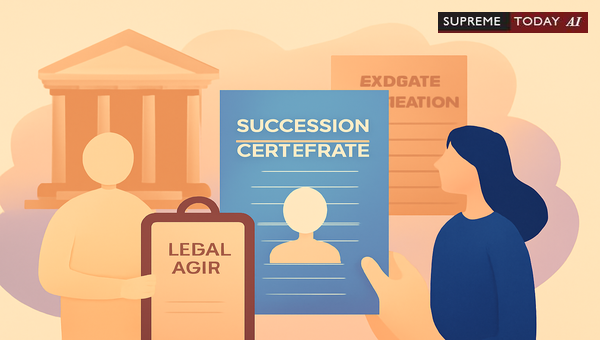
Losing a loved one often raises complex questions about who steps into their shoes legally—especially regarding property, assets, and . A common query arises: Can a civil court declare the successor of a deceased person? This issue touches on , processes, and the boundaries of judicial authority. In this post, we'll break down the legal framework, drawing from established precedents to provide clarity. Note that this is general information and not specific legal advice; consult a qualified attorney for your situation.
play a pivotal role in resolving disputes over estates. Generally, they have to decide questions of succession and inheritance. For instance, even after a is granted, retain authority to determine and based on evidence. This allows them to declare a person as the successor when legal rights are proven through proceedings like or . 2007 0 Supreme(SC) 1364
The court's power stems from its mandate to adjudicate civil matters, including who represents the deceased's estate. This is particularly relevant in cases involving , property disputes, or contested wills.
Who qualifies as a legal successor? The term broadly encompasses persons who, in law, represent the estate of the deceased. This includes , , , or . A key definition from case law states: The expression '' as defined in means any person who in law represents the estate of a deceased person, and includes any person who intermeddles with the estate of the deceased. 1989 0 Supreme(SC) 279
can declare such individuals as successors if they demonstrate entitlement, even in contested scenarios involving a will. 2007 0 Supreme(SC) 1364 1989 0 Supreme(SC) 279
In one related context, a court recognized a petitioner as the legal successor when prior generations (grandfather and father) were deceased, highlighting how lineage establishes rights.
To secure a declaration, claimants must follow established procedures:- : Granted to named , it validates a will and confirms . 2009 8 Supreme 305- : Issued for movable property, proving heirship without a will.- Other Evidence: Birth certificates, family trees, or statutory proofs under .
Courts require solid evidence before declaring successor status. Without it, claims may fail. 2007 0 Supreme(SC) 1364 2009 8 Supreme 305
handle will validity, but can recognize successors post- or in collateral proceedings, even without formal if representation of the estate is clear. 2008 0 Supreme(SC) 567
Yes, may declare a successor when rights are established by law and evidence. This holds in inheritance suits, estate partitions, or disputes. For example, courts assess proof of inheritance or will-based entitlement, declaring accordingly. 2007 0 Supreme(SC) 1364 1989 0 Supreme(SC) 279
However, this power is not absolute. In property transfer cases, cannot override unchallenged instruments without a direct challenge. Under , rights cannot be declared contrary to recitals in valid transfers. 2018 0 Supreme(Tri) 178
Similarly, only can nullify documents like sale-deeds if jurisdictionally appropriate, not administrative bodies like . 2014 0 Supreme(All) 581
While have broad powers, exceptions apply:- Exclusive : typically do not decide a will's genuineness; that's for . 1915 0 Supreme(SC) 16- Proof Requirement: Declaration depends on evidence; contested or lacking proof leads to refusal.- Statutory Bars: Special tribunals (e.g., under land reform acts) may bar civil suits if they act within . intervene only for excess , arbitrariness, or procedural violations. 2006 0 Supreme(Ori) 222- Civil Nature Disputes: Criminal probes halt if a civil court is seized with related issues, like document genuineness, as only declare forgery. 2007 0 Supreme(Pat) 248
In trust or election disputes, courts direct supervisors but defer to specialized authorities for core decisions. 2022 Supreme(Online)(Bom) 3794
If seeking successor status:- Gather evidence: Wills, certificates, genealogical proofs.- File in the appropriate court: for wills, civil for declarations.- Address disputes early via succession proceedings.- Courts ensure legal rights before declarations, promoting fair resolutions.
Precedents reinforce ' role in declarations but stress limits. For instance, in bail contexts, successor courts are noted for procedural continuity, underscoring judicial succession principles.
In service or , courts protect duties but won't declare rights infringing paramount necessities. 2005 0 Supreme(All) 1118
In summary, can declare a successor to a deceased person, provided legal rights are proven via , certificates, or evidence. covers succession questions, but limitations like exclusivity and proof burdens apply. 2007 0 Supreme(SC) 1364 1989 0 Supreme(SC) 279 2009 8 Supreme 305 1915 0 Supreme(SC) 16
Key Takeaways:- handle inheritance declarations post-proof.- Legal successors include and estate representatives.- Always prioritize proper procedures to avoid refusals.- For disputes, seek or specialized forums first.
This framework ensures orderly estate transitions. For personalized guidance, contact a legal professional familiar with your 's nuances.
#SuccessionLaw, #CivilCourt, #InheritanceRights


My attention is invited to the order passed by this Court on 05th May, 2017 in First Appeal No. 2580 of 2016, which reads thus : I. ... Janta Vidya Prasarak Mandal, Sindhkheda, Tq. and district Dhule, be held within a period of six months from the date of this order under the supervision of Assistant Charity Commissioner, Dhule or the prson deputed on his behalf. ... So far as prayer clause ‘D’ of the civil application is concerned, Mr. Deshmukh, the learned Senior Advocate as well Mr. ... It is undisputed that in respect of change report....

Court, in connection with Udakishunganj P.S. ... IN THE HIGH COURT OF JUDICATURE AT PATNA CRIMINAL MISCELLANEOUS No.17135 of 2022 Arising Out of PS. ... be enlarged on bail on his furnishing bail-bond of Rs.10,000/- (Rupees Ten Thousand) with two sureties of the like amount each to the satisfaction of learned A.C.J.M 1st Udakishunganj district-Madhepura/Sucessor ... atul/- (Chandra Prakash Singh, J) U T Patna High Court CR. MISC. ... Patna High C....

below where the case is pending/sucessor court in connection with IN THE HIGH COURT OF JUDICATURE AT PATNA Patna High Court CR. MISC. ... The petitioner has relied upon the judgment of this Court in the case of Heard learned counsel for the parties through virtual court
High Court CR. ... Case No.226/2020 to the satisfaction of learned Judicial Magistrate,Ist Class, Nalanda/sucessor court, subject to following conditions: (i) one of the bailor should be the family member of Patna ... IN THE HIGH COURT OF JUDICATURE AT PATNA CRIMINAL MISCELLANEOUS No.70870 of 2021 Arising Out of PS. ... Learned counsel for the petitioner submits that there is case and counter case in the matter for the same occurrence and Patna High Court CR. MISC. ... Let the de....

COURT MASTER ... Charanjeet Chanderpal, Petitioner-in-prson Mr. Anil Kumar, AOR For Respondent(s) Mr. Sanjay Kapur, AOR Ms. Megha Karnwal, Adv. Mrs. ... In view of the invocation of the remedy by the petitioner in-person, he requests this Court to dispose of the petition, insofar as prayer (a) is concerned without the expression of any opinion by this Court. ... UPON hearing the counsel the Court made the following O R D E R 1 Invoking the jurisdiction of this Court#HL_EN....

That apart in C.S.No.710 of 2022, this Court has clearly recorded a finding to the effect that one C.T.C.Nachiappa Chettiar is also a fictituous prson. Therefore, now the second respondent is relying upon the Will said to have been executed by a fictitius person. 5. ... It is for the petitioner to produce the report of the Invstigation Officer appointed by this Court in W.P.No.47616 of 2006 before the first rspondent. ... in W.P.No.47616 of 2006 and this Court in the said Writ Petition has held that all the documents ha....

In view thereof, he prays that the Court without being hyper-technical may take a pragmatic view and declare that Sanjay has suffered civil death basing upon presumption incorporated in Section 108 of Indian Evidence Act, 1872. 8. ... It can thus be argued that suit for declaration of civil death simpliciter is maintainable under Section 9 of Code. However, a question arises as to whether one has a civil right to declare any other’s death. 12. ... In our opinion, the Civil#HL....

Accordingly, the Appeal is allowed by setting aside the Judgment and Decree dated 11.01.2023 passed in O.S.No.116 of 2020 on the file of learned X Additional Chief Judge, City Civil Court at Hyderabad. ... Aggrieved by the Judgment and Decree dated 11.01.2023 passed in O.S.No.116 of 2020 on the file of learned X Additional Chief Judge, City Civil Court at Hyderabad, the sole plaintiff preferred the present Appeal. 3. ... to declare the plaintiff as absolute owner and possessor of the suit schedule prope....

The findings of the High Court at paragraph No. 11 are as follows: “[11] It is however significant to note that the suit prayer of Maringmei Thaitoungam was not only to declare him as the existing or continuing Chief of Lamdan Kabui Village but also to declare ... The impugned order is an order passed in a Civil Revision Petition. ... It was on this basis essentially that the Court went on to find that the appellate Court erred in not taking note of this vital aspect while considerin....

NAFR grand father name is mentioned he is dead his father is also dead so petitioner is the legal sucessor

Whether without challenge to the instrument of transfer, a civil court can declare the right under Section 44 of the Transfer of Property Act?

This power is given exclusively to a Civil Court, which can only declare a document as null and void. The Court finds that the District Magistrate had no power to declare a sale-deed as null and void.
Moreover, only a regular civil court can only declare whether a paper is forged or genuine one. Now when the civil court is seized with the matter it would not be proper to allow police investigation in respect of same controversy to continue. From the facts and circumstances appearing in the case in my considered opinion, the present dispute is of civil nature.

In this context some of the decisions cited by learned counsel for the parties, which are relevant are indicated below. Act, Civil Court can assume juris¬diction and declare the order of the O.L.R. Now the question is whether in spite of such provision of the O.L.R.
Those orders are justified by the paramount necessity to prevent disturbances. Obviously, the mirasidars who have the duty to lead the service must be protected in the exercise of their duty. A civil court can not in my opinion, be required to declare the right of the plaintiffs to stand.


An indispensable Tool for Legal Professionals, Endorsed by Various High Court and Judicial Officers
Please visit our Training & Support
Center or Contact Us for assistance

Scan Me!
India’s Legal research and Law Firm App, Download now!


For Daily Legal Updates, Join us on :



 Back to top


