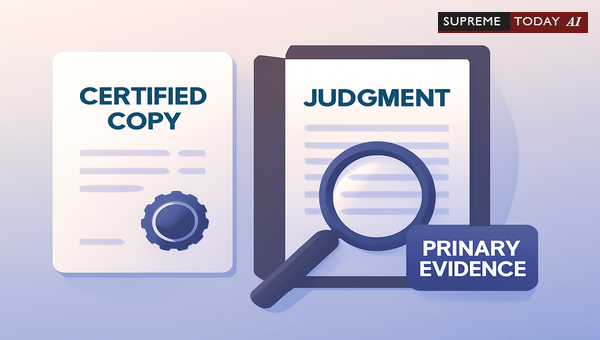
Is Certified Copy of Judgment Primary Evidence in India?
In legal proceedings across India, the authenticity and weight of documentary evidence can make or break a case. One common question that arises is: Whether Certified Copy of Judgment is Primary Evidence? This issue is particularly relevant when parties rely on copies of prior judgments rather than originals, especially in appeals, revisions, or collateral proceedings. Understanding the distinction between primary and secondary evidence under the Indian Evidence Act, 1872, is crucial for lawyers, litigants, and anyone navigating the courts.
This blog post delves into the legal framework, key statutory provisions, judicial interpretations, and practical considerations. While this provides general insights, it is not a substitute for professional legal advice—consult a qualified lawyer for your specific situation.
Primary vs. Secondary Evidence: The Basics
Under the Indian Evidence Act, 1872, documents are classified into primary and secondary evidence to ensure reliability and prevent fraud.
- Primary Evidence is defined in Section 62 as the original document itself, which carries the highest probative value.
- Secondary Evidence, outlined in Section 63, includes certified copies, mechanical copies, or oral accounts of the contents when the original is unavailable.
Section 64 mandates that documents must be proved by primary evidence except in cases specified under Section 65. A certified copy of a judgment falls under secondary evidence because it is a copy of the original judgment, which is the primary evidence. 2018 0 Supreme(Gau) 1677 2013 0 Supreme(Mad) 3950 2001 0 Supreme(Mad) 390 2001 0 Supreme(Mad) 389
This classification ensures courts prioritize originals to verify contents accurately, but secondary evidence like certified copies can be admissible under strict conditions.
Admissibility of Certified Copies of Judgments
Certified copies are not automatically equivalent to originals. Section 65 allows secondary evidence when:- The original is lost or destroyed.- The original is in the adversary's possession and they fail to produce it.- The original cannot be produced without great inconvenience.
Courts presume the genuineness of properly certified copies under Sections 77 (certified copies from public records) and 79 (public documents). However, this presumption is rebuttable if discrepancies or tampering are proven. 2020 0 Supreme(All) 638 2013 0 Supreme(Mad) 3950
For instance, in a case involving a Will, the court emphasized reevaluating admissibility when a certified copy replaces an improper photocopy: Learned trial Court shall accord opportunity to petitioner/defendant to adduce secondary evidence in terms of the judgment, ibid by relying on certified copy of Will. 2023 0 Supreme(P&H) 1447 The ruling set aside an order dismissing secondary evidence, directing the trial court to assess the certified copy properly.
Key Judicial Holdings on Evidentiary Value
Indian courts have consistently held that certified copies prove the contents of judgments as secondary evidence but lack the primacy of originals.
In a property dispute appeal, the court allowed a certified copy of a prior judgment as additional evidence under Order 41 Rule 27 CPC: Certified copy of the judgment in the appeal is produced along with I.A.No.1/12 for being received as additional evidence. 2018 0 Supreme(Kar) 432 This highlights courts' flexibility when documents aid just disposal.
Another example involved illegal constructions where a certified copy was read into evidence: This is a certified copy of a judgment, which can be read into evidence. 2022 0 Supreme(UK) 54 The court relied on it to establish prior findings on encroachments.
Conversely, improper certification leads to rejection. In a foreign judgment case: Therefore, there is nothing on record that the copy, which is claimed to be certified copy of the judgment, is at all the certified copy of the said judgment or not. 2020 0 Supreme(P&H) 636 The court stressed proof of certification per law.
Limitations and Exceptions
While useful, certified copies have boundaries:- They cannot prove execution or authenticity of the original without supporting evidence.
Akbarbhai Kesarbhai Sipai VS Mohanbhai Ambabhai Patel Since Decd. thro his Heirs - Current Civil Cases (2019)
- Procedural compliance is essential, including proper certification and no tampering.
1990 0 Supreme(AP) 341 2001 0 Supreme(Gau) 210In insolvency proceedings, the court noted: Once adjudication is made in this suit, the certified copy of the judgment would be taken as such as evidence. 2009 0 Supreme(Mad) 678 This underscores their role post-adjudication but not as substitutes during trials.
A case on document definition clarified: In the light of the above provisions, I must now examine whether the document P9(a) falls under the above definition of 'Certified copy'.
PEOPLE'S BANK VS. GUNASEKERA AND ANOTHER
Courts scrutinize if copies meet statutory definitions.
In family disputes, certified copies supported maintenance claims but were weighed against originals. 2020 0 Supreme(Guj) 345
Practical Recommendations for Litigants
To maximize evidentiary value:1. Produce the Original First: Always prioritize it if available.2. Ensure Proper Certification: Obtain from authorized custodians with seals and signatures.3. File Applications Timely: Seek permission for secondary evidence under Section 65, explaining the original's unavailability.4. Verify Authenticity: Challenge suspect copies with evidence of forgery.5. Use in Appeals: Certified copies are often accepted as additional evidence under CPC provisions.
In one ruling, the court allowed secondary evidence for a Will after initial rejection of a photocopy, stressing: produce the certified copy and not a photocopy. 2023 0 Supreme(P&H) 1447
Conclusion and Key Takeaways
A certified copy of a judgment is generally classified as secondary evidence under the Indian Evidence Act. It is admissible to prove contents under specific conditions but does not hold the same weight as the primary original. Courts presume genuineness but allow rebuttal, emphasizing procedural rigor.
Key Takeaways:- Rely on Sections 62-65, 77, 79 for guidance.- Originals take precedence; use certified copies judiciously.- Judicial trends favor flexibility but demand proof.- Verify and document everything to avoid rejection.
By understanding these nuances, parties can strengthen their cases. For tailored advice, consult a legal expert familiar with your jurisdiction.
(Word count: approx. 1050. All insights based on referenced judgments; laws subject to interpretation and updates.)
#IndianEvidenceAct, #LegalEvidence, #CourtJudgments