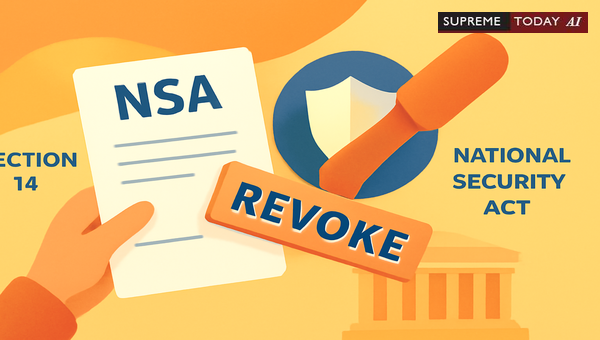
Central Government's Authority to Revoke NSA Detention Orders
In the realm of preventive detention laws in India, one pressing question often arises: Whether Central Govt has Powers to Revoke Detention Order under NSA? The National Security Act, 1980 (NSA) grants significant powers to authorities to detain individuals to prevent threats to public order or security. However, the ability to revoke such orders is equally crucial, balancing individual rights with state interests. This blog delves into the statutory framework, judicial interpretations, and practical considerations surrounding the Central Government's revocation powers under the NSA.
Understanding these powers is vital for legal practitioners, detainees, and policymakers, as they ensure procedural fairness while maintaining national security. Note that this article provides general information based on legal provisions and case law and is not a substitute for professional legal advice.
The Statutory Foundation: Section 14(1) of the NSA
The cornerstone of the Central Government's authority lies in Section 14(1) of the NSA, which explicitly empowers both Central and State Governments to revoke or modify detention orders at any time. The provision reads:
Without prejudice to the provisions of section 21 of the General Clauses Act, 1897 (10 of 1897), a detention order may, at any time, be revoked or modified,— (a) notwithstanding that the order has been made by an officer mentioned in sub-section (3) of section 3, by the State Government to which that officer is subordinate or by the Central Government; (b) notwithstanding that the order has been made by a State Government, by the Central Government. 2013 0 Supreme(Mad) 3351
This language is broad and plenary, using at any time to indicate no temporal restrictions. Importantly, the power is independent of the originating authority—whether a District Magistrate under Section 3(3), State Government, or otherwise. The Central Government can intervene even post-confirmation or during proceedings, without needing prior approval. 2021 0 Supreme(MP) 367
Key points from the statute include:- Revocation applies regardless of the order's origin or stage.- It operates as an overriding authority, supplementing powers of the original detaining body.- Procedural compliance is essential, but does not limit the power itself.
Judicial Backing: Supreme Court and High Court Precedents
Indian courts have consistently affirmed this authority. In Kamlesh Kumar Ishwardas Patel (1995 SCC 51), the Supreme Court held that the revocation power under Section 14(1) is in addition to the power of the authority that has made the order and exercisable at any stage, independent of prior confirmations. The Court emphasized its wide scope, allowing Central Government intervention without fetters, provided statutory bounds are respected. 2021 0 Supreme(MP) 367
Similarly, in Sudeep Jain (W.P. No.21768/2019), courts reiterated that no prior approval of the original order is needed for revocation, reinforcing the Central Government's standalone power. 1995 0 Supreme(All) 1288
Other judgments highlight practical applications:- Central Government can revoke orders passed by District Magistrates or State Governments, as noted in cases where non-communication of representation rights vitiated detentions, underscoring revocation as a remedial tool. 2013 0 Supreme(Gau) 171 On the other hand, the Central Govt. too can revoke the detention order passed by the District Magistrate or State Govt.- In procedural lapses, like failure to inform detainees of representation rights to multiple authorities (including Central Government), orders were quashed, implicitly supporting revocation powers. 2013 0 Supreme(Gau) 171
High Courts have also clarified limits. For instance, revocation must align with law; bad faith or procedural violations can invite challenges. Yet, the power remains robust. 2013 0 Supreme(Mad) 3352
Procedural Safeguards and Limitations
While expansive, revocation is not absolute. Section 14(1) must be exercised judiciously, adhering to constitutional safeguards under Articles 21 and 22. Key considerations include:
- Communication of Rights: Detainees must be informed of their right to represent to the detaining authority, State, Advisory Board, and Central Government. Failures here can invalidate orders, paving way for revocation. 2013 0 Supreme(Gau) 171 Since the detenu was not informed of that he has a right to make representation to the District Magistrate as well as to the Central Government, the detention order in question, being illegal, is liable to be quashed.
- Subjective Satisfaction and Review: Authorities must apply mind based on materials; flimsy grounds invite scrutiny. Courts assess if objective basis exists for detention, not substituting discretion. 2023 0 Supreme(MP) 412
- Timelines: Representations routed through State to Central Government may cause delays, but reasonable time is allowed, especially in complex cases with multiple FIRs. 2023 0 Supreme(MP) 267
Exceptions noted in case law:- Revocation orders should ideally be speaking orders with reasons to withstand challenges, though not always mandatory. 2013 0 Supreme(Mad) 3352 The revocation order must be a speaking order containing reasons...- Post-revocation, fresh orders may be issued if justified, maintaining law and order. 2013 0 Supreme(Mad) 3352- No need to specify detention period in orders, as per precedents. 2023 0 Supreme(MP) 412
From other contexts, like Kerala Anti-Social Activities Act analogies, governments have discretionary revocation powers, but must communicate orders promptly to avoid vitiation. 2022 0 Supreme(Ker) 904
Practical Implications and Recommendations
For authorities:- Exercise revocation judiciously, documenting reasons to preempt challenges.- Ensure compliance with representation rights and timely approvals under Sections 3(4) and 8.
For detainees and lawyers:- File representations to all authorities, including Central Government.- Challenge on grounds like non-supply of legible documents or forged empowerments, as seen in cases quashing orders. 2006 0 Supreme(Gau) 1073 2006 0 Supreme(Gau) 1069
In public order scenarios, such as viral incidents threatening communal harmony, NSA invocation is upheld if subjective satisfaction is evidenced, but revocation remains available if circumstances change. 2023 0 Supreme(MP) 412
Conclusion and Key Takeaways
The Central Government unequivocally holds the power under Section 14(1) of the NSA to revoke detention orders at any time, backed by statute and judiciary. This ensures flexibility in preventive detention, preventing misuse while safeguarding rights. Non-exercise where warranted may contravene the Act. 2021 0 Supreme(All) 891
Key Takeaways:- Broad Power: Independent of origin or stage. 2013 0 Supreme(Mad) 3351- Judicial Support: Affirmed in Kamlesh Kumar and others.- Safeguards Essential: Procedural lapses can nullify.- Best Practice: Record reasons for transparency.
Always consult a legal expert for case-specific guidance, as outcomes depend on facts.
#NSADetention, #CentralGovtPowers, #PreventiveDetention