Searching Case Laws & Precedent on Legal Query..!
Scanned Judgements…!



Searching Case Laws & Precedent on Legal Query..!
Scanned Judgements…!
Berth Certificate as Conclusive Proof of Paternity
Conclusive Proof of Legitimacy Birth during the valid marriage of the mother and the presumed father is considered conclusive proof of the child's legitimacy under Section 112 of the Indian Evidence Act. This presumption is strong but rebuttable if the non-access (no opportunity for marital intercourse) is proven by strong evidence. Several sources emphasize that such birth presumptions are based on legal statutes and are generally accepted as conclusive unless contradicted by strong evidence (e.g., 2023 0 Supreme(Bom) 387,
Deepak Soni VS Anamika - Current Civil Cases
, 2024 0 Supreme(All) 858, 2024 0 Supreme(MP) 644, 2024 0 Supreme(Mad) 914, 2023 0 Supreme(Ker) 641).Scope and Limitations of the Certificate of Birth While birth certificates can serve as evidence of the date and place of birth, they are not necessarily conclusive proof of paternity. Their evidentiary value depends on the circumstances and supporting evidence; school records or certificates, for example, are considered secondary and not conclusive unless corroborated by other evidence such as medical or DNA tests (2025 Supreme(Online)(Kar) 33410, 2023 0 Supreme(Cal) 414).
Rebuttal of Presumption The presumption under Section 112 can be rebutted by proving non-access or other strong evidence to disprove paternity. Scientific advancements like DNA testing are recognized as powerful tools to rebut the conclusive presumption, especially when the presumption is challenged in compelling circumstances (2025 0 Supreme(Bom) 1003, 2023 0 Supreme(Ker) 641, 2024 0 Supreme(MP) 644, 2024 0 Supreme(Mad) 914).
Role of Scientific Evidence DNA tests can rebut the conclusive presumption of legitimacy but are generally considered supplementary and not always mandatory unless specific circumstances demand it. Courts have acknowledged that scientific proof can prevail over legal presumptions when credible and relevant (2025 0 Supreme(Bom) 1003, 2023 0 Supreme(Ker) 641).
Analysis and Conclusion
A Birth Certificate or Berth Certificate is generally not regarded as conclusive proof of paternity. It is primarily evidence of birth details and may support claims of legitimacy but can be challenged effectively through evidence of non-access, scientific testing (DNA), or other strong evidence. The legal presumption under Section 112 of the Evidence Act favors legitimacy when birth occurs during marriage, but this presumption is rebuttable and not absolute. Ultimately, scientific evidence like DNA testing can override the legal presumption, especially in contentious cases, but the birth certificate alone does not constitute conclusive proof of paternity.
References:- Indian Evidence Act, Section 112- Various court judgments emphasizing that birth during marriage is conclusive proof of legitimacy but rebuttable with strong evidence or scientific proof.- Recognition that certificates of birth are not conclusive proof of paternity unless supported by additional evidence.
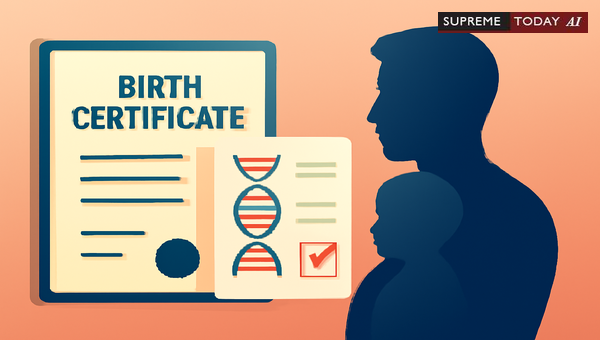
In family law disputes, questions about parentage often arise, especially in matters of inheritance, custody, or maintenance. A common document turned to in such cases is the birth certificate. But does it serve as ? This is a critical question for many in India, where play a significant role.
Whether a birth certificate is hinges on provisions in the , particularly Sections 35 and 112. This blog post delves into the legal nuances, drawing from judicial precedents and statutory principles to provide clarity. Note that this is general information and not specific legal advice—consult a qualified lawyer for your situation.
A birth certificate is an official record issued by municipal authorities or registrars, detailing a child's name, date, place of birth, and often the names of parents. Under , entries in such public documents are admissible as evidence of the facts stated therein. However, admissibility does not equate to conclusiveness.
Courts have consistently held that a birth certificate is generally admissible as evidence under ... However, the entries in such certificates cannot be deemed unless the person who made the entry or provided the information is examined 2023 0 Supreme(Cal) 414. Furthermore, the birth certificate can establish the date and time of birth but does not conclusively prove paternity 2023 0 Supreme(Cal) 414.
In essence, while it supports claims, it can be challenged, especially if the information was provided by interested parties without verification.
The cornerstone of paternity disputes in India is , which creates a . It states that a child born during the continuance of a valid marriage or within 280 days after its dissolution (if the mother remains unmarried) is conclusive proof of the husband's paternity, unless (no opportunity for sexual intercourse) between spouses is proven.
This presumption is strong and difficult to rebut 2005 3 Supreme 569. As one source notes, Birth during the valid marriage of the mother and the presumed father is considered conclusive proof of the child's legitimacy under Section 112... This presumption is strong but rebuttable if the is proven by strong evidence (citing multiple judgments including 2023 0 Supreme(Bom) 387,
).
The idea behind Section 112 is protective: The idea behind this provision was to establish a conclusive presumption in favour of the legitimacy of a child to not subject him or her to the stigma of being a 2010 0 Supreme(Ker) 1004. However, this presumption bars contradictory evidence unless is established MPPL & ANOR vs CAS - Federal Court Putrajaya.
Birth certificates fall short as standalone proof for several reasons:
: They are often based on parental declarations, which may be inaccurate. While a birth certificate may be admissible, it does not serve as , especially when the legitimacy is disputed. The correctness of the information in the birth certificate can be challenged 2016 0 Supreme(Mad) 2796.
Not Substantive for Paternity: In cases, courts have questioned reliance on such documents alone. For instance, whether the trial court dealing with issuance of succession certificate is justified in holding that documents were not sufficient... and DNA test is conclusive2023 0 Supreme(Ker) 440. Similarly, (1) Whether the Transfer certificate issued by the Headmaster... is a substantial piece of evidence to decide paternity or not? 2020 0 Supreme(Mad) 674.
School Records Analogous: Certificates like school leaving ones are treated similarly—not conclusive without corroboration 2025 Supreme(Online)(Kar) 33410, 2023 0 Supreme(Cal) 414.
Modern science has transformed paternity disputes. are now recognized as highly reliable, often overriding presumptions when compelling circumstances exist.
Courts may direct if there's evidence of : such tests can be directed, after the Court is satisfied... that there was no access (to the mother) at the relevant time 2010 0 Supreme(Ker) 1004, 2010 0 Supreme(Del) 921.
DNA is more or less... conclusive prove of paternity 2014 0 Supreme(AP) 546. Resistance to testing may lead to , though not always.
prevails in rebuttal: can rebut the ... Courts have acknowledged that scientific proof can prevail over when credible (citing 2025 0 Supreme(Bom) 1003, 2023 0 Supreme(Ker) 641).
In succession or inheritance suits, documents alone may not suffice if disputed, pushing for DNA verification 2023 0 Supreme(Ker) 440.
When paternity is contested:
Rely on Presumption First: If born during marriage, husband is presumed father unless proven 2009 0 Supreme(MP) 77.
Challenge Birth Certificate: Cross-examine informants; seek corrections if erroneous.
Gather Corroborative Evidence: Testimonies, photos, financial records, or DNA.
Strategic Litigation: Focus on Section 112's burden—petitioner must prove 2005 3 Supreme 569.
In cases like ouster or adverse possession intertwined with paternity, courts scrutinize all evidence holistically 2020 0 Supreme(Mad) 674.
A birth certificate is not in India. It is admissible but rebuttable evidence 2023 0 Supreme(Cal) 414, 2016 0 Supreme(Mad) 2796.
Section 112 provides robust legitimacy presumption, rebuttable only by strong proof or DNA in exceptional cases 2009 0 Supreme(MP) 77, MPPL & ANOR vs CAS - Federal Court Putrajaya.
DNA testing is increasingly pivotal, offering near-conclusive results 2014 0 Supreme(AP) 546, 2025 0 Supreme(Bom) 1003.
For disputes, collect multifaceted evidence beyond certificates. Legal strategies should leverage statutory presumptions while preparing for scientific rebuttals.
Disclaimer: This article summarizes general legal principles based on precedents. Laws evolve, and outcomes depend on facts. Seek professional legal counsel for advice tailored to your case.
, 2024 0 Supreme(All) 858, 2024 0 Supreme(MP) 644, 2024 0 Supreme(Mad) 914, 2023 0 Supreme(Ker) 641, 2025 Supreme(Online)(Kar) 33410, 2025 0 Supreme(Bom) 1003


‘Conclusive proof’.—When one fact is declared by this Act to be conclusive proof of another, the Court shall, on proof of the one fact, regard the other as proved, and shall not allow evidence to be given for the purpose of disproving it. x x x 112. ... One such presumption is the conclusive presumption of paternity under Section 112 of the Evidence Act. ... As to the....

It is conclusive proof of baby’s legitimacy. In such circumstances, the paternity of the child cannot be allowed to be ascertained in the manner sought by the petitioner (husband). ... As to the meaning of “conclusive proof” reference may be made to Section 4 of the Evidence Act, which provides that when one fact is declared to be conclusive proof of another, ....

As to the meaning of “conclusive proof” reference may be made to Section 4 of the EVIDENCE ACT , which provides that when one fact is declared to be conclusive proof of another, proof of one fact, would automatically render the other fact as proved, unless contra ... Though, the judgment cited supra indicates importance and even accuracy of scientific DNA Profiling Test, still question arises as to #HL_....

Birth during marriage, conclusive proof of legitimacy. ... Scientific proof now makes it possible to know with virtual certainty whether a man is genetically related to a child. ... When child was born during valid marriage, it is a conclusive proof of its legitimacy unless strong and cogent evidence is led to prove otherwise. ... This expression conclusive pr....

In fact, DNA test is intended to rebut the `conclusive proof’ provided under Section 112 of the Evidence Act. 8. ... But, it is not always necessary to conduct a DNA test to ascertain whether a particular child was born to a particular person, however, the burden of proof is on the husband who alleges illegitimacy. ... Thus the question to be considered is; whether DNA test can be pressed into, in order t....

Birth during marriage, conclusive proof of legitimacy- The fact that any person was born during the continuance of a valid marriage between his mother and any man, or within two hundred and eighty days after its dissolution, the mother remaining unmarried, shall be conclusive proof that he is the legitimate ... In our opinion, when there is a conflict between a conclusive proof envisaged....

Birth during marriage, conclusive proof of legitimacy. ... When a child was born during the valid marriage, it is a conclusive proof of his legitimacy unless strong and cogent evidence is led to prove otherwise. Therefore, no person is allowed to raise a question of legitimacy by filing an application to seek the child to undergo DNA test. ... After five years, the petitioner filed the petition raising the patern....
The question came up for consideration of the Apex Court in the case cited was whether the trial court dealing with issuance of succession certificate is justified in holding that documents were not sufficient for the purpose of adjudication and DNA test is conclusive. ... Trial court erroneously held in the case that documents produced by the respondents in a suit for issuance of succession certificate were not sufficient....

While the school records (Exs.P4 and P5) may mention Kubendrayya as the father, it is well settled that such entries, particularly in school documents, are not conclusive proof of paternity. When weighed against the incontrovertible medical record, their evidentiary value diminishes significantly. ... They lack the conclusive evidentiary value necessary to establish paternity or maternity, especially in t....

Now, it also may be argued that certificate of birth can be stated to be a proof of date and time of birth but not a proof of paternity. 17. ... He strenuously contended that appellant deposed that she got admitted in primary school but she failed to bring school register or any certificate from the school and she could not bring any certificate of birth to prove her paternity#....

On perusal of the records, this court formulated the following substantial questions of law:- (2) Whether the trial court finding on plea of ouster and adverse possession is (1) Whether the Transfer certificate issued by the Headmaster and marked as Ex A-2 is a substantial piece of evidence to decide paternity or not ?

Here the dispute is not with regard to the genuineness of the birth certificate but the correctness of the information contained therein. Therefore, it is to be held that such certificate though admissible in evidence, cannot be treated as the conclusive proof of paternity, when such claim is disputed by the other side.

I therefore reject the contention of the learned counsel for the respondents that resistance to DNA Test by the respondents cannot lead to an adverse inference. Test more or less is conclusive prove of paternity. At any rate, much water has flown under the bridge after 1993 and in view of the march of science, it is now well settled that DNA

The idea behind this provision was to establish a conclusive presumption in favour of the legitimacy of a child to not subject him or her to the stigma of being a bastard. This is of course, subject to the caveat (on account of the existing structure of Section 112) that such tests can be directed, after the Court is prima facie satisfied on the basis of evidence on the record that there was no access (to the mother) at the relevant time. The said presumption, however, is conclusive ....

This is of course, subject to the caveat (on account of the existing structure of Section 112) that such tests can be directed, after the Court is prima facie satisfied on the basis of evidence on the record that there was no access (to the mother) at the relevant time. The idea behind this provision was to establish a conclusive presumption in favour of the 'legitimacy' of a child to not subject him or her to the stigma of being a 'bastard'. The said presumption, however, is conclus....


An indispensable Tool for Legal Professionals, Endorsed by Various High Court and Judicial Officers
Please visit our Training & Support
Center or Contact Us for assistance

Scan Me!
India’s Legal research and Law Firm App, Download now!


For Daily Legal Updates, Join us on :



 Back to top


