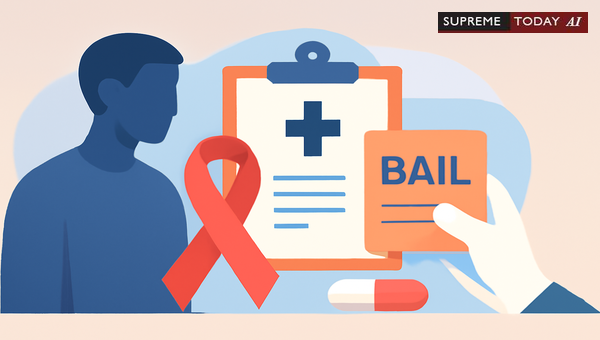
Bail for HIV-Positive Accused: Legal Rights Explained
In the Indian justice system, the question of bail often arises at the intersection of legal rights and human compassion, especially when an accused is battling a serious illness like HIV/AIDS. If an Accused is Suffering from a Serious Disease, should he be Released on Bail? This query strikes at the balance between public safety, statutory mandates, and individual health rights. While courts recognize the vulnerabilities of HIV-positive individuals, bail is not automatically granted solely on medical grounds. Instead, it hinges on strict legal criteria, particularly in serious offenses under laws like the NDPS Act.
This article delves into the legal framework, judicial precedents, and practical considerations, drawing from key cases and statutes. Note that this is general information and not specific legal advice—consult a qualified lawyer for personalized guidance.
The Legal Framework for Bail in India
Bail is fundamentally a matter of right in bailable offenses but discretionary in non-bailable ones, governed by the Code of Criminal Procedure (CrPC), 1973. Courts weigh factors such as the nature and gravity of the offense, evidence strength, risk of absconding, and potential tampering with evidence or witnesses.
For stringent laws like the Narcotic Drugs and Psychotropic Substances (NDPS) Act, 1985, Section 37 imposes twin conditions for bail:- The public prosecutor must be given a chance to oppose.- The court must be satisfied that there are reasonable grounds to believe the accused is not guilty of the offense and is not likely to commit any offense while on bail2024 6 Supreme 568.
The grant of bail under the NDPS Act requires strict compliance with the conditions laid out in Section 37(1)(b)(ii), including the satisfaction of twin conditions—namely, that the prosecution has not established a prima facie case and that the accused does not pose a threat of absconding or tampering with evidence 2024 6 Supreme 568.
Health status, even for serious diseases, is typically a mitigating factor rather than a standalone ground.
Special Provisions for HIV-Positive Accused
The Human Immunodeficiency Virus and Acquired Immune Deficiency Syndrome (Prevention and Control) Act, 2017, offers protections for HIV-positive individuals, including:- Expeditious disposal of legal proceedings under Section 34(2) 2024 0 Supreme(SC) 750.- Right to anonymization of records to safeguard identity 2024 0 Supreme(SC) 750.
An accused who is HIV-positive may be entitled to benefits such as priority disposal of proceedings and anonymization of records 2024 0 Supreme(SC) 750. These aim to protect dignity but do not override bail criteria under CrPC or special statutes. Courts emphasize that the mere status of being HIV-positive is not a sufficient ground for bail; other factors like the gravity of the offence, the quantity involved, and the circumstances of the case are determinative 2024 6 Supreme 568 2006 4 Supreme 67.
Judicial Precedents: When Bail is Denied Despite Illness
Indian courts have consistently prioritized statutory compliance over health alone, especially in grave cases.
In an NDPS Act matter, the court rejected bail for an HIV-positive accused, noting: non-consideration of provisions under Section 37, NDPS Act, has to be taken as a very serious lapse and that the twin conditions under Section 37 of NDPS Act, are not satisfied and on sole reason that accused is a HIV patient, cannot be a reason to enlarge her on bail 2024 6 Supreme 568.
Similarly, in a murder case under IPC Sections 302 and 201, health status was deemed insufficient: the gravity of the offence and the evidence must be thoroughly considered, and mere status as HIV-positive is insufficient for bail 2006 4 Supreme 67.
Another instance under POCSO Act and IPC Sections 376, 342 highlighted medical grounds but rejected bail: Learned counsel for the applicant, however, seeks bail on medical grounds i.e. the applicant is HIV positive. As far as interim bail sought on medical ground is concerned, it is not in dispute that the applicant is HIV+ve. However, the medical report tendered as of today, shows that the applicant's medical condition is stable and that he is being taken care of by the jail authorities 2022 0 Supreme(Bom) 1229. The focus shifted to expediting trials rather than release.
Cases Where Health Led to Bail or Interim Relief
While denial is common, exceptions exist when health is dire and facilities inadequate.
In an NDPS Section 20 case, interim bail was granted: In view of the facts and circumstances of the case as well as the health condition of the petitioner that he is a chronic patient of HIV/HCV and require special diet and care, interim bail for a period of six months is granted to the petitioner 2018 0 Supreme(P&H) 565. This was under CrPC Section 439, with conditions like expedited trial cooperation.
For a convicted murderer under IPC Section 302 seeking suspension of sentence under CrPC Section 389, compassionate bail was allowed due to AIDS: The court granted bail to the appellant on compassionate grounds, subject to specific conditions to ensure continued medical care and monitoring of the appellant's health 2013 0 Supreme(All) 1495. The judgment referenced international recommendations for HIV prisoners, stressing proper care or release.
These cases illustrate that stable jail medical care often negates bail claims, but chronic needs may tip the scale.
Broader Principles from Related Judgments
Bail philosophy underscores discretion: Faced with an allegation of a crime, the accused applies for bail. But, in cognizable cases, the bail has never been a matter of course. He pleads innocence, aided by the common law presumption to that effect. In either event, it has its limitations; we cannot stretch it to a snapping point 2020 0 Supreme(Bom) 1162 2020 0 Supreme(Bom) 831.
Violations post-bail, as in NDPS cases, lead to cancellation if conduct prejudices the trial 2020 0 Supreme(Bom) 1162.
Key Factors Courts Consider for Medical Bail
When evaluating serious diseases:- Jail facilities: Adequate treatment? (Often decisive against bail) 2022 0 Supreme(Bom) 1229.- Offense gravity: NDPS, murder, POCSO—stricter scrutiny.- Twin conditions met?: Prima facie innocence and no risk 2024 6 Supreme 568.- Mitigating evidence: Viral load, special diet needs 2018 0 Supreme(P&H) 565.
Exceptions and Limitations:- HIV benefits don't confer automatic bail 2024 0 Supreme(SC) 750.- Serious offenses demand caution regardless of health 2006 4 Supreme 67.- Standalone disease claims fail without statutory compliance.
Practical Recommendations
For HIV-positive accused or advocates:- Demonstrate twin conditions under NDPS Section 37 2024 6 Supreme 568.- Invoke HIV Act for speedy trials and privacy 2024 0 Supreme(SC) 750.- Provide medical reports showing inadequate jail care 2013 0 Supreme(All) 1495.- Argue health as a factor alongside case merits.
Courts may grant interim bail for monitoring, as in HIV/HCV cases 2018 0 Supreme(P&H) 565. Legal practitioners should blend health pleas with procedural adherence.
Conclusion: Balancing Justice and Compassion
While serious diseases like HIV warrant empathy and protections, they do not automatically unlock bail doors. The judiciary emphasizes adherence to statutory mandates and procedural principles, and the special provisions for HIV-positive persons do not override the statutory requirements for bail, especially in serious offences 2024 0 Supreme(SC) 750 2024 6 Supreme 568.
Key Takeaways:- Bail prioritizes statutory tests over health alone.- Seek expeditious proceedings and anonymization under HIV Act.- Success depends on case specifics—stable health in jail often means denial.- Always pair medical evidence with legal compliance.
Stay informed on evolving precedents. For tailored advice, reach out to a legal expert. Justice tempers mercy with law.
References:- 2024 0 Supreme(SC) 750, 2024 6 Supreme 568, 2006 4 Supreme 67, 2022 0 Supreme(Bom) 1229, 2018 0 Supreme(P&H) 565, 2013 0 Supreme(All) 1495, 2020 0 Supreme(Bom) 1162, 2020 0 Supreme(Bom) 831.
#BailLaw #HIVLegalRights #NDPSAct