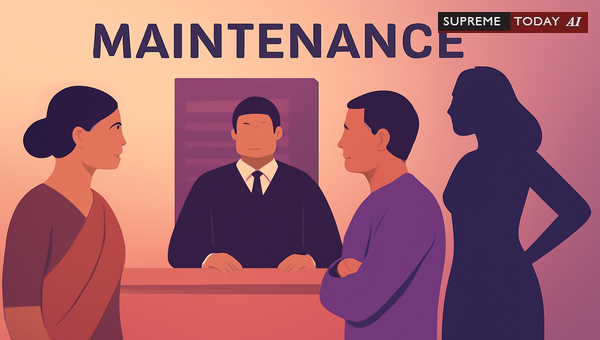
Does Adultery Bar Maintenance in Indian Law?
In family law disputes, one burning question often arises: If the conduct of the petitioner is adulterous, are they not entitled to maintenance? This issue frequently surfaces in maintenance petitions under Section 125 of the Criminal Procedure Code (CrPC), 1973, and provisions of the Hindu Marriage Act, 1955. While adultery can complicate claims, Indian courts have established nuanced principles that prioritize dependency, especially for children and faithful concubines, over moral judgments. This post delves into the legal framework, judicial precedents, and limitations, drawing from key cases and statutes.
Legal Principles on Maintenance and Adultery
Maintenance is a statutory right designed to prevent vagrancy and ensure dignity for dependents, including wives, children, and even certain non-marital partners under Hindu law. Section 125(4) CrPC explicitly bars maintenance for a wife living in adultery, but courts interpret this strictly.
Key Entitlements Despite Adulterous Context
- Illegitimate Children: Under Hindu law, an illegitimate son of a Sudra is entitled to maintenance from his father's estate, even if conceived through adultery. The child's right persists regardless of the mother's marital status or the relationship's nature, as long as the father acknowledges paternity 1965 0 Supreme(SC) 48.
- Avaruddha Stree (Kept Woman): A woman in concubinage is entitled to maintenance from her paramour's estate if she maintained sexual fidelity during the relationship. The adulterous origin does not negate this right 1965 0 Supreme(SC) 48.
Courts emphasize protection for dependents: The concept of maintenance is recognized independently of the legitimacy of the relationship, as long as the child is acknowledged by the father 1965 0 Supreme(SC) 48.
Defining 'Living in Adultery'
The phrase living in adultery under Section 125(4) CrPC does not cover isolated acts but requires proof of continuous adulterous conduct. As observed: The words 'living in adultery' are, in my opinion, merely indicative of the principle that occasional lapses from virtue are not a sufficient reason for refusing maintenance. Continued adulterous conduct is what is meant by 'living in adultery'. ... The word live conveys the idea of continuance, and consequently the phrase 'living in adultery' in my opinion refers to a course of guilty conduct and not to a single lapse from virtue
ARUMUGAM v. ATHAI
.
Similarly: Learned counsel for the respondent relied upon the observation of this court in case Chandrakant Gangaram Gawade Vs. Sulochana Chandrakant Gawade... mere stray or single lapse on part of wife is not sufficient to bring her conduct within meaning of 'living in adultery' as provided under section 125(4) Cr.P.C. 2018 0 Supreme(Bom) 184.
It denotes a course of continuous adulterous conduct 2018 0 Supreme(Ori) 13. Courts demand specific and cogent evidence of ongoing adultery, not mere suspicion 2018 0 Supreme(Ori) 13. Evidence like one instance of traveling together falls short: RW 2, brother of husband, claimed to have seen petitioner travelling together in a car with alleged adulterer... was not sufficient to conclude that petitioner was living in adultery
Sheela VS Albert Hemson alias James
.
Judicial Precedents Upholding Maintenance
Indian courts consistently protect claimants unless continuous adultery is proven:- Akku Prahlad v. Ganesh Prahlad: A married woman living with her paramour could claim maintenance if faithful to him, despite adultery 1965 0 Supreme(SC) 48.- In Chandrakant Gangaram Gawade v. Sulochana: Mere lapses do not constitute 'living in adultery'; continuous proof is needed 2018 0 Supreme(Bom) 184.- Baishnab Charan Jena v. Ritarani Jena: Allegations alone entitle the wife to separate living and maintenance
Sheela VS Albert Hemson alias James
.- A divorce decree not based on adultery (e.g.,
cruelty/desertion) does not bar child
maintenance, even with immorality allegations
2018 0 Supreme(Bom) 184.
Even accusations can backfire: Very allegation by the husband and members of his family that the wife is having extra-marital relationship... is insulting and humiliating her amounting to cruelty 2018 0 Supreme(Ori) 13
Sheela VS Albert Hemson alias James
.
In one case, courts were slow in questioning the chastity of woman unless there is strong circumstance available
Sheela VS Albert Hemson alias James
. Hearsay or single sightings do not suffice; no divorce petition on adultery grounds weakens the claim
Sheela VS Albert Hemson alias James
.
Counterarguments: When Adultery May Bar Relief
While entitlements exist, limitations apply:- Own Wrongdoing: Under Section 23 of the Hindu Marriage Act, a party cannot benefit from their misconduct if egregious 2001 3 Supreme 403.- Judicial Discretion: Courts may deny if conduct undermines marriage sanctity or is exploitative 2001 3 Supreme 403.- Proven continuous adultery disentitles: When the wife destroys the sanctity of marriage and lives in adultery with another person, she would not be entitled... Living in adultery denotes a continuous course of conduct and not isolated acts 2018 0 Supreme(Ori) 13.
In Smt. Chandrama Biswal v. Banchhanidhi Biswal, isolated acts do not qualify 2018 0 Supreme(Ori) 13. Past relationships as propensity evidence may not prove ongoing adultery
IVA vs ROM & ANOR
.
For children, rights remain robust: Liability persists post-divorce unless explicitly barred 2018 0 Supreme(Bom) 184. Daughters may claim until marriage, even post-majority
Sheela VS Albert Hemson alias James
.
Quantum of Maintenance
Courts fix amounts considering income, status, and needs: The amount should be fixed... to enable the wife to live with dignity and comfort... General and reasonable rule is to charge one-fifth of the income of the husband 2018 0 Supreme(Ori) 13. Deduct statutory taxes, not voluntary allowances.
Conclusion and Key Takeaways
Generally, a petitioner's adulterous conduct does not automatically bar maintenance in Indian law, especially for children or faithful dependents. 'Living in adultery' requires proven continuous conduct, not stray lapses or suspicion. Courts prioritize welfare, as seen in precedents like Akku Prahlad and Chandrakant Gawade 1965 0 Supreme(SC) 48 2018 0 Supreme(Bom) 184.
Key Takeaways:- Isolated adultery rarely disqualifies; prove continuity with cogent evidence.- Children and acknowledged dependents retain strong rights.- Gather dependency proof; counter misconduct allegations.- Accusations may justify separate living.
This is general information based on precedents and not specific legal advice. Consult a qualified lawyer for your case, referencing documents like 1965 0 Supreme(SC) 48 2001 3 Supreme 403
ARUMUGAM v. ATHAI
2018 0 Supreme(Bom) 184 2018 0 Supreme(Ori) 13Sheela VS Albert Hemson alias James
#MaintenanceLaw, #AdulteryIndia, #FamilyLaw