Searching Case Laws & Precedent on Legal Query..!
Scanned Judgements…!



Searching Case Laws & Precedent on Legal Query..!
Scanned Judgements…!
Mode of Proof of Wound Certificate - Supreme Court recognizes that the method of proving a wound certificate is procedural, and objections regarding the mode of proof must be raised at the time of marking the document. The absence of the doctor for cross-examination does not necessarily invalidate the certificate if it was properly proved through other evidence, such as the signature or the circumstances of its issuance. Several judgments, including AIR 2007 SC 2786 (Rajendra Singh v. State of West Bengal), support that non-examination of the doctor who issued the certificate does not automatically render the evidence inadmissible or unreliable ["PREM SINGH vs STATE OF UTTARANCHAL - Uttarakhand"], ["PREM SINGH vs STATE OF UTTARANCHAL - Uttarakhand"].
Evidence Supporting Wound Certificates - Courts have upheld that wound certificates, even if the doctor is not available for cross-examination, can be accepted if properly proved, for example, through signatures or hospital records. The Supreme Court has emphasized that the credibility of such certificates depends on the circumstances of their issuance and the supporting evidence, not solely on the doctor's presence in court. In cases where the certificate is supported by other evidence, courts have upheld the prosecution's case despite the absence of the doctor ["2022 Supreme(Online)(Ker) 79992"].
Expert Evidence and Post-Mortem Reports - The Court has clarified that the doctor conducting a post-mortem is not necessarily an expert for all aspects, such as determining the size of weapons or bullets. The absence of the expert who prepared the FSL report or post-mortem report does not automatically affect the case if other evidence supports the findings. The Supreme Court has held that the credibility of such reports depends on the overall evidence and not solely on the availability of the expert for cross-examination ["PREM SINGH vs STATE OF UTTARANCHAL - Uttarakhand"].
Medical Evidence and Delay - The Court has recognized that medical evidence, including wound certificates, can be accepted even if examination or treatment occurred days after the incident, provided the circumstances support the injury's connection to the incident. The timing of examination and the absence of immediate records do not necessarily undermine the evidence if the medical certificates are properly proved ["
Sulabh Jain vs The State Of Madhya Pradesh - Madhya Pradesh
"].Inference from Non-Examination of Doctor - Supreme Court judgments suggest that the failure to examine a doctor who issued a wound certificate does not automatically lead to adverse inference if the certificate is proved through other means, such as signatures, hospital records, or circumstantial evidence. The emphasis is on the overall reliability and proper proof rather than strict adherence to examining the doctor in court ["PREM SINGH vs STATE OF UTTARANCHAL - Uttarakhand"].
Analysis and Conclusion:The Supreme Court has consistently held that the mode of proof of wound certificates is procedural and that their evidentiary value depends on proper proof, not solely on the availability of the doctor for cross-examination. If the certificate is supported by signatures, hospital records, or circumstances, it can be accepted even when the doctor is not examined. The courts focus on the credibility of the evidence and the overall circumstances rather than rigid procedural adherence. Therefore, non-availability of the doctor for examination does not necessarily weaken the admissibility of wound certificates, provided other proof elements are satisfied.
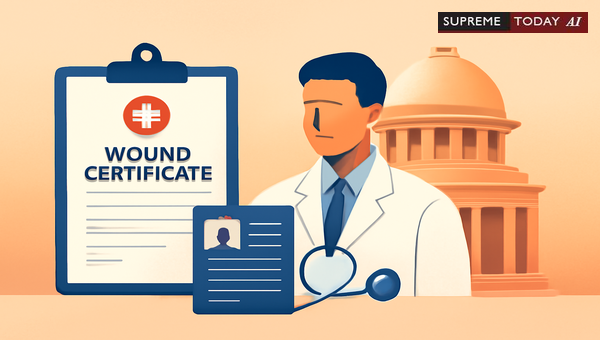
In criminal trials, particularly those involving assault or hurt under the , like plays a pivotal role. But what happens when the doctor who prepared the wound certificate is not available for examination as a witness? This is a common challenge in litigation, raising questions about , reliability, and the mode of proof under the (now ).
Find me few Judgments of on the Mode of Proof of Wound Certificate when the Doctor who Prepared it is Not Available for Examination as a Witness. This query strikes at the heart of evidentiary challenges in Indian courts. The has addressed this issue in nuanced rulings, emphasizing caution without outright rejection. This blog post delves into key findings, precedents, and practical implications, drawing from authoritative sources.
The recognizes the of or medical reports but insists on cautious handling when the issuing doctor cannot be cross-examined. hinges on reliability, authenticity, and surrounding circumstances. The Court does not deem such certificates automatically inadmissible but treats them as requiring . 2006 7 Supreme 705
Key points from precedents include:- Evidentiary Value with Safeguards: Medical certificates have value but need the doctor's testimony for full . Failure to examine the doctor, especially if authenticity is disputed, diminishes its weight. 2006 7 Supreme 705- Court's Proactive Role: Under (), courts must scrutinize proactively, potentially summoning the doctor if needed. 2006 7 Supreme 705- Not Rejection: While -like, certificates issued in routine medical practice may be accepted if circumstances support credibility. 2006 7 Supreme 705
The 's approach prioritizes procedural prudence. In cases where the prosecution fails to produce the doctor, courts assess:- Context of Issuance: Was the certificate prepared in the normal course of hospital duties?- Corroborative Evidence: Eye-witness accounts, other medical records, or X-rays can bolster it.- Objections on Mode of Proof: Challenges must be raised timely during trial, as noted in related precedents on procedural evidence. 2004 5 Supreme 752
For instance, the Court has observed that the prosecution's failure to examine the doctor who issued the certificate, especially when the doctor’s identity or the certificate’s authenticity is in question, weakens the evidentiary value of the document. 2006 7 Supreme 705
This mirrors broader evidence law principles where certified copies or reports require proper proof stages. Objections not raised at marking cannot be entertained later. 2004 5 Supreme 752
While focusing on views, lower courts echo these principles, providing practical context:
In a matter, the court relied on eyewitnesses and a wound certificate (Ex.P2) despite no X-ray or full treatment records, but downgraded conviction from () to 324 IPC due to insufficient proof of fracture without doctor . The evidence of PW5 doctor supported simple hurt, but gaps highlighted proof challenges. 2024 Supreme(Online)(KER) 7671
noted that even if an FSL expert (analogous to doctors) does not testify, it may not dent the case if other evidence suffices, referencing in AIR 2007 SC 2786.
In another instance, a wound certificate (Ex.P14) was issued by PW17, who treated the victim, reinforcing that availability of the treating doctor strengthens proof.
stressed proving the original doctor for injury reports, dismissing medical certificates alone if signatures or details are unverified.
case involved an unexamined Dr. Bharkavi's wound certificate (Ex.P8), marked but not fully relied upon due to incomplete records. 2022 Supreme(Online)(MAD) 4354
These cases illustrate that courts generally prefer doctor examination but admit certificates with caution if supported elsewhere.
rulings set that absence of does not bar but invites careful scrutiny. Certificates akin to must be approached cautiously. 2006 7 Supreme 705
Historically, courts favor summoning the doctor to resolve authenticity doubts. Without it, the certificate becomes weak unless:- Issued routinely in medical practice.- Backed by independent evidence like eyewitnesses. 2024 Supreme(Online)(KER) 7671
In one reference (procedural), objections to proof method must be at trial time.
For prosecutors and defense lawyers:- Secure Doctor's Presence: Always summon the issuing doctor.- Gather : Use X-rays, treatment sheets, or multiple witnesses.- Raise Timely Objections: Challenge mode of proof during marking. 2004 5 Supreme 752
Exceptions exist: Courts may admit if inherent credibility (e.g., government hospital routine) or other proof supports. But evidentiary weight typically diminishes.
Disclaimer: This is general information based on precedents and not specific legal advice. Consult a qualified lawyer for case-specific guidance.
In summary, while the provides flexibility, reliability remains paramount. Staying updated on these evolving standards ensures robust case preparation in criminal law.
References:- 2006 7 Supreme 705: Core discussion on doctor examination necessity.- 2004 5 Supreme 752: Procedural safeguards for proof objections.- Additional High Court insights as cited.
#SupremeCourtIndia, #WoundCertificate, #EvidenceLaw


This Court does not find any illegality or infirmity in the judgments of the Courts below and the same are hereby and issued the Wound Certificate (Ex.P14). ... PW17 is the another Doctor, who treated PW11 and issued the Wound Certificate (Ex.P14). ... PW14 is the Doctor who treate....

or method of proof.” ... The mode or method of proof is procedural and objections, if not taken at the trial, that the kind of injury which he has noticed could not have proof has to be raised at the time of marking of the Supreme Court observed as hereunder:- p style="position:absolute;white-space:pre;margin:0;padding:0;top:427pt;left

court and this court in aforesaid judgments, we will not be able to hold 30 judgments of Supreme Court reported in AIR 2007 SC 2786 (Rajendra ... Tomar, the expert who has prepared the FSL report has not entered the witness box, it will not create any dent on the opined that Doctor....

We find support in our conclusion from the 30 judgments of Supreme Court reported in AIR 2007 SC 2786 (Rajendra Singh Vs. ... Tomar, the expert who has prepared the FSL report has not entered the witness box, it will not create any dent on the story of prosecution. ... State of West Bengal) the Apex Court opined that witness....

PW12 is the Doctor who examined PWs1 and 2 in Perambra Government Hospital immediately after the incident. Ext P22 is the wound certificate of PW1 issued by PW12. ... During cross-examination, he had stated that he could not name the persons who had assaulted him to the Doctor when he was initially examined at General Hospital, Permbra, as he was not in a position to me....

It is suggested by the defence that due to the slip and fall such injury is possible, which is confirmed by PW7, Doctor. In this case, AR medical record produced is incomplete. The wound certificate issued by one Dr.Bharkavi is Ex.P8 and the said Doctor has not examined in this case as witness. ... The wound certificate not marked thr....

But, the learned counsel for the appellant invited my attention to the evidence of PW5, doctor, in cross examination to show that PW5 has admitted that an x-ray was taken and that apart from the evidence of PW5 doctor and Exhibit P2 wound certificate, the prosecution has not adduced any reliable evidence ... As noticed earlier, the evidence of PWs 1 to 4 regarding the occurrence is suppo....

of PW-11 doctor, wherein PW-11 doctor had specifically stated in his cross-examination that injury was not on the vital part of the body, I ... The original doctor, who had prepared the injury report of the injured informant was not proved as a relevant fact and not the medical certificate. ... Even though the signature on the m....
available on record. ... This witness is a secondary witness to S.I. ... Court in the case of Deepak Verma (supra) wherein the Hon'ble Supreme Court explained it like this: Council in Barendra

The witness further stated that after recording statement of CW.4 to 7 and collecting the wound certificate given by the doctor as per Ex.P.3, he has completed investigation and filed the charge sheet ... To the height of the above, the wound certificate marked by the doctor at Ex.P3 would go to show that the 13 complainant has approached the doctor#HL_E....


An indispensable Tool for Legal Professionals, Endorsed by Various High Court and Judicial Officers
Please visit our Training & Support
Center or Contact Us for assistance

Scan Me!
India’s Legal research and Law Firm App, Download now!


For Daily Legal Updates, Join us on :



 Back to top


